I’ve visited 47 distribution centers in the last 18 months. At least 30 had invested heavily in digital transformation. Millions of dollars in software designed to bring visibility and intelligence to their operations.
And in almost every one of those facilities, a receiving manager was still holding a clipboard.
Not because the technology didn’t work. The dashboards were live. The reports were accurate. The integrations were running. But at the point where physical freight meets the digital system, at the dock door where pallets are unloaded and counted and checked, the transformation had not arrived. The actual work of inventory receiving, verifying, and routing physical goods was still manual.
This is not an isolated observation. A RAND Corporation report (The Root Causes of Failure for AI Projects), based on interviews with 65 data scientists and engineers, found that, by some estimates, more than 80% of transformations fail. Even as adoption accelerated, the proportion of organizations reporting positive impact from their investments fell year over year across revenue growth, cost management, and risk management.
Why? Because most digital transformation in logistics has digitized everything except the work itself.
The Execution Gap: Planning Is Digital, Recording Is Digital, But Work Is Still Analog
Most logistics operations today have two digital layers that work well. Planning systems forecast demand, optimize routes, and schedule work. Systems of record (WMS, ERP, TMS) capture what happened. Both are sophisticated, connected, and increasingly intelligent.
But between planning and recording sits the physical work: receiving freight, verifying shipments, counting inventory, checking for damage, and routing exceptions. This is where digital transformation stops, and manual processes take over. A worker opens a trailer, counts pallets, reads labels, enters data into a handheld device, and confirms receipt. The system trusts whatever the worker enters.
The cost of this gap is staggering. IHL Group’s 2025 research found that global inventory distortion (the combined cost of out-of-stocks and overstocks) reached $1.73 trillion annually, representing 6.5% of global retail sales. Much of that distortion originates at receiving, where inaccurate data enters the system and propagates through allocation, replenishment, picking, and fulfillment.
Traditional OCR systems attempted to bridge this gap by digitizing label data. But they only solved half the problem. They could extract text from a shipping label. They could not verify that text against the purchase order, detect a shortage, document damage, or route an exception. They captured data. They did not execute the work.
This is the distinction between a system of record and a system of action. Systems of record capture transactions after work is performed. Systems of action verify physical reality before information enters core systems. Most AI pilots deliver inference to a system of record. What logistics needs is execution through a system of action.
Why Traditional Approaches Keep Failing at the Point of Work
Most technology deployed at the point of physical work, whether traditional OCR systems, barcode scanners, or newer cloud-based tools, shares a common limitation: it is built to capture information, not to drive action.
This shows up in three specific failure patterns:
The Inference Problem.
Most systems answer the question “what might this be?” rather than “make this happen correctly.” They produce a probabilistic output (a label read, a confidence score) and hand it to a worker to interpret. But at a receiving dock, the operation doesn’t need a suggestion. It needs a verified answer:
- Does the count match the purchase order?
- Is this the right SKU?
- Are there overages, shortages, or damages?
- If a discrepancy exists, what happens next, right now, before the freight moves?
The latency problem.
Cloud-only architectures introduce delays at every step. Data must travel from the device to the data center and back. In a warehouse where a worker is processing 40 to 60 shipments per shift, they cannot wait 3 seconds per verification. If the system can’t keep pace with the speed of physical work, workers route around it. Major operators have recognized this: DHL deployed edge-processed smart glasses for its Vision Picking program, and FedEx built edge-based sensor networks for real-time tracking, both of which process data locally rather than relying on cloud round-trips.
The context problem.
Traditional OCR systems read characters on a page. But logistics documents (shipping labels, bills of lading, packing slips) require contextual understanding. The system needs to know that “MFG: 10/24” is a manufacturing date, that a BOL contains line items that must be matched to a PO, and that a multi-barcode pallet requires simultaneous decode of overlapping symbologies. Text extraction without logistics context creates data that looks clean but is operationally unreliable.
Vision AI Scanning: Closing the Execution Gap
The technology capable of closing this gap already exists. Vision AI scanning uses computer vision to automate the identification, verification, and routing of physical freight, replacing manual data capture with intelligent, context-aware execution.
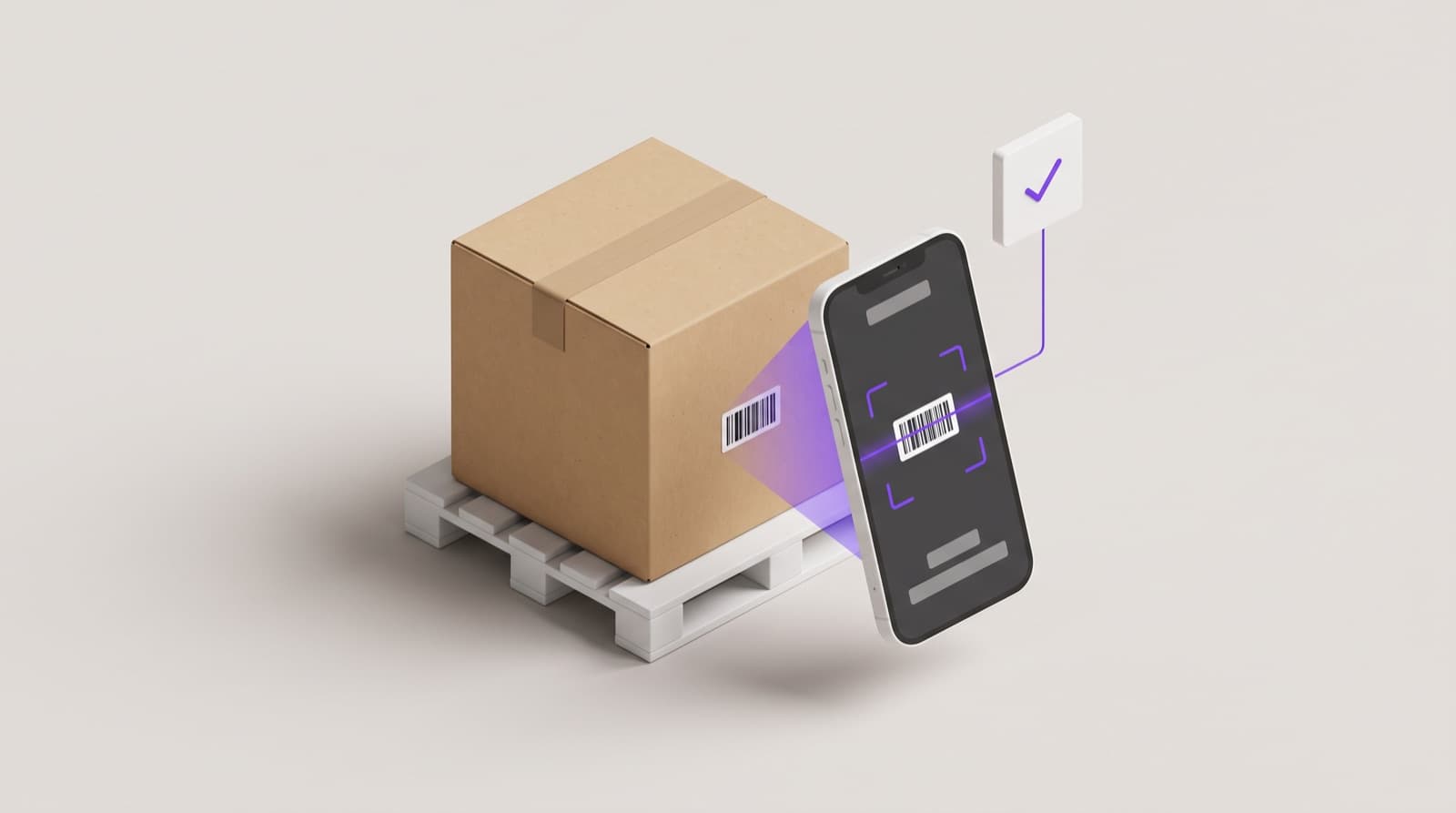
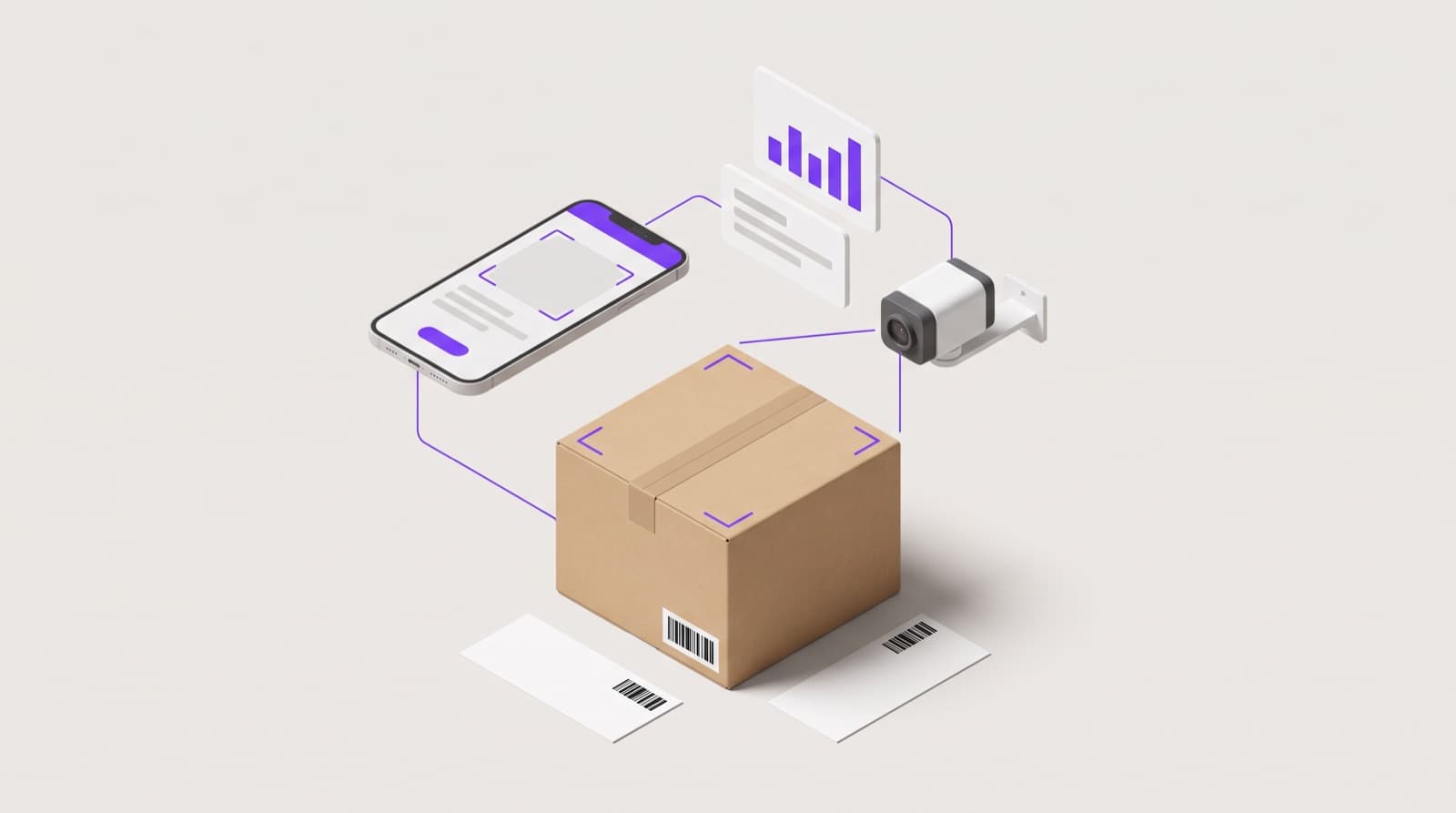
Unlike traditional OCR systems, which read characters and hand them to a worker, Vision AI scanning analyzes the entire scene. Cameras (fixed on dock doors, mounted on forklifts, or running on mobile devices) capture images of cargo as it moves and process them through models that understand logistics context, not just text. The system extracts carrier data, tracking numbers, SKUs, and destination information, then cross-references it against the ASN, PO, or BOL in real time.
The result is a workflow, not a data field:
- Scan the shipping label or BOL
- Vision AI extracts and interprets carrier, tracking, and item data
- System matches against the expected shipment
- Verification succeeds, and clean data syncs to WMS, or exception routes are immediately
- Downstream workflows (putaway, cross-docking, damage documentation) trigger automatically
The worker doesn’t interpret output or make judgment calls. The worker follows a guided process that the technology powers invisibly. All from a single scan.
This also means the system produces deterministic outcomes rather than probabilistic suggestions. Every scan resolves to a definitive state before the next step proceeds. Quantity verification confirms the physical count matches the supplier commitment. Identity verification ensures the SKU matches the purchase order. Condition verification documents visible damage before items become available for allocation. The system doesn’t guess and move on. It confirms or escalates.
For this to work at the speed of physical operations, the architecture matters as much as the model. The most resilient implementations run Vision AI at the edge (on the device itself) for sub-second execution, use on-premises compute for facilities that require data residency, and rely on cloud connectivity for model updates and cross-facility analytics. Execution never depends on the cloud. If Wi-Fi drops during peak receiving, the system keeps working. The worker never notices.
This is what shifts Vision AI scanning from a data capture tool to an execution layer: it sits between the physical world and the system of record, ensuring that verified truth (not manual entry, not probabilistic guesses) is what enters the WMS.
Every extraction, every match, every exception is documented and auditable. When clean, structured data flows directly into the WMS or ERP through this layer, the downstream processes that depend on receiving accuracy finally have a foundation they can trust.
5 Questions to Ask Before Your Next Digital Transformation Investment
If the execution gap is where most transformations stall, the evaluation criteria for the next investment should focus squarely on closing it. Before committing budget to another initiative, put these questions to every vendor and every internal team:
1. Does it work at the speed of physical operations? Execution at the dock happens in seconds. The system should deliver sub-second response, whether connectivity is strong, weak, or temporarily unavailable. Look for architectures that span edge, on-premises, and cloud so that real-time execution and long-term intelligence work together.
2. Does it drive a workflow or just produce an output? A scan should trigger the next operational step automatically: verification against the PO, exception routing, and data sync to the WMS. If the worker still has to interpret a result and decide what to do next, the execution gap is still open.
3. Does it understand the logistics context, or just extract text? There is a meaningful difference between reading characters on a label and understanding what those characters mean in the context of a shipment, a PO, and a receiving workflow. Contextual intelligence is what separates Vision AI scanning from traditional OCR systems.
4. How does it handle ambiguity at the point of work? Dirty labels, damaged barcodes, overlapping stickers, and handwritten text. These are daily realities on a dock. The system should resolve ambiguity in the moment, not flag it for someone to investigate later. How exceptions are handled in real time determines whether your WMS gets verified truth or inherited assumptions.
5. How fast can you go from pilot to production, and on what hardware? Ask whether workflows are configurable or require custom development. Ask whether the system runs on any camera (mobile, mounted, fixed) or only proprietary equipment. The best Vision AI scanning platforms deploy on existing devices and configure workflows in hours, not months.
The logistics industry doesn’t have a technology problem. It has an execution problem.
Digital transformation has enabled the digitization of planning and recording. What’s been missing is the layer that digitizes the physical work itself: at the edge, in real time, with deterministic outcomes that systems of record can trust. Vision AI scanning is that layer. It turns any camera into an agent that doesn’t just see. It acts.
The next wave of logistics transformation won’t be defined by better dashboards or smarter forecasting. It will be defined by who closes the execution gap at the point of work, where physical freight becomes digital data. That’s not a technology bet. It’s an architecture decision. And it’s the one that separates the transformations that stall from the ones that scale