Supply chain technology investment continues to grow as companies seek faster decision-making and greater operational visibility. The global supply chain management (SCM) market is projected to grow up to USD 58 billion by 2030, reflecting a CAGR of 8.7%.
At the same time, visibility remains a widespread challenge due to unstructured, blind, and manual execution processes. Research shows that only a small percentage of companies report full real-time visibility across their supply chain, leaving most operations blind to critical delays, exceptions, and inventory discrepancies that often originate at the receiving dock.
Receiving dock operations are uniquely complex because they deal with unstructured physical data. Such as damaged labels, handwritten notes, inconsistent formats, and a constant mix of carriers and suppliers. Even with advanced WMS and ERP systems, many warehouses still treat inbound data capture as a manual process, which disconnects physical freight from digital systems.
Vision AI is emerging as a solution to this problem. By combining visual perception with semantic reasoning, Vision AI can interpret unstructured inbound data and convert it into actionable records in real time.
In this article, we will explore:
- Why traditional receiving processes struggle with visibility and accuracy
- Where legacy tools fall short
- What capabilities does Vision AI bring to receiving operations
- Tangible benefits for warehouse performance and efficiency
Why Receiving Dock Visibility Breaks Down
Inbound receiving often looks simple on paper, but in practice, it is one of the most error-prone stages of warehouse operations.
A shipment arrives at the dock. Labels are damaged, partially covered, or handwritten. After all that, the receiving associate must interpret the information and enter it into the system. Until that process is complete, the inventory is physically present but digitally invisible.
This gap between arrival and system record is where visibility and accuracy is lost. It slows processing, increases labor effort, and creates downstream delays and errors that affect order fulfillment, planning, and production.
Understanding the Receiving Black Hole
The receiving black hole refers to the time between when goods arrive at the dock and when they are accurately recorded in warehouse systems. During this period:
- Inventory is not visible to operations teams
- Orders cannot be allocated against received items
- Fulfillment and manufacturing may pause due to assumed shortages
In real warehouse operations, this often results in critical items sitting idle while they wait to be processed or logged through manual workflows.
Why This Breakdown Occurs
The underlying issue is a mismatch between two realities:
- The unstructured nature of physical freight
- The rigid structure required by digital systems
Inbound labels rarely arrive in perfect condition. They may be wrinkled, smudged, wet, or hidden inside packaging. Handwritten notes such as “Urgent” or “Fragile” add useful context but are difficult for traditional systems to interpret. Because legacy tools struggle with this variability, human intervention becomes necessary, slowing down receiving and increasing the risk of errors.
The Cost of Inefficient Receiving
Receiving inefficiencies show up in many parts of a business.
Detention and Demurrage Fees
When docks run slowly, trucks wait. Carriers charge detention fees for waiting beyond the agreed free time. These fees add up quickly for high-volume facilities, effectively penalizing inefficiency.
At ports or intermodal facilities, demurrage charges apply when containers remain at the facility longer than warehouses can move product inward. These penalties can quickly exceed the value of the freight itself.
For example, at ports or intermodal facilities, demurrage applies when containers remain at the terminal past the allotted free days. Typical demurrage fees in the United States range from around $75–$300 per container per day, and can escalate further in peak seasons or congested ports.
Retail Penalties and Chargebacks
Big retailers enforce strict compliance requirements. If a shipment is mislabeled, miscounted, or incorrect, downstream penalties apply:
- Walmart can fine suppliers around 3% of the goods value for non-compliance
- Amazon charges per unit for labeling violations
- Target issues fines per instance of errors
For a company shipping up to $80 million in goods annually, even modest chargeback rates can equal millions in losses.
Labor Costs and Rework
Human data entry is imperfect. Even a 99% accuracy rate results in thousands of errors when processing tens of thousands of items daily. Each error creates a “rework loop” that drains labor liquidity. Workers must:
- Investigate discrepancies
- Find misplaced items
- Correct WMS entries
- Re-label or reship
These tasks take far more time than getting it right the first time, reducing productivity and slowing throughput.
Why Legacy OCR Technology Falls Short
To address these inefficiencies, many warehouses turned to OCR as a way to digitize inbound information without changing existing processes. Optical Character Recognition (OCR) has been the go-to tool for digitizing printed text. It works well for clean documents.
But receiving docks are not controlled environments.
OCR’s Limitations
- OCR matches pixel patterns to characters.
- It assumes high contrast, straight text, and standard fonts.
- Real-world conditions, bent labels, uneven lighting, and handwriting cause performance to collapse.
Even when OCR extracts text, it doesn’t understand context. A string like “10/24” could be a date, a ratio, or a batch code. To interpret it correctly, OCR technology relies on rigid templates and rules that break down when a vendor changes its format.
The Maintenance Burden
Because every trading partner may use different label layouts, maintaining OCR templates is a constant task. IT teams regularly update rules to keep detection working, which slows onboarding and reduces operational agility.
That’s why warehouse teams need tools that adapt without constant tuning.
Key Capabilities of Vision AI in Receiving Operations
Vision AI changes the scenario by combining visual and semantic understanding. Unlike generic AI systems that always return an answer, even when wrong. Logistics-grade Vision AI must be deterministic. When confidence is low, the system should explicitly signal uncertainty so humans review only true exceptions.
How Vision AI Works
Vision AI operates by using deep learning to analyze and interpret visual data from images or videos.
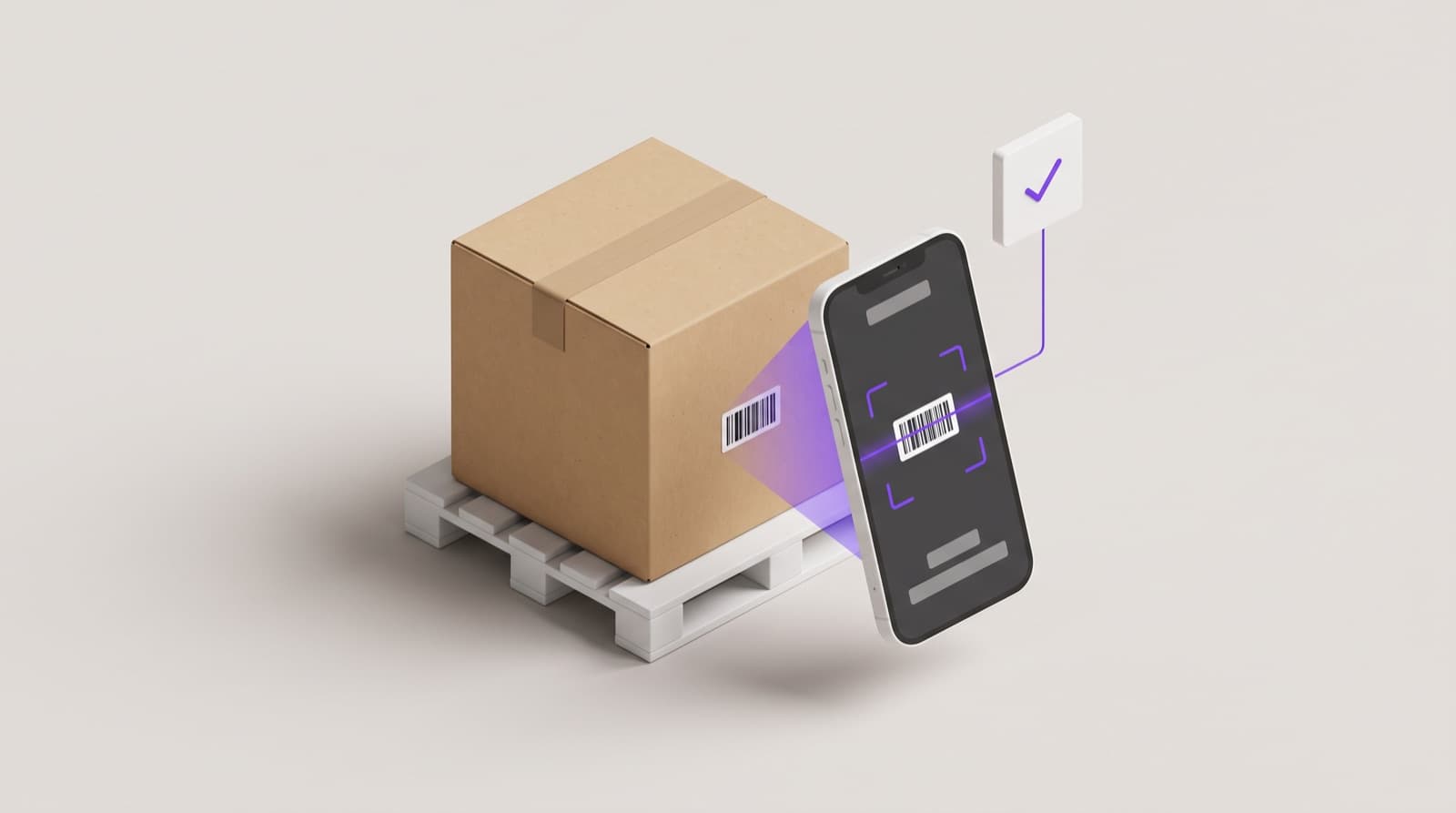
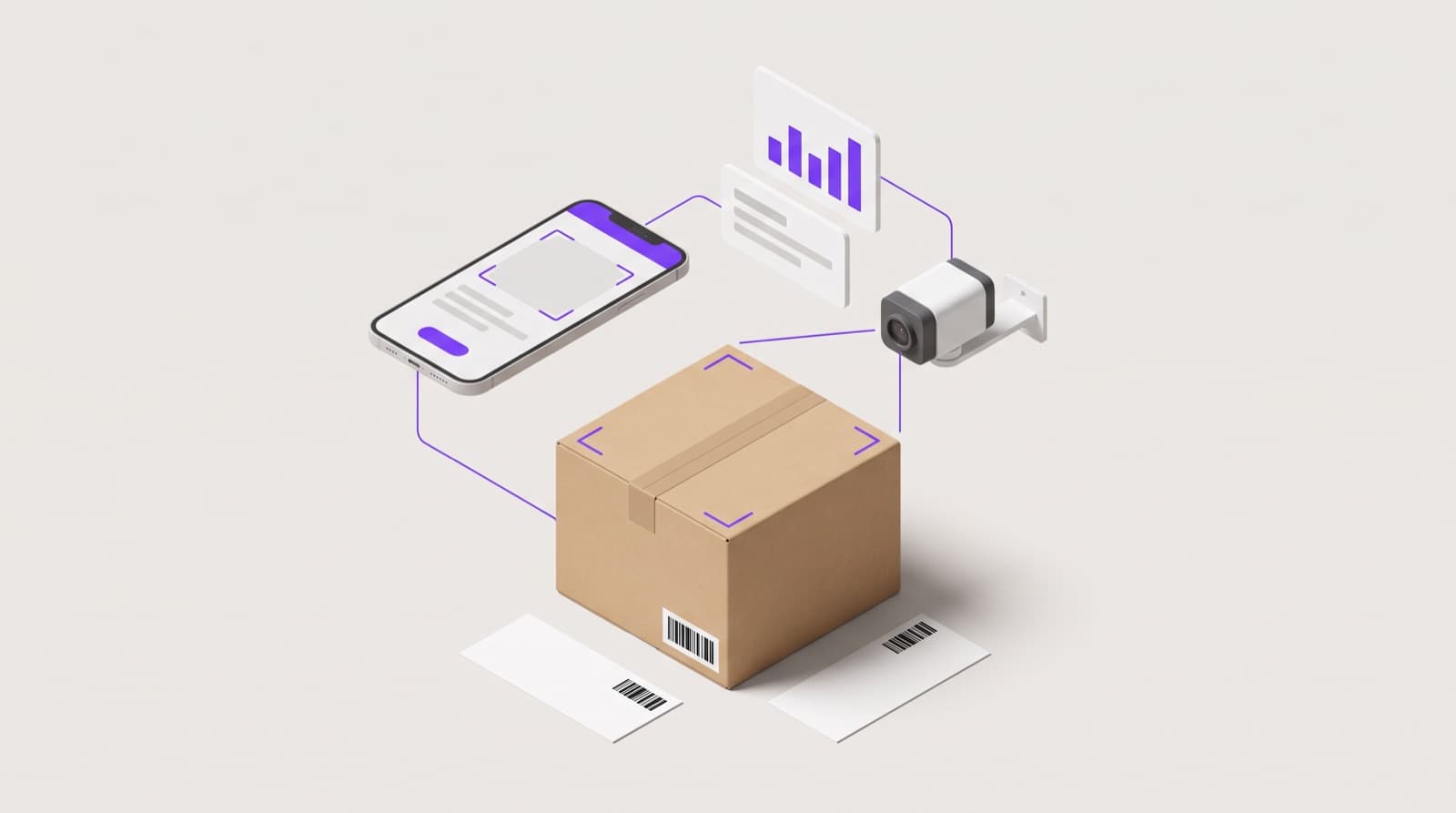
- Image Capture at the Dock: Vision AI captures images of labels, pallets, and paperwork directly at the receiving dock using standard mobile devices or fixed cameras.
- Visual Understanding: The system analyzes the full image in context, recognizing label layouts, barcodes, handwritten notes, symbols, and damaged areas, even under poor lighting or other adverse conditions.
- Semantic Interpretation of Inbound Data: Vision AI applies semantic reasoning to determine what visual information represents operationally, identifying quantities, purchase orders, dates, and reference IDs within logistics workflows.
- Real-Time Validation and Structuring: Interpreted data is validated against expected records, such as purchase orders or ASNs.
- Actionable Output Through Workflows: Validated information flows directly into WMS or ERP systems or triggers workflows for verification, exception handling, and inventory updates, enabling real-time execution at the receiving dock.
Key Advantages of Vision AI
Semantic Understanding
Vision AI interprets what visual fields represent in context, not just the text itself. For example:
- A value next to “Qty” is understood as a quantity
- Numbers next to a currency symbol are interpreted as prices
- Expiration dates are recognized even when printed in different formats
This contextual understanding eliminates the need for rigid templates and enables immediate adaptation to new label and document formats.
Structured Layout Recognition
Vision AI understands document structure, including tables, headers, and complex layouts such as a bill of Lading. It recognizes relationships between fields rather than treating text as isolated characters, making it far more effective for real-world logistics paperwork.
Reliable Performance in Real Receiving Environments
Because logistics-grade Vision AI is trained on diverse, real-world inbound data, it performs reliably even when labels are blurred, partially covered, damaged, or handwritten. Rather than requiring perfect input, it uses surrounding visual and contextual cues to interpret missing or unclear information, making it well suited for the unpredictable conditions of receiving docks.
Ideal Operationalization of Vision AI Intelligence
Raw Vision AI capability alone is not enough. To deliver real operational impact, it must run inside a platform designed for logistics workflows and tightly integrated with enterprise systems.
Mobile-First Scanning
PackageX enables enterprise scanning using standard mobile devices. Workers can use:
- Smartphones
- Tablets
Vision processing occurs at the edge, allowing scans to be completed instantly even in environments with unreliable connectivity. This creates an immediate “scan to action” feedback loop, keeping workers productive and reducing delays at the dock.
API-First Integration With Your Systems
PackageX connects Vision AI directly to existing WMS and ERP platforms through APIs, eliminating the need to replace core systems. This modular, composable approach allows organizations to:
- Embed Vision AI intelligence into critical receiving workflows
- Preserve existing systems of record
- Modernize operations incrementally without disruption
Key APIs enable:
- Vision inference extraction
- Shipment and manifest validation
- Automated fulfillment and receiving logic
- Asset tracking
This flexibility accelerates deployment and minimizes risk.
Why Receiving Needs a System of Action
Vision AI now makes it possible to understand unstructured inbound freight at the receiving dock with high accuracy.
However, understanding information alone does not execute work.
Most warehouses already have:
- Systems of record, like WMS and ERP platforms
- Reporting tools that analyze historical data
- Scanning or OCR tools that capture fragments of inbound information
Yet receiving remains one of the most error-prone and delayed stages of warehouse operations. The reason is simple: intelligence is present, but execution is missing.
What a System of Action Means at the Dock
A System of Action is the operational layer that connects what arrives physically at the dock to executed decisions in real time. Instead of capturing data for later processing, it determines what should happen next and triggers that action immediately.
This shift marks the emergence of a new operational layer in logistics: Vision AI Workflows; systems that don’t just capture data, but execute work in real time.
In receiving operations, this layer typically handles:
- Verifying inbound data against purchase orders or ASNs
- Identifying shortages, overages, or labeling issues early
- Updating WMS or ERP systems without manual re-entry
This approach connects Vision AI directly to real-world execution through a simple operating model:
Vision AI captures → Workflows act → Humans supervise
Vision AI, paired with configurable workflows, is what turns intelligence into a true System of Action.
A Real-World Receiving Example
Consider a pallet arriving with multiple labels. One label is partially torn. Another includes handwritten notes indicating a partial shipment.
With OCR:
- Only part of the printed text is captured
- A receiving associate manually fills in missing fields
- The data is entered into the WMS
- The quantity mismatch is discovered later during reconciliation
With Vision AI operating inside a System of Action:
- The full visual context is interpreted, including handwriting and layout
- Data is matched against the expected purchase order in real time
- The mismatch is detected immediately
- The exception is flagged and documented before the inventory is accepted
When Vision AI and configurable workflows work together, receiving shifts from manual data entry to automated execution. Human effort shifts from oversight to routine work, visibility improves instantly, and downstream disruptions are prevented before they begin.
That is where intelligence becomes operational.
What Vision AI-Powered Receiving Looks Like in Practice
Let’s break down how this technology changes daily operations.
Scan to Record
Workers simply point a device at a label. Vision AI identifies:
- Tracking numbers
- Purchase orders
- SKUs
- Handwritten notes
The data is extracted and logged to your system immediately, eliminating manual entry and reducing errors.
Scan to Verify
Each scan is validated against the expected manifest in real time. If something doesn’t match, workers see an alert and can correct it before the shipment enters inventory, preventing avoidable penalties.
Scan for Condition
Vision AI can document the physical condition of freight, detecting:
- Damage
- Crushed boxes
- Wet spots
- Tears
This creates a timestamped visual record for claims and reduces disputes with carriers.
Scan to Retrieve
When items are in staging, workers can use their camera as a search tool. Scan the area and instantly highlight the item you’re looking for, saving time and reducing stress.
How Vision AI Systems Can Transform Your Organization?
Organizations using Vision AI-enabled systems report major improvements. Here are the notable results:
- Improved Visibility: Businesses that once relied on stapled spreadsheets now capture items at the point of arrival, eliminating days of backlog and drastically improving operational flow.
- Decentralized Receiving: Distributed operations, such as coworking spaces, have turned non-logistics staff into effective receivers with intuitive mobile scanning tools.
- Reduced Chargebacks: Third-party logistics providers have dramatically cut retailer penalties by capturing all barcodes on pallet faces and validating quantities with high confidence.
The Financial Impact of Vision AI-Driven Receiving Automation
When the costs of manual processes are compared to gains from Vision AI-powered intelligence, the return becomes clear.
- Labor Savings: Reduced manual entry and fewer corrections free up 20–30% of labor capacity, letting existing teams handle more volume without adding headcount.
- Lower Penalties: Chargeback reductions directly protect profit margin. Reducing fines by just a few percentage points on a large account delivers significant bottom-line benefits.
- Faster Inventory Turn: As dock-to-stock times decrease, inventory becomes usable sooner, improving turnover and reducing capital tied up in invisible goods.
- Fewer Carrier Fees: Quicker unloading and processing reduce detention fees and strengthen carrier relationships.
What’s Next: Agentic AI and Sustainability
Vision AI adoption sets the stage for even more advanced capabilities like agentic AI, where systems can:
- Detect damage and automatically file claims
- Trigger reorder actions
- Route items
- Initiate cross-dock moves
On sustainability, precision reduces waste. Better inbound accuracy means:
- Fewer unnecessary truck rolls
- Less return freight
- Lower emissions
Conclusion:
The receiving dock has become the data ingestion engine of modern supply chains. When visibility is poor, costs rise, labor drains, and competitive advantage slips away.
Vision AI and configurable workflows give the dock the intelligence it has always lacked. They turn unstructured chaos into clean digital data in real time. This improves operational performance, protects margins, and positions companies for future automation.
The only remaining question here is whether your organization is ready to turn on the lights at the dock and give it a brain.