
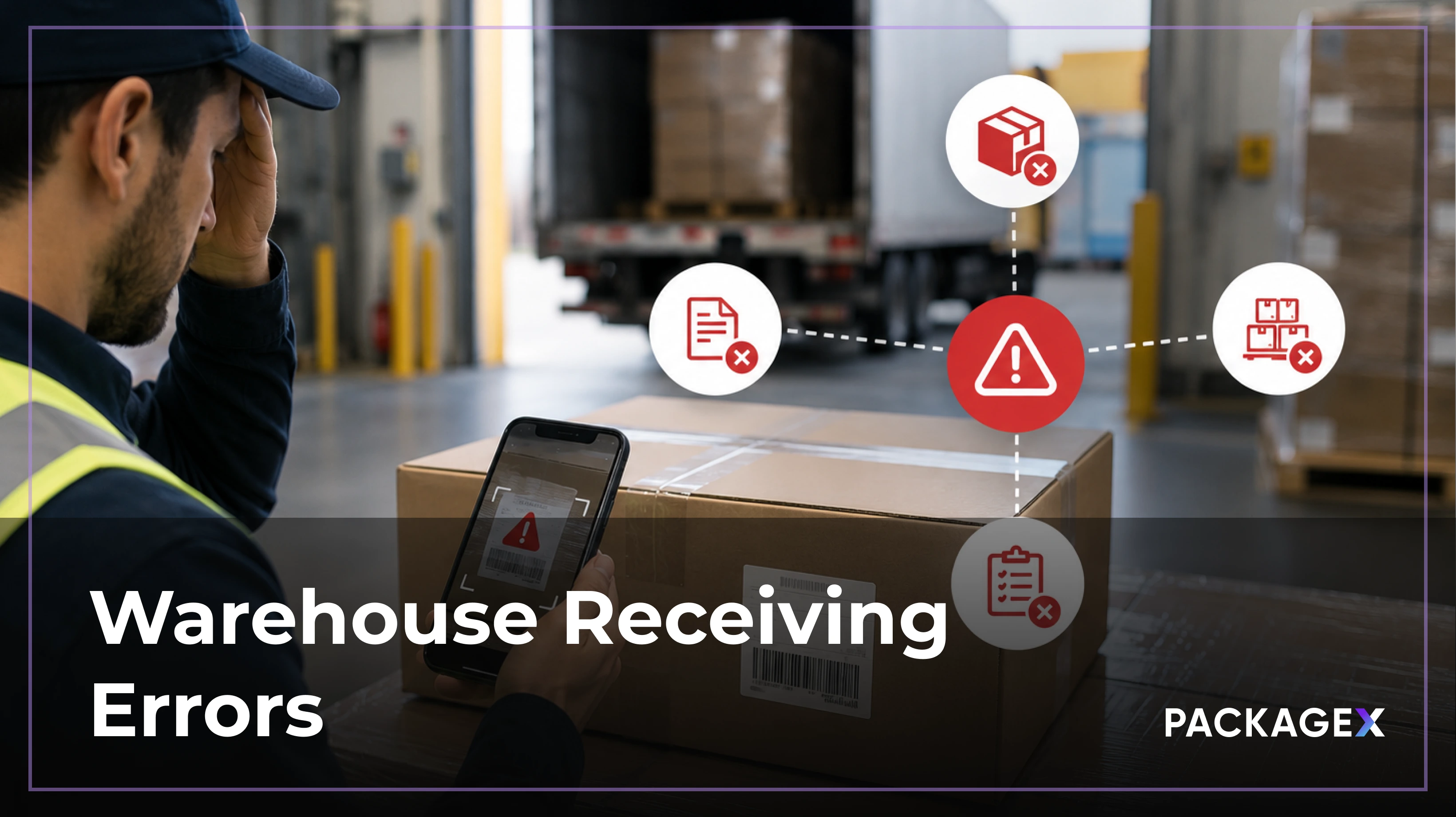
A miscounted case doesn't stay in receiving. It becomes a mispick three days later, then an oversized carton, then a stockout your forecast never saw coming, then a line item on a retailer's deduction notice. By the time anyone traces it back to the dock, the error has cost several times what it would have cost to catch on arrival.
The industry is investing to close exactly these gaps. The global warehouse management system market is projected to grow from USD 4.38 billion in 2026 to USD 10.64 billion by 2034, at a CAGR of 11.70%, according to Fortune Business Insights. More spend means more pressure on receiving to deliver clean data into the systems that depend on it.
What Counts as a Receiving Error
A receiving error is any discrepancy between what physically arrived at your dock and what your system says arrived. That covers wrong quantities, wrong SKUs, unrecorded damage, units logged to the wrong location, and correct receipts entered too late to be true.
Every receiving error sits on at least one of three axes:
- Quantity: The count is wrong.
- Identity and Condition: The item, or its state, is wrong.
- Timing and Location: The record is accurate but late, or points somewhere the goods aren't.
Receiving deserves more attention than any other error point in the building because it's the only place bad data enters before anything downstream can catch it. Picking, packing, slotting, replenishment, and forecasting all inherit the receipt and trust it completely.
The 7 Most Common Receiving Errors, Grouped by Root Cause
Most lists of receiving errors are lists of symptoms. Grouping them by where they originate is more useful, because the fix lives at the root, not the symptom.
Upstream and Vendor Data
- ASN Mismatch: The advance shipment notice says 20 units per case. The case holds 16, and they're the wrong colorway. Nobody opens one to check, so the WMS receives the ASN rather than the truck. This is the highest-leverage error on the list because it corrupts the record before a single unit is touched.
- Unrecorded Overages: Extra units arrive and get absorbed into stock without a note. The count is wrong in the direction nobody complains about, the vendor is never corrected, and the variance shows up months later during a physical count with no audit trail attached.
Dock Execution
- Quantity Variance From Eyeball Counting: No blind count, no sampling standard, high-volume pallets waved through because the driver is waiting and the dock is backed up. Speed pressure at the door is the most common reason counts go unverified.
- Missed Damage and Quality Defects: Without an inspection gate, crushed cases and expired lots are discovered at pick time, often after the carrier's claim window has closed and the cost is unrecoverable.
- Wrong SKU, Mislabeled, or Misrouted Units: Near-identical SKUs, missing or unscannable barcodes, no lot or serial capture. The units are in the building; your system thinks they're something else.
System Recording
- Late or Manual Recording: Receipts keyed from paper at the end of a shift, or held in a spreadsheet until someone reconciles them. For those hours, your inventory is knowingly wrong, and every downstream decision is made on stale data.
- Wrong Bin or Location Assignment: The count is right, the SKU is right, but the WMS points to the wrong slot. Operationally, this is identical to a shortage. The goods exist and cannot be found.
The Error Underneath the Other Seven
Throughput-only receiving targets manufacture all seven. It's a persistent complaint among warehouse practitioners that the fastest workers post the highest error rates, and the reason is structural rather than personal: if the scorecard only counts cases per hour, verification is the thing that gets cut. Accuracy has to appear on the same scorecard as volume, or it will lose to volume every shift.
What Receiving Errors Actually Cost You
Most articles about receiving costs quote the cost of receiving. The more useful number is the cost of getting it wrong. Here's a four-line stack you can run against your own operation.
- Rework Labor: Published benchmarks put receiving costs at roughly $2.50 per SKU, $12.91 per pallet, $40.79 per labor hour, and $350 per container. A corrected receipt means paying that cost twice, plus the investigation time to work out what happened.
- Downstream Fulfillment Cost: A wrong count or wrong item dimension propagates. Directed putaway sends fast movers into slow slots. Pickers hunt for stock that isn't where the system says, then pick off-system from another location, quietly breaking a second location's count. The WMS suggests a carton sized from bad dimensional data, so you either damage product or overpay freight. One bad receipt can generate a dozen downstream corrections.
- Chargebacks and OS&D Deductions: This is the line most operators underestimate. Retail chargebacks commonly run 2 to 5% of gross revenue, and a large share of them are invalid or preventable. Industry estimates put overage, shortage, and damage losses at 5 to 10% of annual warehouse revenue once you count lost product, freight claims, extra labor, and the relationship damage with trading partners. Without a discrepancy log from the dock, you can't dispute any of it.
- Phantom Inventory and Shrink: Most facilities run 85 to 90% inventory accuracy against a 95 to 99% standard, and shrinkage tied to inventory inaccuracy costs roughly 1.4% of revenue annually. Phantom stock produces stockouts your forecast can't anticipate and dead stock your reports can't see.
Run the arithmetic on a single case-level error in a 40-case inbound: the rework, the two or three mispicks it seeds, the deduction if that shipment was destined for a retail DC, and the reorder you place against a count that was never real. The number is rarely under three figures, and it recurs every week you leave the root cause in place.
How to Measure Receiving Accuracy
You can't reduce what you don't count. Two formulas, both simple:
Receiving Accuracy = (shipments received without error ÷ total shipments received) × 100
Inventory Accuracy = (units matching the system record ÷ total units counted) × 100
One trap worth naming: measuring at case level hides each-level errors. If your discrepancies are inside cases, a case-level accuracy figure will look excellent while your pick faces tell a different story. Match the measurement level to the error level.
Collecting this takes three habits. Log every discrepancy at the dock, in the moment, with a reason code. Run cycle counts on a fixed cadence rather than waiting for an annual physical. And reconcile receipts against the ASN and purchase order, not the packing slip alone. The packing slip is produced by the same party that made the error.
How to Eliminate Receiving Errors
Eight fixes, each mapped to the errors above.
- Validate the ASN Before the Truck Arrives: Require electronic ASNs, reconcile them against the PO ahead of arrival, and schedule dock appointments so your team knows what's coming and when. Kills errors 1 and 3.
- Set an Inspection Tolerance and Write It Down: Sample 10 to 20% of inbound cases for SKU and count accuracy. Blind-count high-value and high-volume lines. Measure and weigh every new SKU on arrival so your dimensional data stays clean. Kills errors 3 and 4.
- Scan at the Right Level, Every Time: Barcode or RFID at case level as the default, each level for mixed cases and SKUs with a history of variance. Capture lot and serial numbers wherever recalls or warranties matter. Kills error 5.
- Record in Real Time, at the Point of Receipt: Mobile capture on the dock. No end-of-shift keying, no spreadsheet standing in as the system of record. Kills error 6.
- Use System-Directed Putaway With Location Confirmation: Scan to confirm the bin so the WMS knows where units actually went, not where it suggested they go. Kills error 7.
- Standardize With an SOP and a Receiving Checklist, and Require Sign-Off: Same steps every shift, every dock door, every crew. Keep it digital and versioned so an update reaches everyone at once instead of living in a binder. Creates the accountability trail everything else depends on.
- Close the Loop With Vendors: Log every discrepancy, aggregate by supplier, and send it back as a scorecard on a regular cadence. This is how you stop paying for the same error every month, and it's the evidence you need to win a chargeback dispute.
- Fix the Incentives: Put receiving accuracy in the performance review next to throughput, with a stated target. Kills the error underneath the other seven.
If you can't do all eight, sequence them: measure first, then ASN validation, then real-time capture. Those three move the number fastest and make the rest easier to justify.
Where Automation and AI Actually Help
Three things automation genuinely fixes in receiving.
- Document Capture: OCR on bills of lading, packing slips, and labels, so nothing is transcribed by hand.
- Real-Time Sync: The receipt appears in the WMS and ERP the moment it's scanned, not at shift end.
- Exception Flagging: The system catches an ASN-versus-actual mismatch and holds the shipment, instead of relying on someone noticing.
One caution: automating a broken process produces wrong data faster and with more confidence. Standardize first, then automate.
Cutting Errors Before They Enter the System
Every receiving error in the list above shares one root problem: the physical goods and the system record fall out of sync at the moment of arrival. Once that gap opens, everything downstream inherits it. PackageX shrinks the gap by capturing the receipt as it happens, on hardware you already own.
- Any Device Becomes a Scanner: Any smartphone, tablet, or fixed camera can act as an AI scanner that reads barcodes, QR codes, and text on packing slips, BOLs, and case labels at the dock.
- Receipts Captured in Real Time: The system record updates the moment the driver walks off, not at shift end, so downstream teams work from what actually arrived.
- Exceptions Surface Immediately: Damage, short shipments, and PO mismatches trigger an alert at the dock, where the carrier is still there and the correction is still cheap.
- Verified Data Flows Into Your Stack: Captures sync through the PackageX API and SDK into your WMS or ERP, with a timestamped, image-attached record for every event.
Conclusion
Receiving errors are cheap to fix at the dock and expensive to chase everywhere else. Measure them, root-cause them, and put accuracy on the same scorecard as throughput. Do that consistently and the rework, chargebacks, and phantom stock that quietly eat margin start to disappear.
Frequently Asked Questions
What Is Blind Receiving?
Blind receiving is a practice where the receiving clerk counts and records inbound units without seeing the expected quantities from the PO or ASN. It forces an independent verification of what actually arrived rather than confirming what should have arrived. Retailers and pharma operations use it on high-value or high-shrinkage lines to catch counting errors and vendor short-shipments that a matched-count workflow would miss.
What Is OS&D in Warehousing?
OS&D stands for overages, shortages, and damages, the three categories of discrepancy tracked at receiving. Overages are extra units the vendor shipped without invoicing, shortages are missing units against the PO, and damages are units received in unsellable condition. OS&D logs are the raw evidence supply chain teams use to file freight claims, chargeback disputes, and vendor scorecards.
Who Is Responsible for Warehouse Receiving Accuracy?
Receiving accuracy is a shared responsibility across the vendor, the carrier, and your dock crew. Vendors control what and how they ship, carriers control transit conditions and delivery timing, and your team controls what gets counted, inspected, and logged. In most operations, the warehouse manager owns the accuracy metric, but the fix for a persistent gap usually lives with one specific link in that chain.
.webp)

.webp)