Raw materials inventory management is the daily tightrope every manufacturer walks: order too little and the production line stops; order too much and cash gets tied up in raw materials sitting in the warehouse. Both mistakes are expensive and stem from limited visibility into what is on hand and what is being consumed. Strong inventory management raw materials practices turn guesswork into a controlled process, lowering carrying costs while protecting the production schedule.
That pressure is driving real investment. The inventory management market is expected to grow to USD 2.95 billion in 2026 and reach USD 4.14 billion by 2031 at a 6.99% CAGR, as manufacturers race to digitize the tracking, valuation, and replenishment of raw inputs.
This guide is part of our broader manufacturing inventory management playbook. In short: raw materials inventory management is the discipline of planning, ordering, storing, tracking, and consuming raw inputs so production never stops and capital never sits idle.
Key Takeaways
• Raw materials inventory management plans, orders, tracks, and consumes raw inputs so production runs smoothly and capital stays free. • The raw materials inventory formula is: Beginning Inventory + Purchases - Raw Materials Used = Ending Inventory. • A healthy raw materials turnover ratio ranges from 4 to 6 turns per year for most manufacturers. • FIFO, LIFO, and weighted average each drive different COGS and tax outcomes, so consistency matters. • Real-time scanning, cycle counts, and ERP integration are the biggest levers for accuracy in modern operations.
What Is Raw Materials Inventory Management?
Raw materials inventory management is the practice of planning, ordering, storing, tracking, and consuming all unprocessed inputs used to make a finished product. It covers everything from steel sheets and fabric rolls to packaging and chemicals, and it ties directly into the bill of materials, procurement, and the company’s balance sheet.
In simple terms, the raw materials definition used in inventory management is this: any unprocessed input the business has bought but not yet turned into a finished good. These materials are recorded on the balance sheet as current assets until they are consumed in production.
| Stage | What It Is |
|---|---|
| Raw materials | Unprocessed inputs ready to enter production |
| Work-in-process (WIP) | Materials being transformed on the line |
| Finished goods | Products ready to ship or sell |
Raw materials inventory management is upstream of bill of materials management, which defines the recipe each finished good follows.
Types of Raw Materials
Most operations split raw materials into two main categories based on whether the input enters the bill of materials directly or supports production indirectly. Some operations also track seasonal and obsolete/slow-moving stock separately.
Direct Materials
Inputs that physically enter the finished product and appear on the BOM. Examples: steel for auto bodies, fabric for clothing, flour for bread. They appear on the balance sheet as inventory assets and flow into COGS upon consumption.
Indirect / MRO Materials
Maintenance, repair, and operations supplies that keep production running without becoming part of the product. Examples: lubricants, gloves, cleaning supplies, replacement bearings. Usually treated as overhead.
Effective inventory management of raw materials keeps both categories accurate and visible, since indirect items often drive hidden downtime when they go missing.
Why It Matters in Manufacturing
Raw materials inventory management is a strategic discipline for manufacturing leaders. Strong control over raw inputs prevents downtime, protects margins, and frees working capital for growth.
- Prevents stockouts and downtime: Accurate on-hand counts and reorder points keep the production line running without panic orders.
- Controls costs and margins: Tighter quantities mean less spoilage, less obsolescence, and lower carrying costs.
- Frees cash flow: Trimming excess inventory releases capital tied up in raw materials sitting on shelves.
- Supports planning: Clean data feeds demand forecasting, MRP, and lead time decisions.
- Cushions supply chain disruption: Smart safety stock buffers production through supplier delays and price shocks.
- Protects quality: First-in, first-out rotation prevents materials from expiring or degrading before use.
How to Calculate Raw Materials Inventory (with Example)
The raw materials inventory formula is simple:
Beginning Inventory + Purchases - Raw Materials Used = Ending Inventory.
That single equation drives every period-end report, COGS calculation, and reorder decision.
Step-by-Step
- Find beginning inventory: Take the ending inventory from the previous period as your starting balance.
- Add purchases: Include all raw materials purchased during the period, plus freight-in, customs, and duties (these are included in inventory cost).
- Subtract usage: Pull total raw materials consumed in production from your BOM and work order records to arrive at ending inventory.
Worked Example
A furniture manufacturer starts Q1 with USD 80,000 in lumber. During the quarter, it purchases USD 120,000 of additional lumber (including freight) and consumes USD 150,000 in production runs.
Ending Inventory = 80,000 + 120,000 - 150,000 = USD 50,000
That USD 50,000 sits on the balance sheet as a current asset and becomes the beginning inventory for Q2.
Raw Materials Inventory Turnover Ratio
Raw materials inventory turnover measures how many times a year you cycle through your raw materials stock, calculated as COGS divided by average raw materials inventory. Higher turnover means leaner operations; lower turnover often signals trapped cash.
Formula: Turnover = COGS ÷ Average Raw Materials Inventory
Worked example: If annual raw materials COGS is USD 600,000 and average inventory is USD 120,000, turnover is 5.
Healthy benchmark: Most manufacturers target 4-6 turns per year.
- Below 4: Likely overstocked or carrying obsolete materials.
- Above 6: Lean and capital-efficient, but watch for stockout risk.
- Days on hand: Divide 365 by turnover to convert turns into days of stock.
Valuation Methods: FIFO, LIFO & Weighted Average
Inventory valuation drives COGS, taxable income, and balance sheet value. Most manufacturers pick one of four methods and apply it consistently to stay compliant with accounting standards.
- FIFO (First-In, First-Out): Assumes the oldest stock is sold first. In rising-price environments, it yields lower COGS and higher profits, making it the go-to method for perishable or dated raw materials.
- LIFO (Last-In, First-Out): Assumes the newest stock is sold first. In rising-price environments, it produces higher COGS and lower taxable income, which is why US firms often use it during inflationary periods. Note that LIFO is not allowed under IFRS.
- Weighted Average Cost (WAC): Averages the unit cost across all available stock. It smooths out price swings and is best suited for commodities and blended inputs where individual units are interchangeable.
- Specific Identification: Tracks each unit individually with its own cost. It is the most accurate but also the most manual method, best reserved for high-value or unique items such as bespoke parts, serialized components, or precious metals.
The consistency principle requires sticking with one method once chosen, since switching back and forth distorts year-over-year comparisons and raises red flags in audits.
Methods & Techniques to Manage Raw Materials
Effective inventory management of raw materials combines forecasting, replenishment rules, and lean techniques to keep stock at the right level. The right mix depends on demand volatility, business size, and supplier reliability.
Core Techniques
- Just-in-Time (JIT): Order materials only as needed to minimize carrying costs. Best for stable demand and reliable suppliers.
- ABC Analysis: Rank materials by value and usage. A-items get tight control, C-items get bulk reorder rules.
- Economic Order Quantity (EOQ): EOQ calculates the order size that minimizes total ordering and carrying costs.
- Material Requirements Planning (MRP): Software-driven planning that maps BOMs to demand and automatically triggers purchase orders via ERP integration.
- Safety Stock: Buffer inventory that absorbs supplier delays and demand spikes.
- Reorder Point (ROP): The stock level that triggers a new purchase order.
| Method | What It Does | Best When |
|---|---|---|
| JIT | Cuts carrying costs | Demand is stable, suppliers reliable |
| ABC | Prioritizes control by value | Mixed-value SKUs |
| EOQ | Optimizes order size | Predictable usage |
| MRP | Automates planning | Complex BOMs, multi-product |
| Safety Stock | Buffers disruptions | Volatile lead times |
Most growing manufacturers blend two or three of these methods rather than pick one.
Tracking Technology for Raw Materials
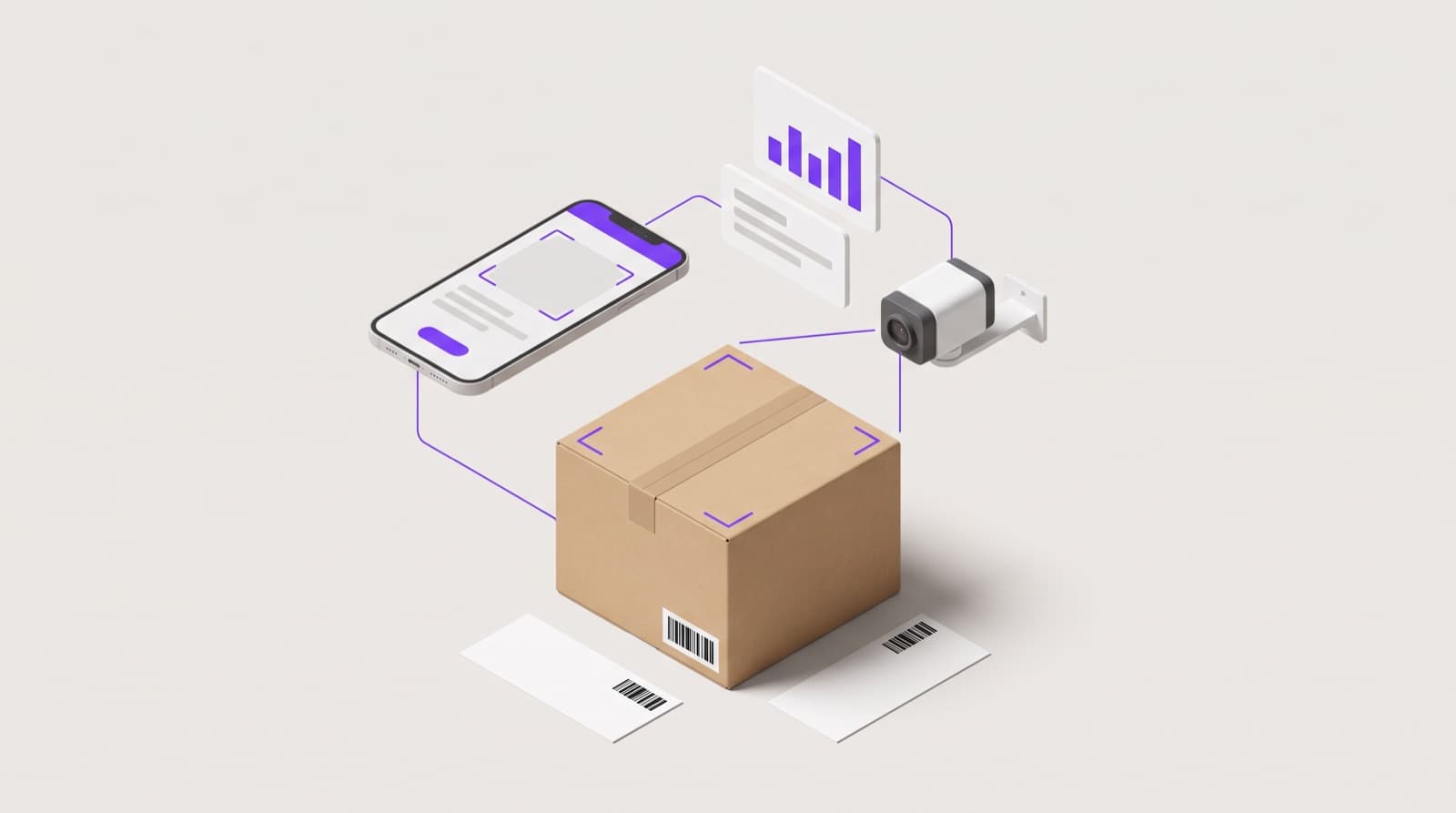
Modern inventory management for raw materials runs on real-time data, not periodic spot checks. Tracking technology turns the warehouse from a black box into a continuously updated system of record, with every receipt, move, and consumption captured automatically.
- Barcode scanning: Fast, low-cost capture at receiving, putaway, and production picking via tools like the PackageX VScan mobile scanner.
- RFID: Hands-free tracking for bulk materials, drums, and high-value items.
- Real-time/perpetual systems: Every transaction updates the inventory record instantly, no waiting for month-end counts.
- Cycle counting: Rolling counts of small portions of inventory keep records accurate without full stop-take audits. See our cycle counting best practices guide.
- Kanban: Visual signals trigger replenishment on the production line.
- IoT and automation: Sensors, smart bins, and automated receiving cut human error and capture damage at the dock.
| Approach | Speed | Accuracy | Best For |
|---|---|---|---|
| Manual / paper | Slow | Low | Tiny operations only |
| Automated scanning | Real-time | High | Most manufacturers |
Building on real-time inventory visibility is the highest-ROI move most manufacturers can make.
Common Challenges & How to Solve Them
Even disciplined operations run into recurring challenges in raw materials inventory management. The fix usually comes from process, data, or both.
- Demand swings: Volatile customer demand throws ordering off in both directions. Solve it with rolling forecasts and dynamic safety stock that flexes with seasonality and market signals.
- Price volatility: Raw input costs rarely stay flat for long. Hedge where it makes sense, lock in multi-supplier contracts, and use weighted average cost (WAC) valuation to smooth the impact on COGS.
- Supplier overreliance: One late shipment from a sole-source vendor can stop the line. Diversify the supplier base and dual-source critical materials so you always have a backup.
- Storage costs: Excess stock eats warehouse space and capital. Lean ordering, just-in-time (JIT) replenishment, and ABC-based space allocation keep storage costs in check.
- Data accuracy: Spreadsheets and paper logs drift fast. Real-time scanning at receiving and frequent cycle counts keep records aligned with what is actually on the shelf.
- Obsolescence: Materials expire, designs change, and slow movers pile up. Enforce FIFO rotation and conduct regular reviews of obsolete inventory to flag dead stock early.
- Compliance: Regulated industries face strict storage and traceability rules. Use climate-controlled storage where required, and capture lot or batch numbers on every transaction to ensure full traceability.
The common thread is visibility. Most challenges shrink fast when raw materials data is captured at the moment of transaction rather than reconstructed weeks later.
Best Practices
Best practices for raw materials inventory management come down to discipline, data, and the right tools. These habits separate top-quartile manufacturers from the rest.
- Set up clean SKUs: Every material gets one unique code, no duplicates.
- Run cycle counts weekly: Continuous accuracy beats one big year-end count.
- Forecast demand from data, not gut: Use ERP or MRP outputs.
- Maintain the right safety stock: Match the buffer to lead-time variability.
- Stay consistent on valuation: Pick FIFO, LIFO, or WAC and stick with it.
- Repurpose or recycle waste: Capture credit and reduce disposal costs.
- Automate and upgrade software: Real-time tracking unlocks every other practice.
How to Choose Inventory Software
Choosing inventory software is a business decision, not just an IT one. Use this checklist when shortlisting:
- Real-time visibility: Live on-hand counts across every site.
- Scalability: Handles SKU and volume growth without a rebuild.
- Integrations: Connects to your ERP, accounting, and purchase order workflows.
- Barcode and RFID support: Hardware-flexible capture at the dock and on the floor.
- Reporting: Built-in turnover, valuation, and aging dashboards that simplify inventory auditing.
- Security and audit trail: Role-based access and immutable transaction logs.
The right software pays for itself in 6 to 18 months through accuracy gains alone.
How PackageX Closes the Raw Materials Inventory Loop
A raw materials inventory record is only as accurate as the data captured at the receiving dock. PackageX closes that loop with AI-powered scanning and exception management that turn every inbound shipment into a clean, ERP-ready transaction.
- Vision AI scanning: The PackageX VScan captures part numbers, lot numbers, supplier labels, and packing slips at intake without manual entry.
- PO-to-receipt matching: Auto-match each delivery to the purchase order via the dock-to-stock workflow and flag mismatches before they reach inventory.
- Damage and shortage capture: AI flags damaged packaging and short shipments so claims start immediately.
- ERP and MRP integration: Receiving data flows directly into your ERP and warehouse management stack through APIs and webhooks.
- Cycle count and audit support: Built-in tools for rolling cycle counts and real-time audit trails via the inventory audit module.
FAQs
What is the purpose of raw materials inventory management?
The purpose of raw materials inventory management is to keep enough unprocessed inputs on hand to run production without tying up cash in excess stock. It controls how materials are ordered, stored, tracked, and consumed so the line never stops and carrying costs stay low.
How do you track raw materials in manufacturing?
Most manufacturers track raw materials through a perpetual inventory system that updates in real time as goods are received, moved, and consumed. The most accurate setups combine barcode or RFID scanning at the dock, mobile capture on the production floor, and ERP integration so every transaction flows into one record.
What is the difference between raw materials inventory and work-in-process inventory?
Raw materials inventory covers unprocessed inputs that have been bought but not yet entered production, while work-in-process (WIP) inventory covers materials that have already started being transformed into finished goods.