
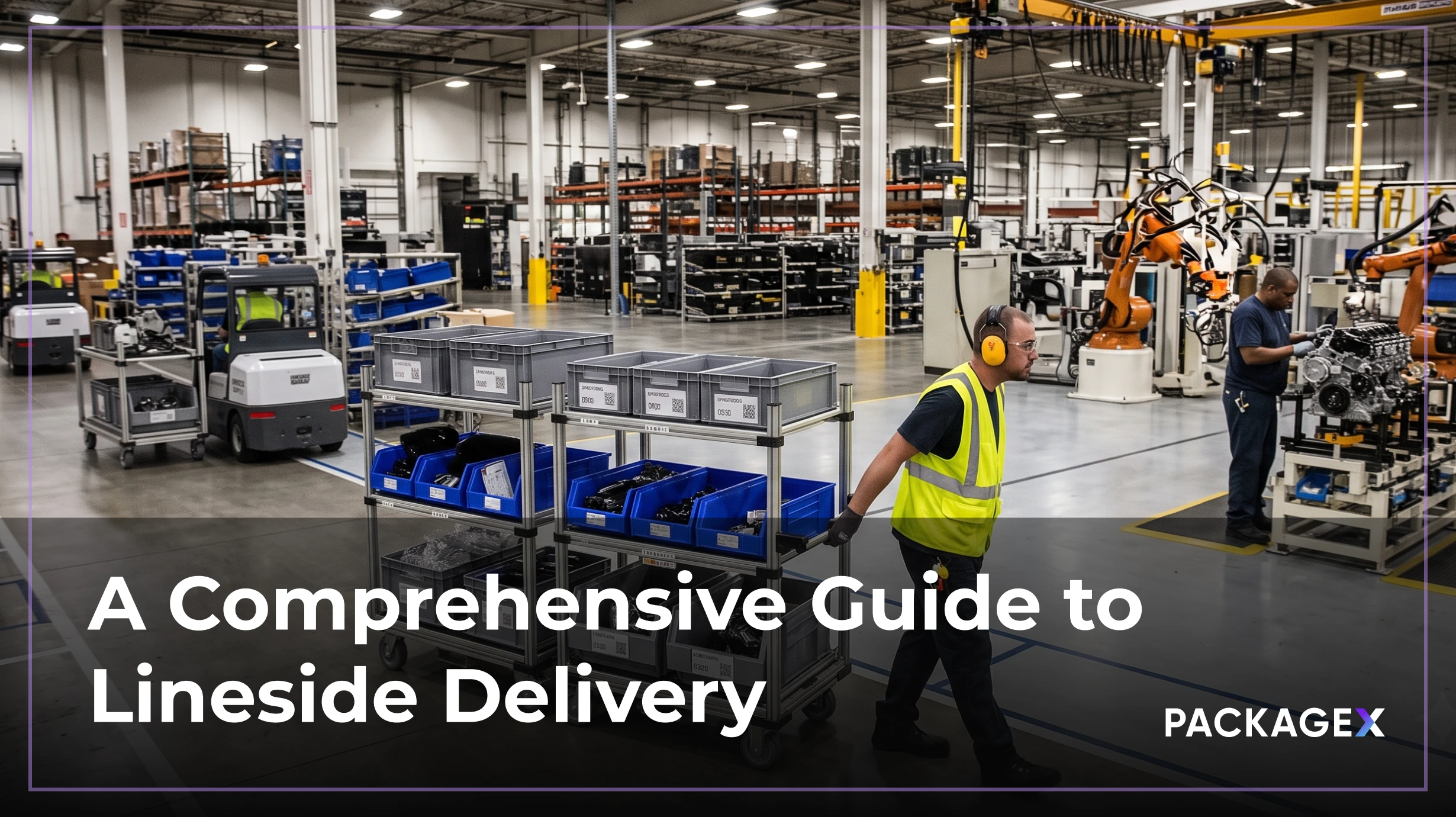
The production line only runs as fast as the parts arrive at it. When a component is late, wrong, or missing, the whole line waits, and every second of downtime is money burning. Lineside delivery is the discipline that keeps that from happening. It moves raw materials, subassemblies, and components from your warehouse to the exact point of use on the line, in the right quantity, at the right time.
When done well, it reduces operator walking and slashes work-in-process inventory. Done poorly, it creates bottlenecks that no upstream automation can fix. The pressure keeps rising, too. The global last-mile delivery market is projected to reach USD 288.9 billion by 2031, growing at a CAGR of 8.13%. The same expectation of exact, on-time delivery to a specific point now shapes internal factory flows just as much as it shapes home deliveries.
This guide covers what lineside delivery is, the methods and equipment that make it work, how WMS and real-time tracking optimize it, its benefits, and how to design and implement it in your plant.
What is Lineside Delivery?
Lineside delivery is the logistics process of moving raw materials, parts, and components directly to the assembly or production line where they are needed. It is the interface between the warehouse or internal logistics operation and the production floor.
It also helps to separate three related terms:
- Lineside delivery is the movement itself, transporting parts from storage to the line.
- Lineside storage is the presentation racking at the line where parts sit ready for the operator.
- Lineside logistics is the broader strategy that includes both plus the planning behind them.
The point of use (POU) is the exact workstation, work cell, or designated assembly point where a part gets consumed. Every part needs to land at its correct POU before the operator reaches for it. That is the promise lineside delivery has to keep, every cycle, every shift.
Lineside Delivery and Lean Manufacturing
Lineside delivery is one of the clearest applications of lean manufacturing on the plant floor. It attacks muda directly, especially the waste of excess inventory, unnecessary movement, and waiting.
In a traditional push system, parts pile up at the line whether they are needed or not. Cash sits idle, floor space fills up, and operators still walk to hunt for the right item. A lineside delivery pull system flips that logic: parts arrive only when a downstream signal calls for them.
Kanban cards were the original pull signal, and they still work well in stable, medium-volume environments. Their limit shows up in high-variety, mixed-model production, where card management becomes an overhead in itself. Modern lineside delivery layers electronic signals, RFID, and IoT sensors onto Kanban so that replenishment triggers occur automatically.
The payoff is smaller WIP buffers at the line, tighter compliance, and lower inventory holding costs. Downtime falls because parts arrive before the line runs out, and workflow efficiency climbs because operators spend more time building and less time hunting.
How Lineside Delivery Works: Methods and Equipment
Lineside delivery methods fall into four main buckets. Most large plants combine two or more.
Kitting and sequencing
Kitting bundles all the parts needed for one assembly cycle into a single container, so an operator gets everything for the next unit in one trip. Sequencing, sometimes called just-in-sequence (JIS), goes further: parts arrive in the exact order of consumption on a mixed-model line. Automotive plants rely heavily on JIS for seats, mirrors, and instrument clusters, where each vehicle gets its exact spec.
AMRs and AGVs
Autonomous mobile robots (AMRs) and automated guided vehicles (AGVs) move parts from staging areas to the line without a human driver. AGVs follow fixed paths using magnetic strips or wire guidance and work best in layouts where the layout is stable. AMRs navigate dynamically with sensors and lidar, so they can adapt to layout changes and reroute around obstacles.
Both can be triggered by Takt-time thresholds or WMS demand signals, delivering parts point-to-point on a predictable cadence. Predictive replenishment layers demand forecasts on top, so the AMR shows up before the bin is empty.
Flow racks and tuggers
Flow racks are gravity-fed shelves where full containers slide from the back to the front as operators pull the front ones off. First-in, first-out rotation happens automatically. Tuggers, or tow tractors, pull trains of wheeled carts on a fixed route called a milk run, dropping full containers at each stop and picking up empties on the return.
Milk runs offer flexibility without full automation. A single tugger can service multiple lines and cells on a schedule, and the route adapts as production plans change.
Manual carts and forklifts
Manual carts and forklifts are the baseline. They stay useful for low-volume operations, one-off deliveries, and heavy or oversized items that automation cannot easily handle. The tradeoff is labor intensity and lower consistency.
Optimizing Lineside Delivery with WMS and Real-Time Tracking
The biggest gains in lineside delivery come from tying material flow to real-time data. Integrated tracking plus a warehouse management system (WMS) ensures the right part hits the exact assembly point on time, every time.
RFID tags on totes and carts, along with receiving and line-side sensors, automatically identify inventory as it moves. Real-time location systems (RTLS), usually ultra-wideband or Bluetooth beacons, track high-value assets like tuggers and AMRs across the plant floor. IoT weight and photoelectric sensors on flow racks trigger replenishment when levels drop past a threshold.
The WMS ties it together. It receives consumption signals from the line, matches them against inventory in the warehouse, and issues replenishment tasks to the right delivery method. A WES (warehouse execution system) sits above the WMS on the plant floor, orchestrating people and equipment in real time and adjusting when a machine goes down or demand spikes.
Predictive replenishment layers analytics on top. Instead of waiting for a min/max threshold, the system forecasts consumption based on production plans and delivers before the trigger fires. The result is fewer stockouts, fewer emergency runs, and a plant floor that runs on verified data rather than guesswork.
Benefits of an Optimized Lineside Delivery Process
The benefits show up across cost, throughput, and safety. Each one ties back to a measurable line on the P&L.
- Less operator walking and reaching: Studies of manual assembly show operators can spend around 50% of their time walking, reaching, or waiting. Bringing parts to the POU reclaims that time for building.
- Reduced line-side inventory and footprint: Smaller buffers at the line free floor space and cut carrying cost. Many plants recover 15 to 30 percent of the floor area after redesigning material presentation.
- Fewer stockouts and line stoppages: Automated triggers catch low bins before they run empty, so the line does not wait for parts.
- Higher throughput: Well-designed lineside delivery drives 25 to 40 percent productivity gains in high-volume assembly, based on industry benchmarks.
- Better ergonomics: Right-angled bins, correct reach zones, and pre-kitted containers reduce operator strain and injury rates.
- Labor reallocation: People who were fetching parts move to value-adding tasks like assembly, quality checks, or supervision.
- Higher accuracy: Pre-kitted, sequenced parts reduce build errors from wrong-item selection at the line.
None of these is theoretical. Plants that measure them consistently see the same gains within the first year.
How to Design and Implement Line-Side Delivery
A good lineside delivery design starts with an inventory strategy, not the tool. Do the following before you buy a single AMR or flow rack.
- Map consumption at each POU: Measure how many of each part a workstation uses per hour, per shift, and per day. This is the foundation of every downstream decision.
- Right-size containers and packaging: Small containers mean frequent replenishment; large ones eat floor space. Aim for one to two hours of stock on hand at the line.
- Design the presentation: Flow racks with gravity lanes, angled bins, and clear labeling put parts within ergonomic reach and enforce FIFO automatically.
- Decide sequencing vs. Batching: Sequencing suits mixed-model lines. Batching suits single-model, stable-volume production.
- Set replenishment triggers: RFID scans, weight sensors, or WMS signals all work. Pick the one that matches your automation maturity.
- Deploy tracking: RFID, RTLS, and IoT sensors give the visibility that separates modern lineside delivery from paper-based Kanban.
- Integrate the WMS: Consumption data has to flow back to warehouse planning so replenishment stays aligned with actual usage, not forecast usage.
- Monitor KPIs: Track downtime caused by material shortages, delivery cycle time, and throughput per hour. If those numbers move, the system is working.
Watch out for the common pitfalls. Siloed material-flow decisions, where warehouse and line planning do not talk, create imbalance fast. Over-centralized purchasing, disconnected from actual consumption, results in the wrong quantities. Rigid AGV routes struggle when layouts shift for new models or campaigns.
Lineside Delivery in Automotive and High-Volume Assembly
Automotive is where lineside delivery was perfected, and it is still the reference case. A modern car has thousands of parts, dozens of variants, and mixed-model lines that build different specs one after another. Nothing about that flow works without disciplined lineside delivery.
The typical automotive flow: parts arrive at the plant and are received into the WMS. Kitting and sequencing stations pull specific parts for specific vehicle build orders. Tuggers or AMRs deliver those kits to the correct line station in the sequence the line will consume them. Operators grab the pre-sequenced kit and assemble without hunting.
The same playbook now runs in electronics, appliance, and industrial equipment manufacturing. Anywhere product variety is high, cycle time is tight, or floor space is expensive, lineside delivery pays back. The methods scale down too. A small precision-machining shop can benefit from a simple flow rack and tugger route as much as a Tier 1 auto supplier benefits from a full AMR fleet.
How PackageX Feeds Clean Data Into Line-Side Delivery
Lineside delivery only works when the data feeding it is accurate. Wrong receiving counts, missed part numbers, or unverified kits ripple straight to the line as stockouts or mis-picks. PackageX removes those upstream errors with Vision AI that reads and verifies every inbound and internal move.
- Verified receiving at the dock: The vision AI reads supplier labels, packing slips, and part numbers from a single camera frame, so inbound parts hit inventory clean and ready to kit.
- Kit and sequence verification: Scan-based checks at the kitting station confirm each kit has the right parts in the right order before it heads to the line.
- Live data into your WMS and WES: Verified events flow through the PackageX API and SDK into your existing warehouse and execution systems, so replenishment triggers fire on real consumption, not stale counts.
- No hardware to install: Because it runs on any smartphone, tablet, or fixed camera, PackageX adds an accuracy layer without touching your AMRs, AGVs, or flow racks.
Conclusion
Lineside delivery is one of the highest-leverage disciplines in manufacturing. The plants that get it right protect Takt time, free floor space, and reclaim labor for value-adding work. Get the strategy right first, layer the right mix of kitting, AMRs, tuggers, and flow racks on top, then tie it all to real-time data through a WMS. The operations that treat lineside delivery as a data-driven, verified process, not a Kanban card on a hook, are the ones that stay lean and competitive.
Frequently Asked Questions
What is lineside delivery in manufacturing?
Lineside delivery is the process of moving raw materials, parts, and components directly to the assembly or production line where they will be used. It is the interface between the warehouse and the plant floor, and it is central to lean and just-in-time manufacturing.
What methods are used for lineside delivery?
The four main methods are kitting and sequencing, AMRs and AGVs, flow racks with tuggers on milk runs, and manual carts or forklifts. Most large plants combine two or more depending on volume, variety, and layout.
How does lineside delivery support just-in-time manufacturing?
Lineside delivery is the physical mechanism that makes JIT possible. Parts arrive only when needed, in the quantities to be consumed, at the exact point of use. That eliminates excess inventory, cuts WIP holding cost, and keeps the line flowing at Takt time.
.webp)