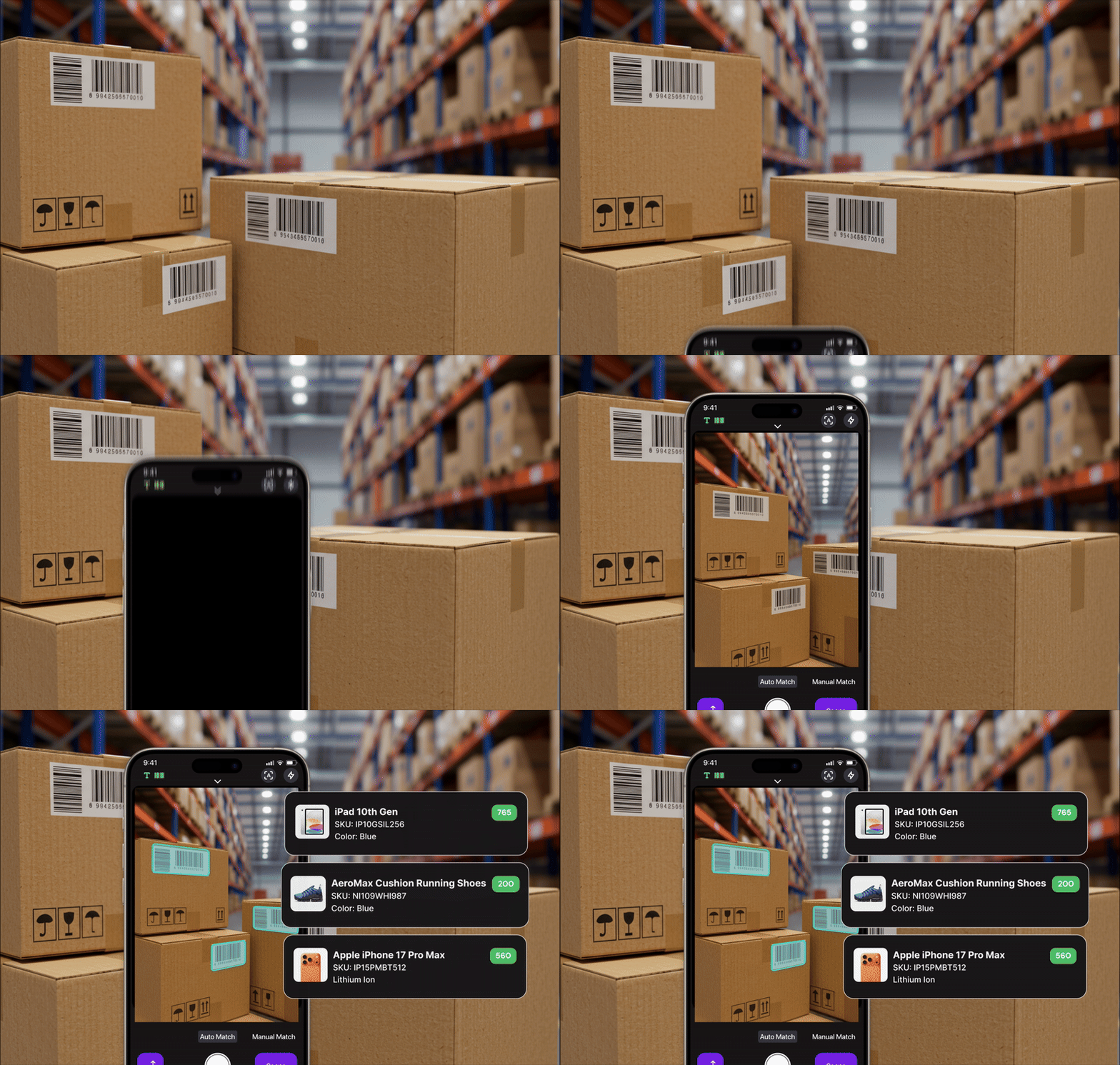
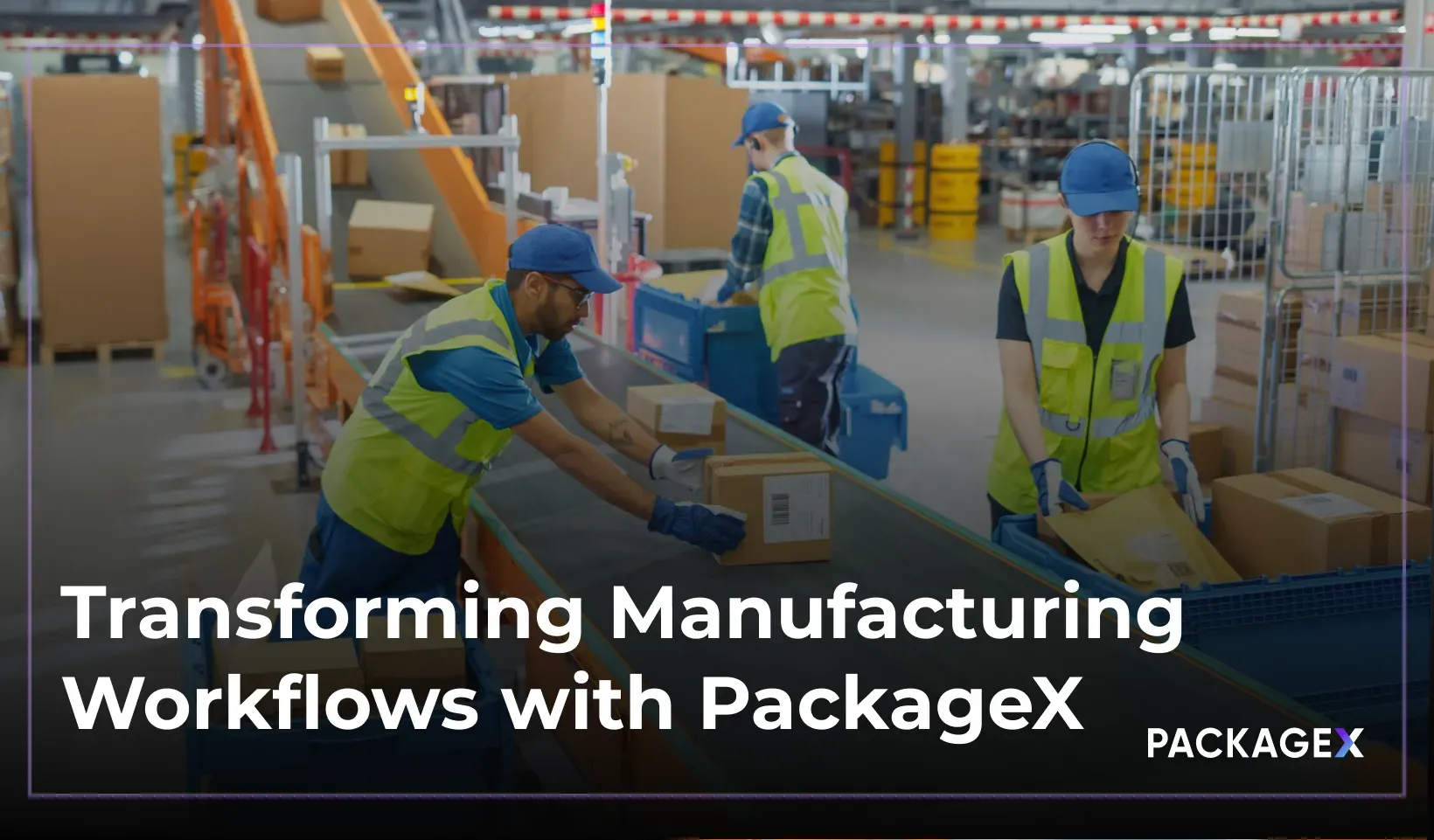
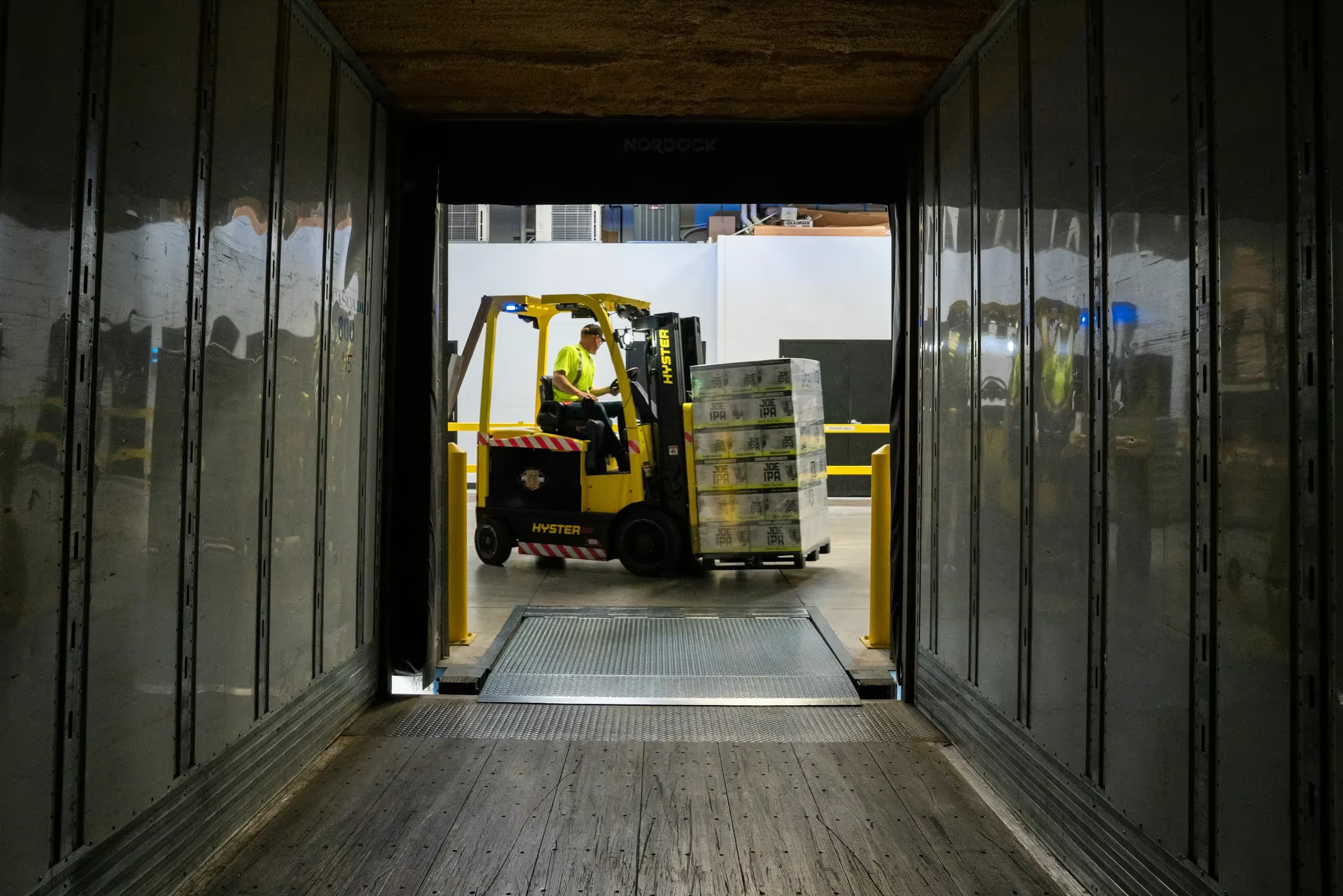
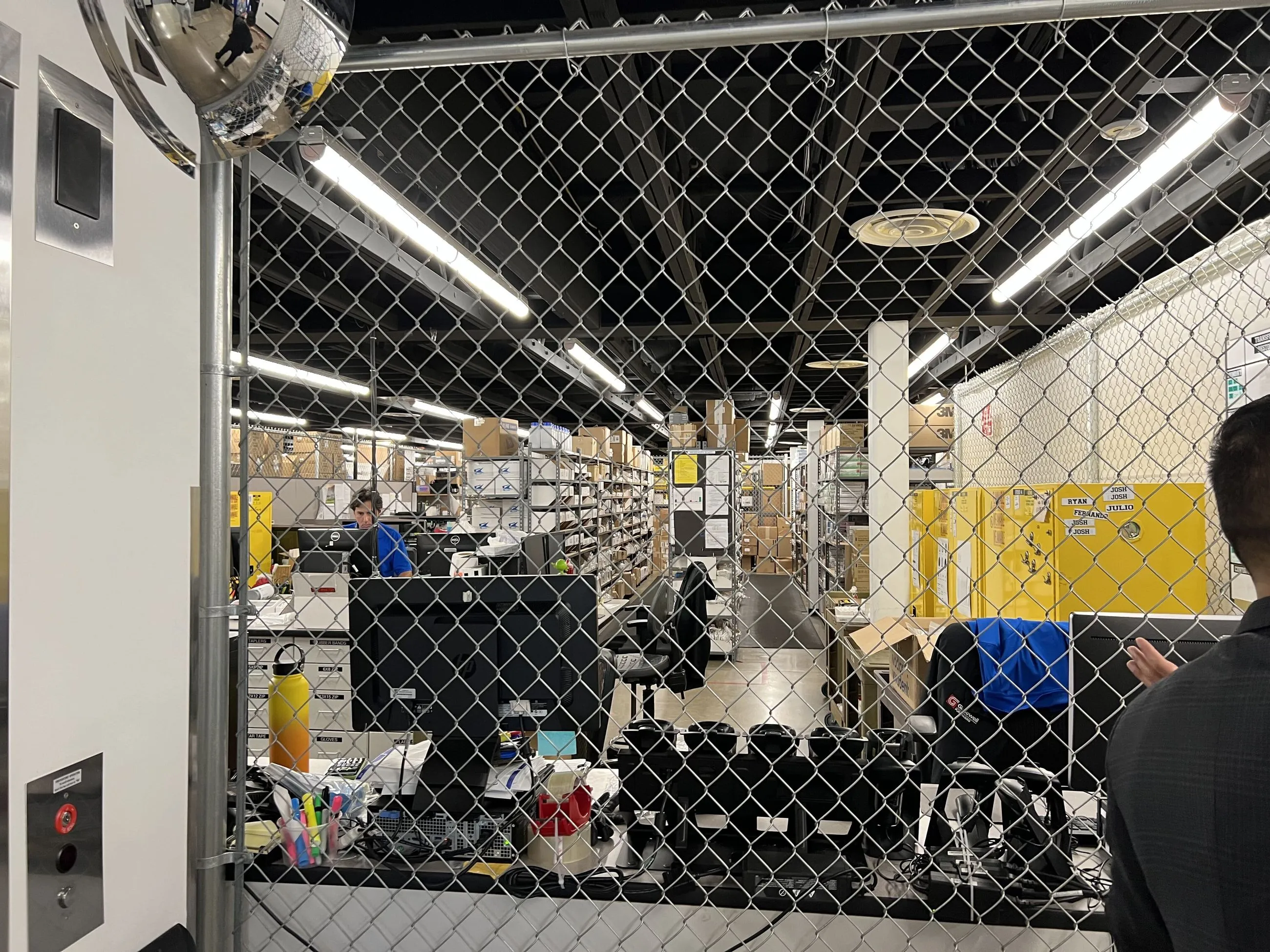
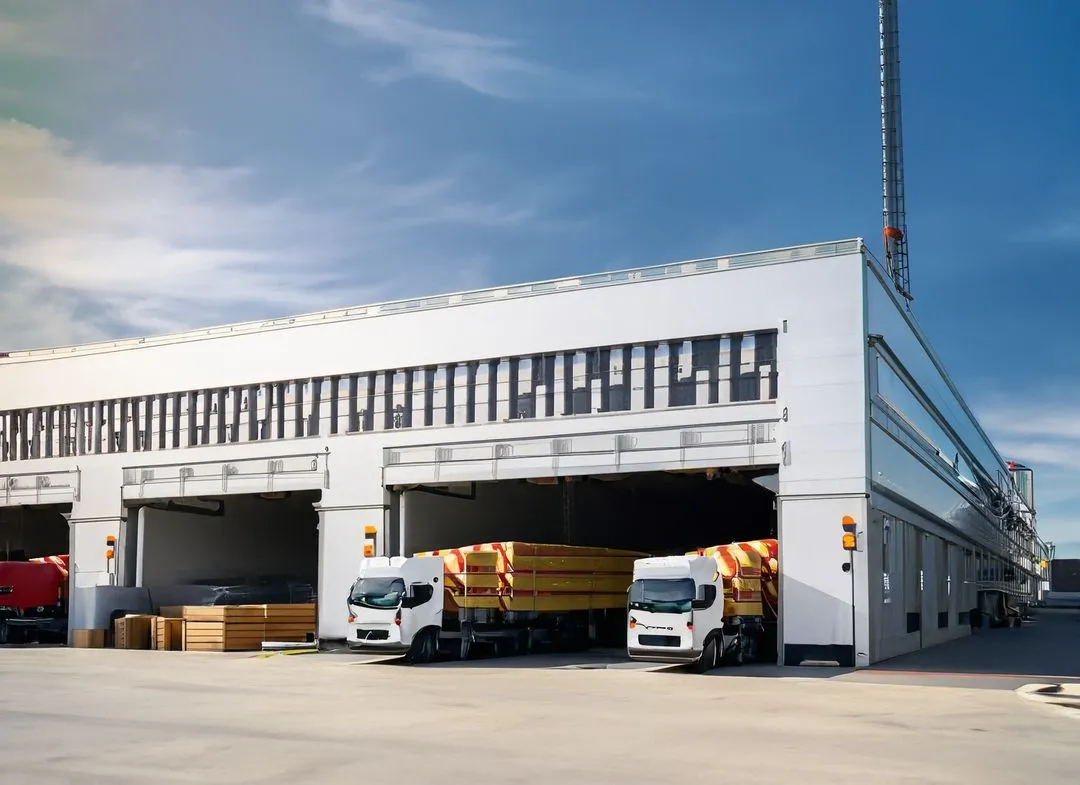
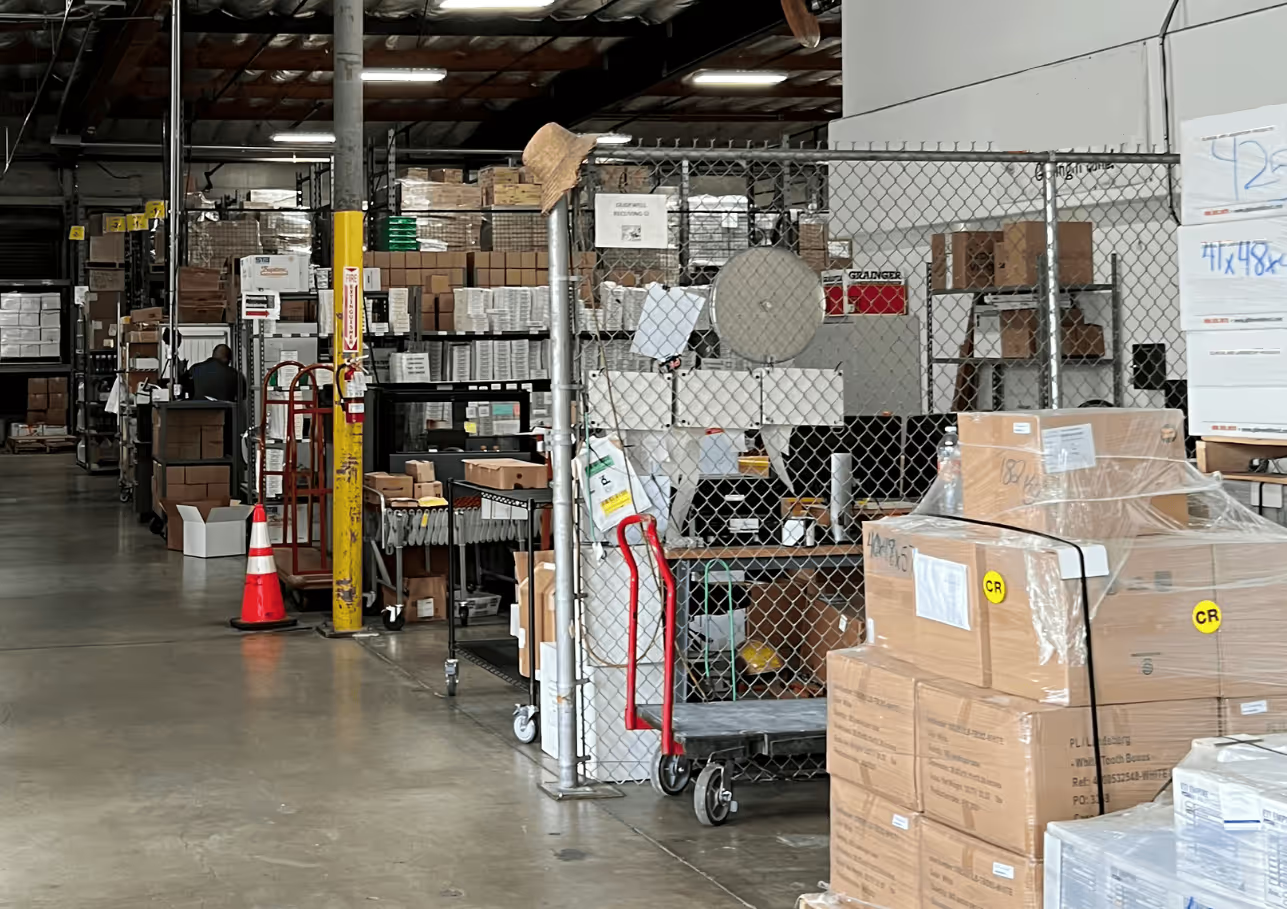
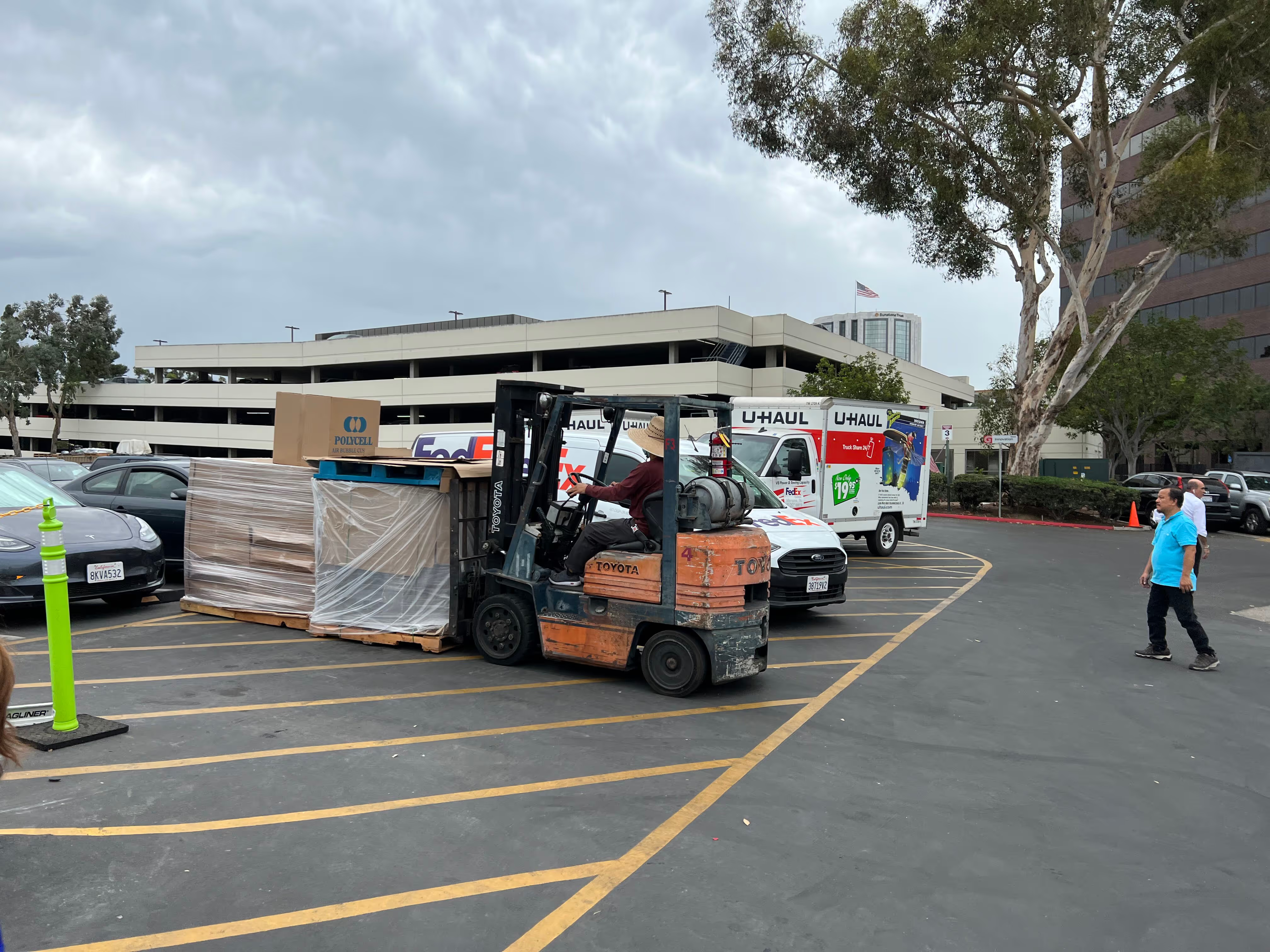
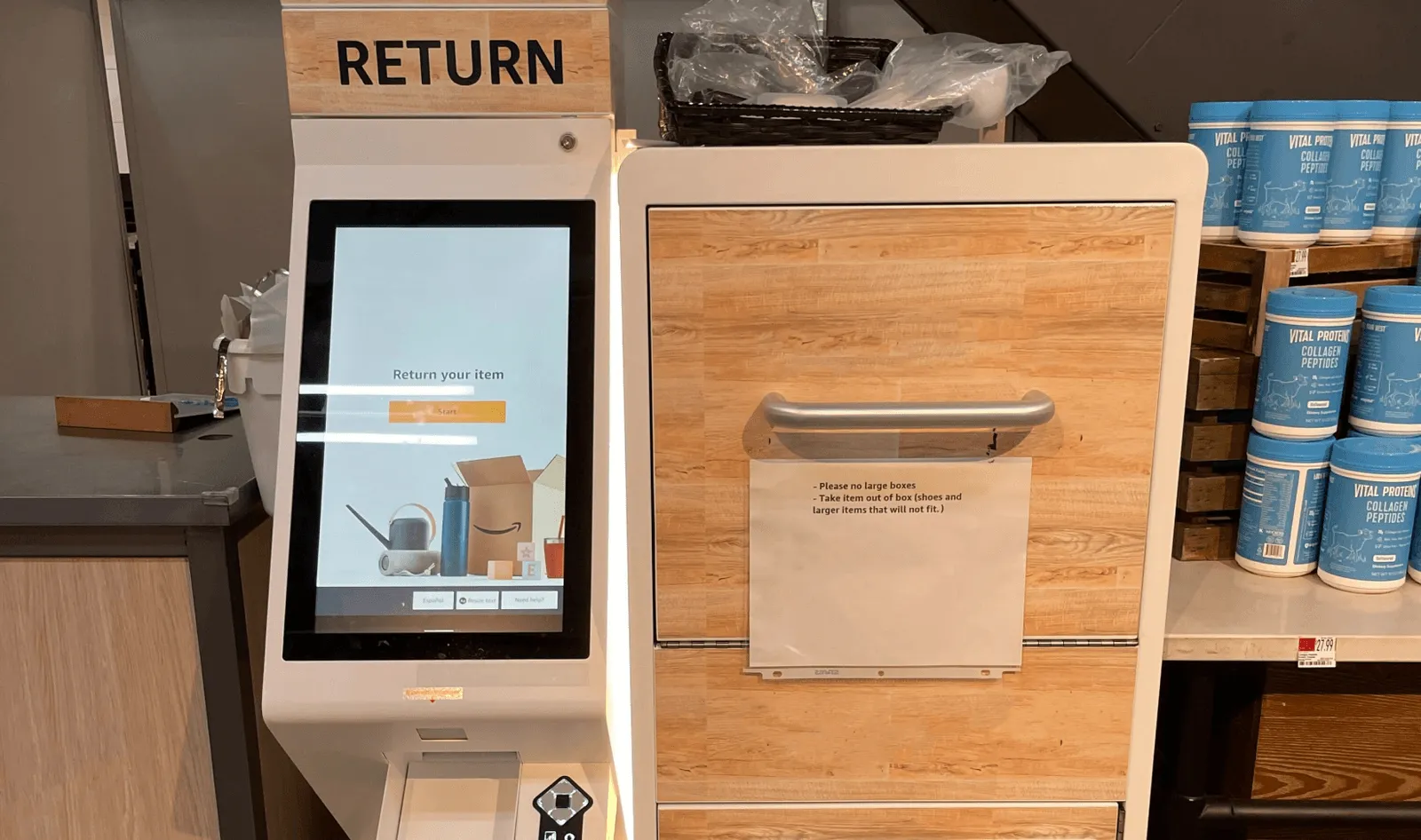
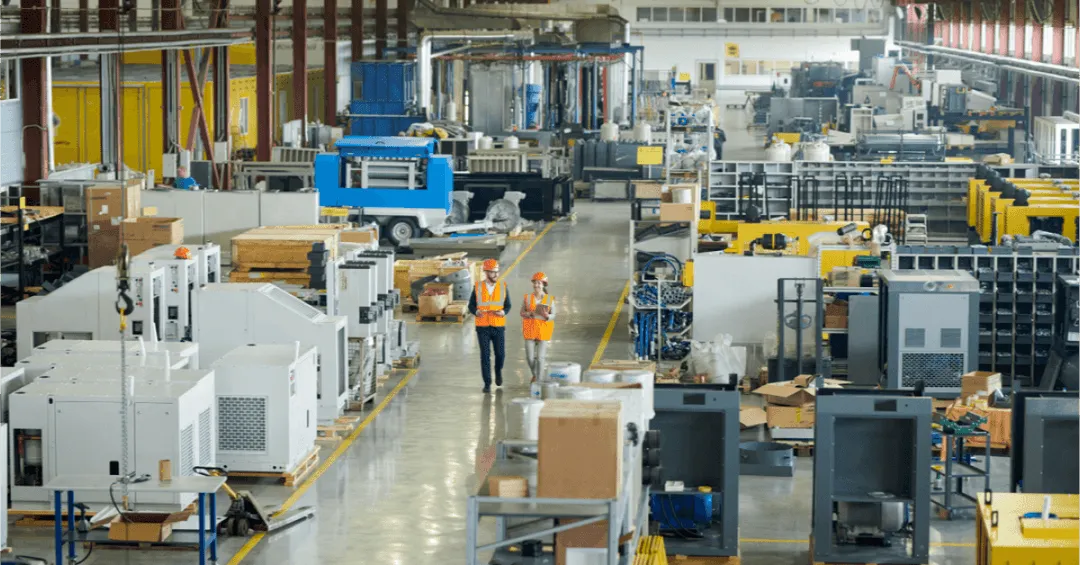
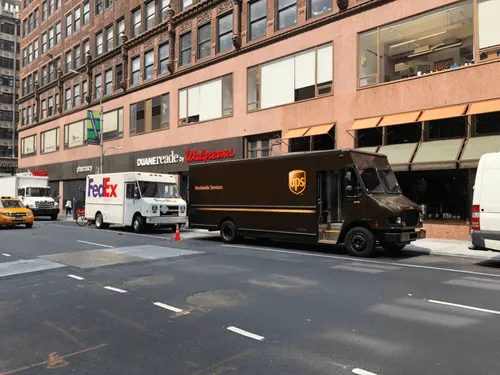
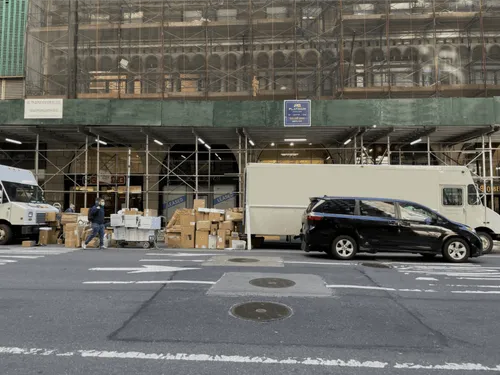
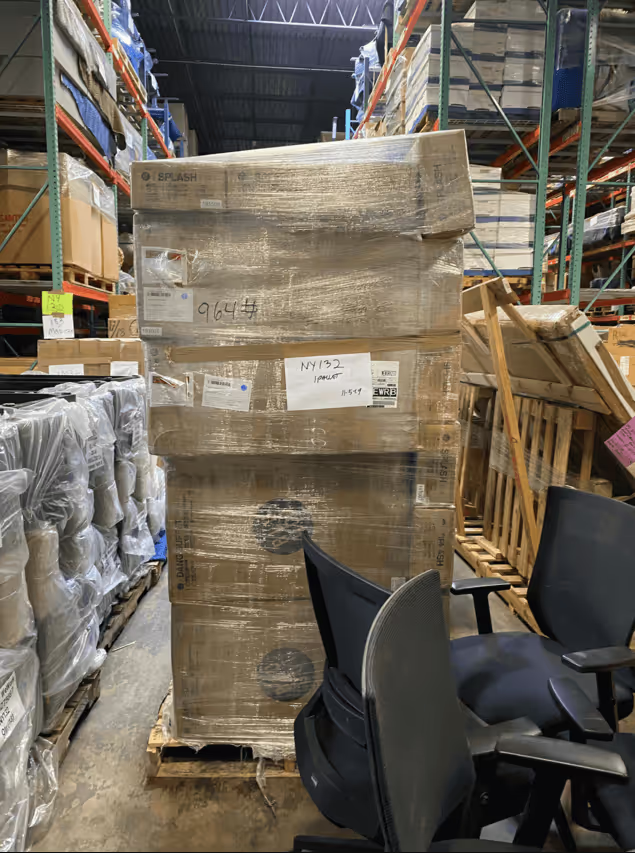
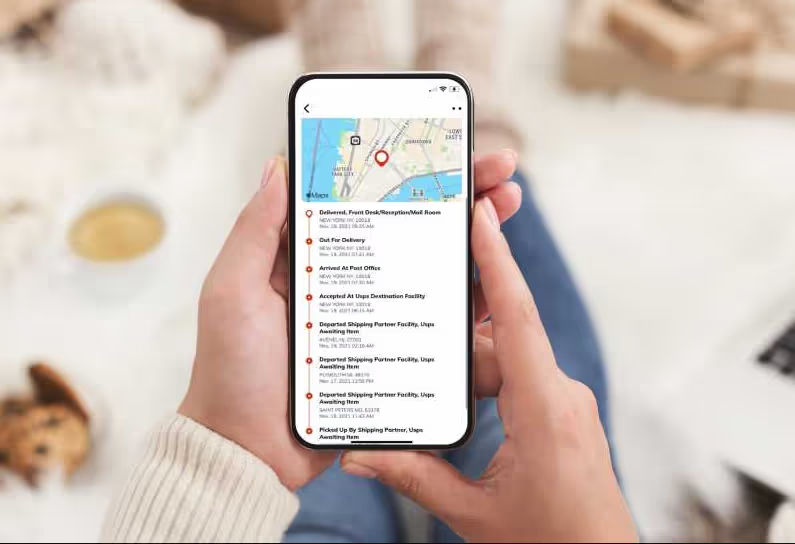
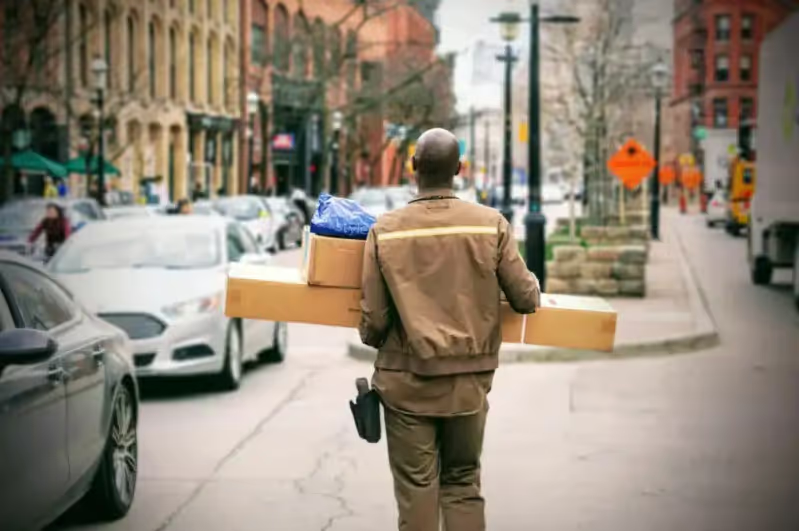
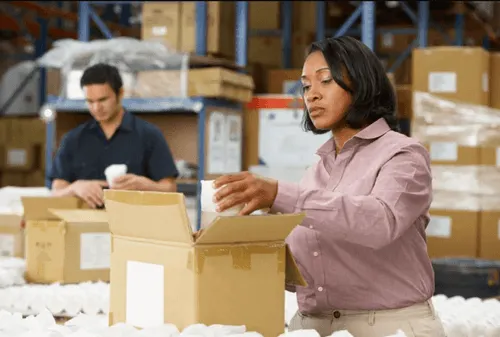
Manufacturing and logistics are two crucial aspects of the industrial world. However, they have become even more important with the increasing global trade, demand for goods, and eCommerce growth. Therefore, manufacturing sites must streamline their logistics operations. There are nearly 638, 583 manufacturing businesses in the USA, which is 1.4% higher than the previous year, i.e., 2021.
Logistics 4.0 is rapidly advancing and driving the digital transformation of businesses. Similarly, strict customer demands for quick deliveries also call for digitization in manufacturing logistics. In such circumstances, manufacturing sites need to overhaul their logistics model if they want to survive in today's competitive market and meet customer demands. In this article, we will explain five simple ways manufacturing sites can adopt to unlock their logistics efficiency.
What Is Manufacturing Logistics?
Manufacturing logistics refers to managing the transportation and storage of materials and finished products in the manufacturing plant. It includes several activities, such as transporting raw materials to the production plant, finished products to the warehouse and customers, and managing inventory levels.
Ways to Improve Logistics Efficiency
In this section, we will discuss five critical ways manufacturing sites can strengthen their supply chain and improve logistics efficiency.
1.Get Rid of Spreadsheets
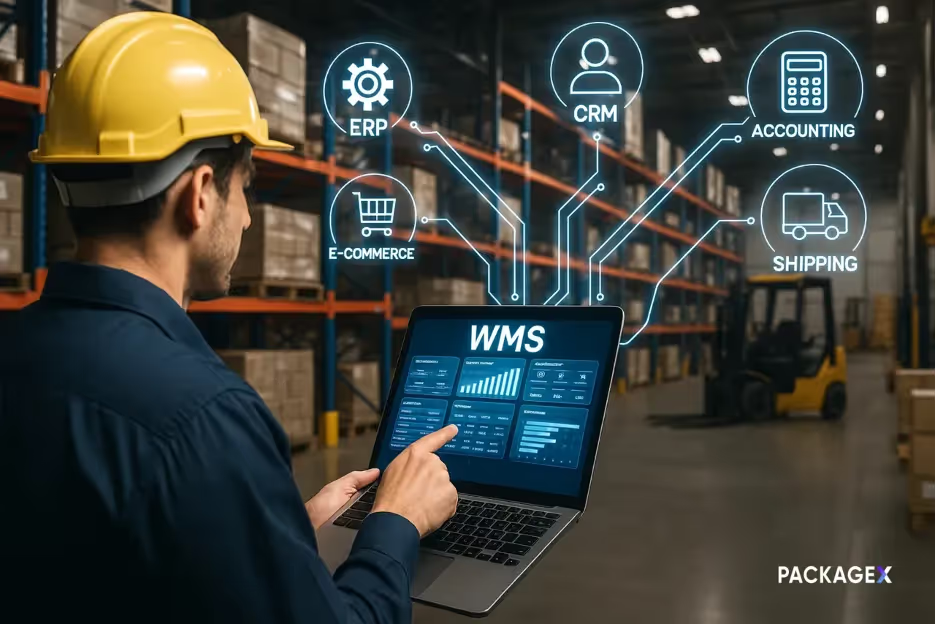
Manufacturing sites must ditch spreadsheet or Excel models and embrace digitization in the supply chain. Every step of the supply chain should be digitized, from ordering to production and logistics. Having a centralized and integrated solution for production and planning breaks functional silos in a cross-organizational manner. Also, it simplifies gathering, sorting, and analyzing data for manufacturing companies and sites.
By relying on spreadsheets, the manufacturing sites become stiff and less agile because predictive planning and visualization are hard to engage with static data sets. Through digitization, you can incorporate dynamic data sets, which provide manufacturing sites agility and end-to-end visibility.
2.Deploy Modern Technology to Process Packages
Manufacturing sites have to process thousands of packages daily. Having outdated or legacy systems that involve manual data entry creates challenges, consumes a lot of time, and affects the staff's productivity. To increase logistics efficiency at your manufacturing site, you must invest in a modern, smart, and easy-to-use technology that automates your logistics operations.
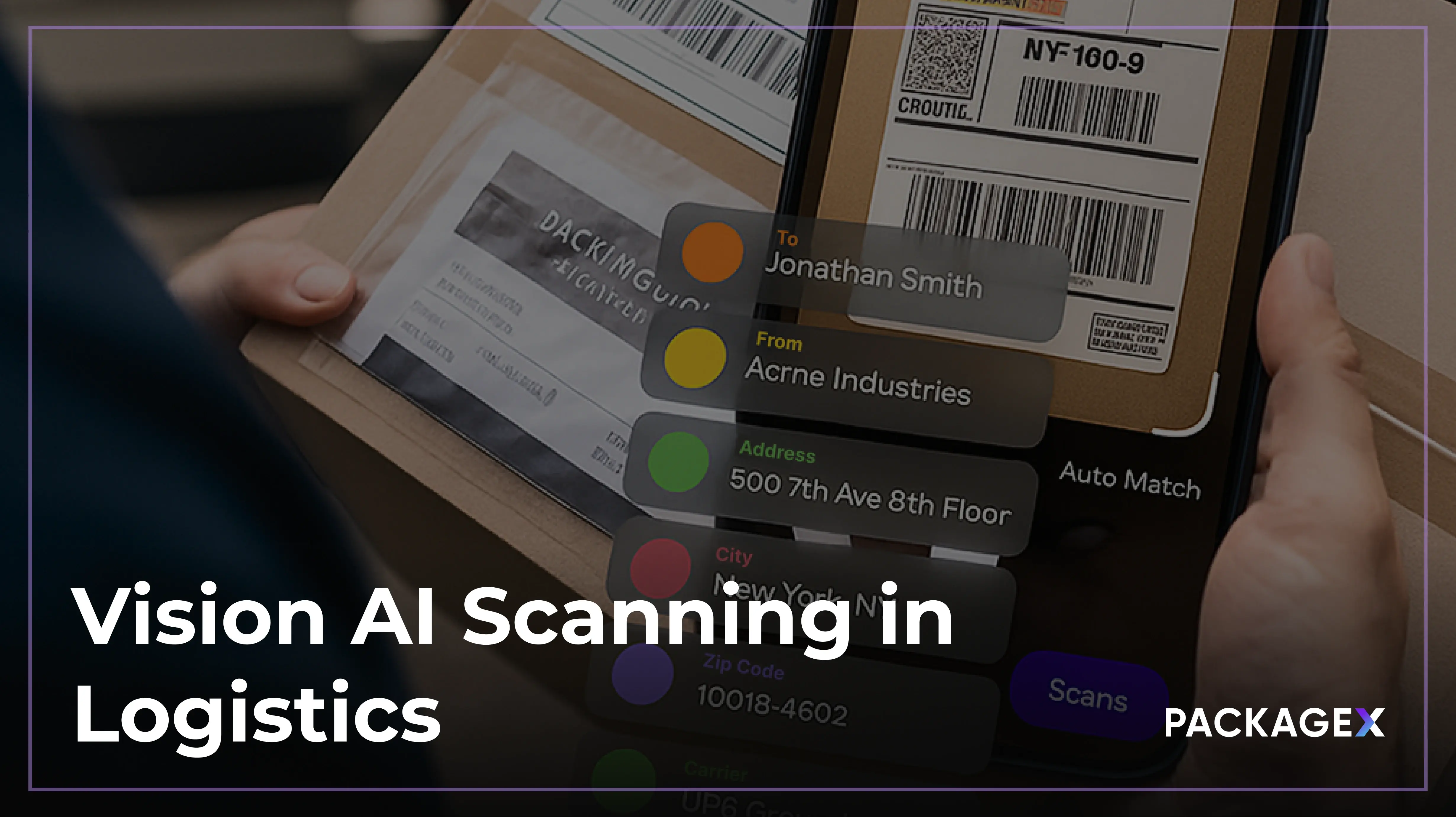
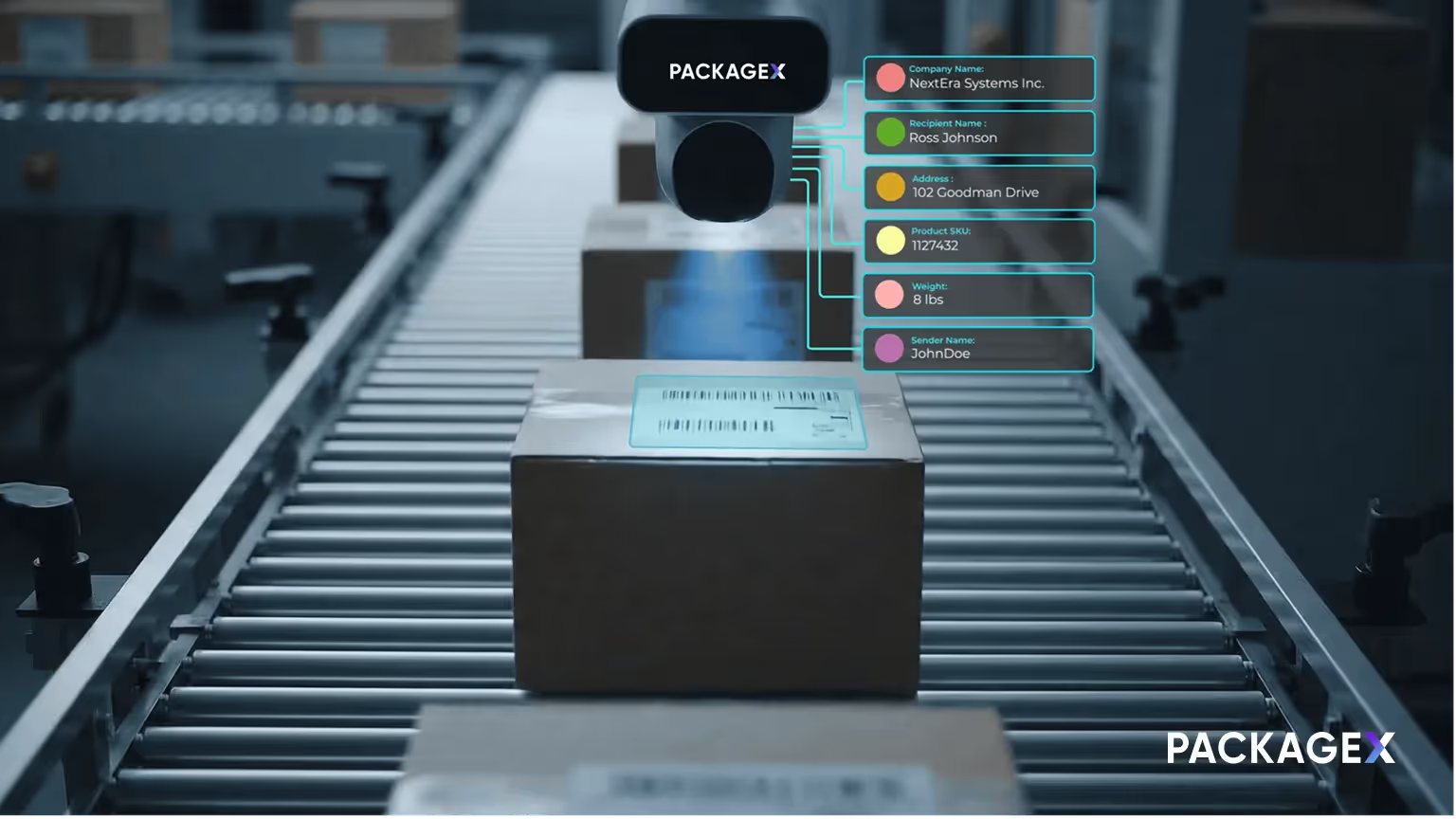
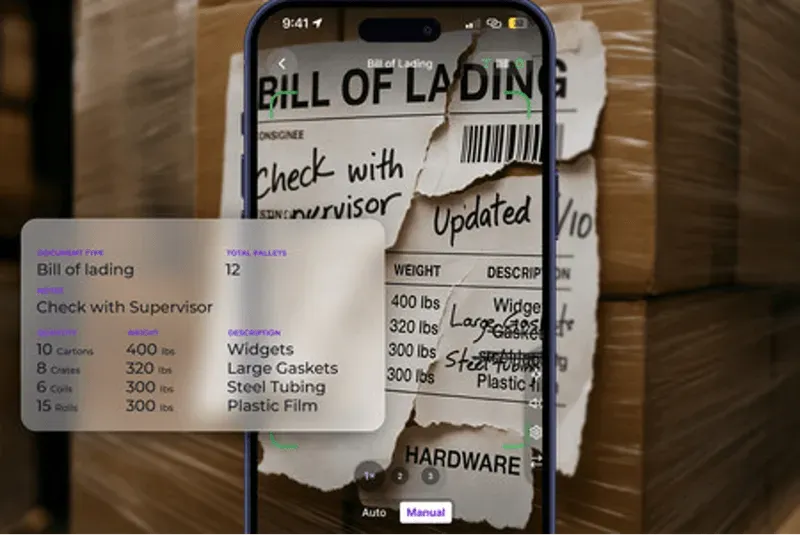
Receive is a package management software that processes inbound deliveries within seconds at any receiving site. It automates all the package receiving operations, such as label data ingestion, notifications to the recipients, package storage, forwarding, pick-up, and retrieval. You can package labels with our AI-powered label OCR and auto-ingest package data into the system with up to 100% precision. Moreover, it allows you to map various steps of your receiving process.
3.Get a Smart Package Shipping Solution
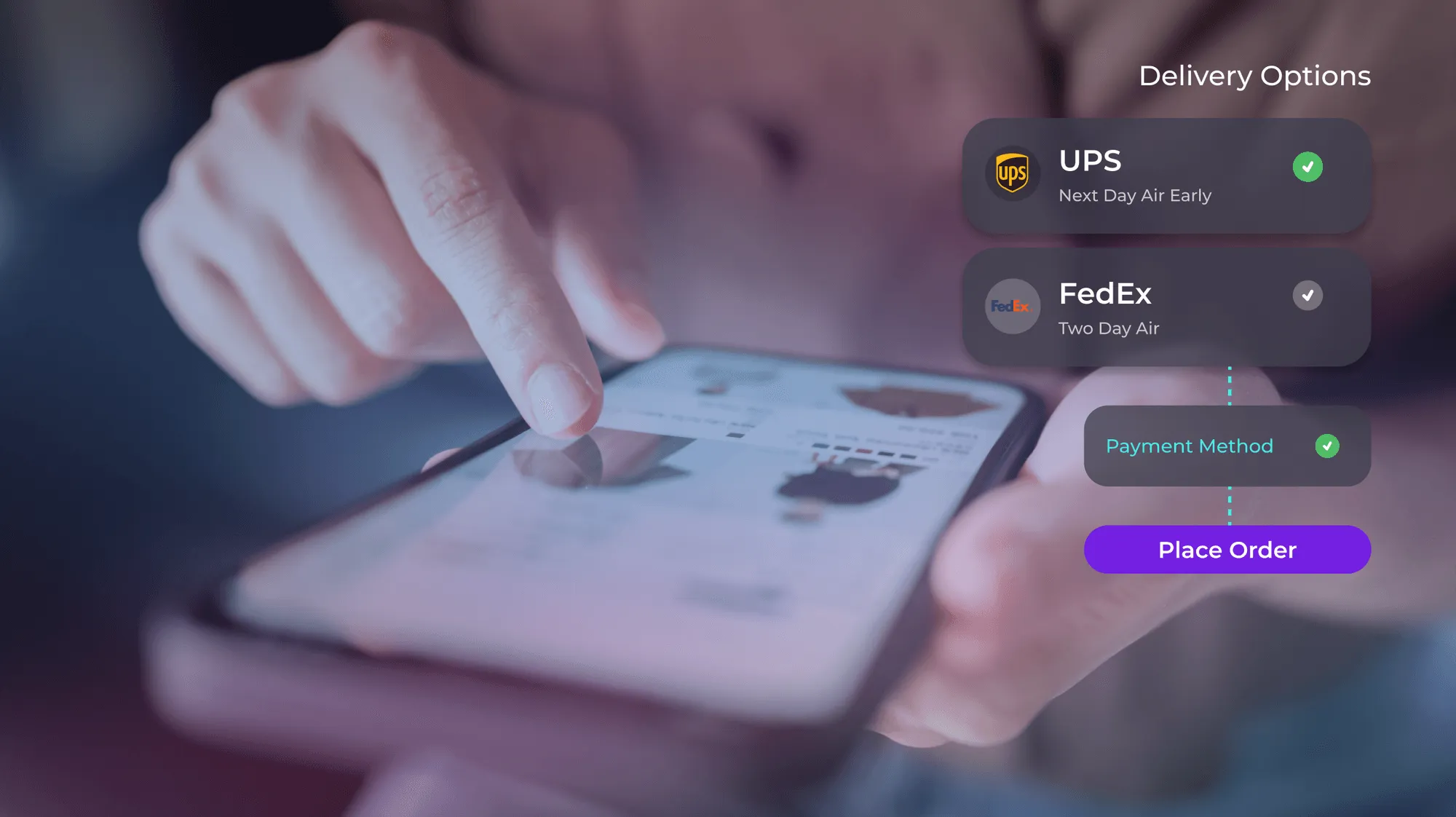
Shipping is one of the most crucial processes at manufacturing sites. Therefore, it is necessary to have optimized and intuitive shipping software that simplifies the process. Ship is one such shipping platform that automates your label generation and lets you generate and track shipments in one place. It has a network of 100+ carriers and on-demand couriers that you can choose for shipping after comparing their rates.
4.Automate Manufacturing Inventory Management
Another best way to enhance logistics efficiency at manufacturing sites is automating inventory management. Managing inventory levels can be a challenge at manufacturing sites. Production schedules and customer demand can fluctuate, making it difficult to maintain sufficient stock levels. As a result, disruption can occur in production.
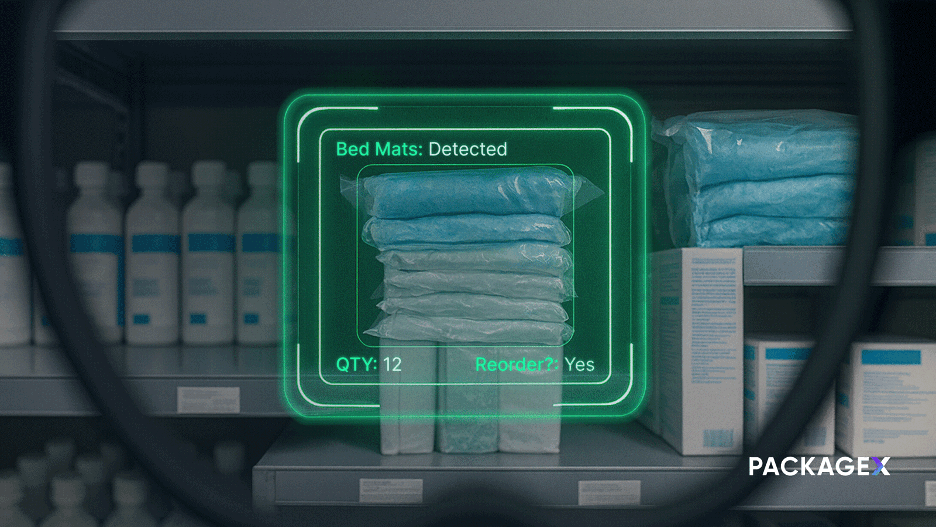
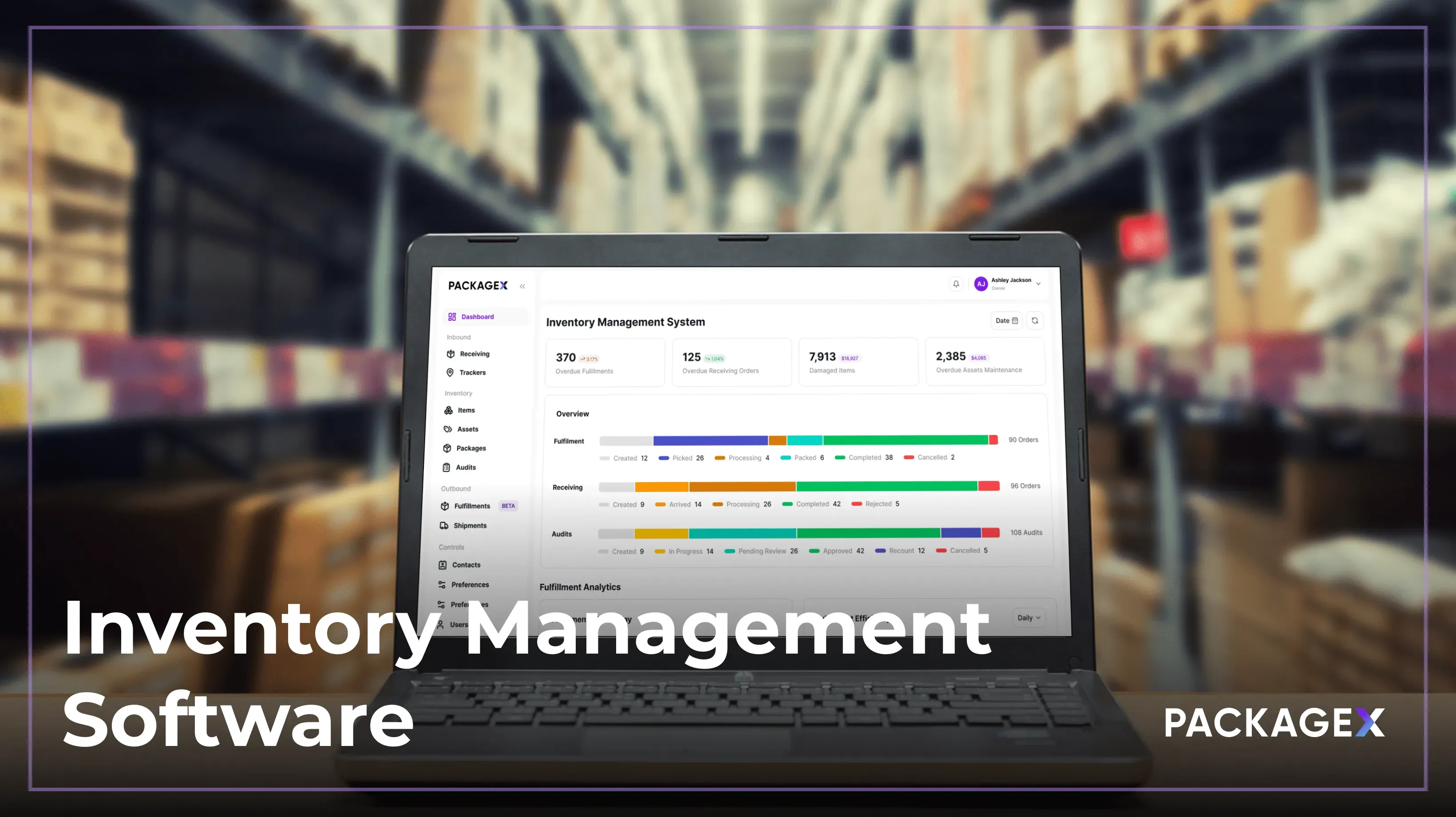
The primary goal of inventory management is to have the right inventory level all the time without any stockouts or excess inventory. PackageX Inventory streamlines inventory workflows for your manufacturing site to increase productivity, efficiency, and visibility. With a digital log of inventory, manufacturers can plan the production process in a streamlined manner and improve their inventory management. Moreover, you can automate your package storage and retrieval workflows with our manufacturing inventory management software.
5.Foresee and Mitigate Disruptions
In today's global economy, a manufacturing company is stable and productive if it can forecast, mitigate, and combat possible disruptions or breakdowns. Manufacturing companies must be able to predict when disruptions occur and take necessary steps to avoid them. It can be done through real-time reporting, data gathering, simulations, forecasting, and creating actionable plans to prevent breakdowns in the future.
{{returns-webinar}}
Conclusion
The manufacturing industry nowadays is up against a flexible and diversified landscape. To provide efficient customer service, all the gears of manufacturing logistics must fit together. It is only possible when you introduce automation to your logistics operations, increasing efficiency and productivity. You can avoid interruptions to your manufacturing site operations through integrated tools to process and track mail, packages, and inventory with PackageX apps. In addition, you can build custom apps for your manufacturing site logistics operations using our APIs.
Higher education is a substantial industry in the U.S., home to nearly 6,000 colleges and universities that spend millions of dollars annually to deploy, maintain, and upgrade campus technologies and systems. Most of their technology systems have been in place for years, are outdated, and operate in silos. The campus technology ecosystem requires a much due overhaul due to multiple waves of changes in behaviors, expectations, technology advancements, adoption, and the accelerated demand for secure and reliable digitalization. One perfect example is campus mailroom logistics systems.
Most educational institutions are scrambling as their conventional mailroom management systems cannot keep up with the influx of 3-5x more packages and deliveries due to the rise of eCommerce and hybrid learning. A mid-size U.S. University receives ~120,000 packages annually for students and faculty. One of the biggest reasons for this growing package problem is the increased online shopping trend among students, especially after COVID-19 halted brick-and-mortar commerce.
Almost 96% of students have smartphones, purchasing everything online from food and groceries to electronics and dorm room supplies. Hence, students are the key players in the online shopping boom that has cramped the university mail services and package centers.
So, what is the way out?
The answer is simple. Tech-enabled digitalization and automation!
Digital shopping is here to stay. You cannot change the shopping behavior of students, faculty, or staff members. Therefore, universities and colleges must upgrade their mailrooms to have streamlined and less intensive workflows.
The Scale of the Package Problem
The global coronavirus pandemic has exacerbated the growing package dilemma, posing serious productivity and efficiency problems. Typical university mailrooms are not designed to deal with the package volume eCommerce has created. Global eCommerce sales are expected to exceed $5 trillion in 2022, surpassing $7 trillion by the end of 2025. College students maintain a sizable portion of the market with a spending power of $593 billion.
In 2022, 110M packages will be shipped and delivered daily in the U.S. compared to the 56M packages transporteda year ago. Educational institutions process a significant portion of these packages (in millions). Disproportionately high package volumes affect the mailroom staff, expectant students, and faculty members.
Recent data from PackageX systems indicate that Universities & Colleges receive an average of two packages per month per student or a faculty member, excluding paper mail. This translates into thousands of packages that university mailrooms must process every month for thousands of students and staff members. In 2021, approximately 506,654 packages were scanned in higher education shipping facilities using the PackageX platform. These numbers are starting to snowball as the world returns to normal.
Current State of Campus Mailrooms
Let’s take the example of Delaware University, a non-profit university located in Doylestown, Pennsylvania. Its package deliveries have recently increased by 20% per academic year, and its manual barcode scanning systems were too slow to handle the university package volume efficiently.
Likewise, Georgetown University Mail Services Department also reported delays in package processing as the number of packages they received increased at an unprecedented rate. Since the semester began, they had to sort through almost 3,000 packages per day.
The Pennsylvania State University also faced a similar situation when welcoming students back to campus. Some of their university mailroom employees estimated they were receiving 800 to 1,000 packages daily, a drastic increase from previous years.
The University of Dallas is another private university in Irving, Texas, experiencing the growing tidal waves of package influx. Their final package count for 12 months was over 30,000, translating into ~2,500 packages per month on average. They also struggled with outbound shipping because of the truly expensive rates for annual software and hardware required by their previous system.
It clearly shows the current state of campus mailrooms or shipping centers and how they grapple with antiquated and labor-intensive manual processes to perform inbound and outbound logistics operations. Legacy mailroom and logistics platforms currently available in the market still rely on on-premise desktop software and traditional barcode scanners for shipping and receiving. These platforms scan a barcode, require manual recipient matching, and send only one notification per package, making the process more complicated and vulnerable to errors.
Moreover, a signature is required upon parcel pick-up, and the user interface of these systems is not designed for productivity and efficiency. To generate a shipment, you have to manually fill many fields that make shipping burdensome. Also, the shipping carrier options are minimal and costly.
And the list goes on…
A Growing List of Challenges
Once a package is received at an institution, it is the mailroom’s responsibility to get them out of the mailroom and into the right hands. The majority of Universities & Colleges in the U.S. still rely on pen & paper methods or outdated, legacy, and vulnerable systems to process inbound packages or inventory. Likewise, they rely on bulky hardware and obsolete solutions for outbound shipping and forwarding.
As a result, the list of challenges they face in package management keeps growing, including the following:
Thousands of hours to manually process packages, shipments, and deliveries every month, including manual data entry, managing paperwork and logs, generating labels, planning deliveries, answering inquiries, and performing inefficient retrieval. It is not only error-prone but also slows down the entire process.
Lost, delayed, and misplaced packages lead to liability issues and losing important documents and checks that are very hard to replace.
Inefficient package logistics operations lead to poor tracking, visibility, and pick-up experiences for students and faculty members.
Higher expectations of students, parents, and faculty. They demand fast and error-free notifications and deliveries.
Lack of storage space as university lockers and mailrooms cannot accommodate the massive package volume of recent times.
Outdated and complicated systems for outbound shipping that not only have expensive rates but also have limited shipping carrier/courier options.
Lastly, data privacy and cybersecurity are increasingly critical, and continuous reliance on legacy systems could lead to major catastrophes.
It’s Time for Campus Mailrooms to Get an Upgrade
With a massive increase in package volumes, labor shortages, cyber-threats, and increased focus on digitalization, modernization, and automation, the forward-thinking educational institutions are already deploying modern, unified, secure, and reliable logistics platforms at college & university mailrooms for increased efficiency, higher productivity, greater visibility, and a superior experience for staff, faculty, and students.
Universities should invest in tech-forward solutions like PackageX to handle the daily influx of packages and deliveries. The PackageX platform solves several pain points for campus mailrooms as it moves you from outdated, legacy, and vulnerable systems to a modern logistics platform with easy-to-use apps, intelligent workflows, and APIs to perform receiving, shipping, internal routing, inventory, and tracking operations on campuses.
How Can PackageX Help?
PackageX Apps and APIs offer a variety of benefits to schools, colleges, and universities on a simple, modern, unified, and connected platform. Some notable benefits include the following:
92% faster receiving per package or inventory item.
50% reduction in package pick-up time.
Generate shipping labels at the best rates from multiple providers in less than 100 seconds.
Ship same-day via local delivery providers of your choice.
Turn your package operations into a profit center through a self-service shipping kiosk.
Achieve end-to-end inventory visibility.
Perform intelligent staffing.
Get enterprise-grade security and end-to-end encryption.
Access to many other great features like self-service pick-up, locker integrations, etc.
{{returns-webinar}}
Key Takeaways
Educational institutions cannot overcome the package conundrum with the same old package management systems using outdated hardware. We live in the digital era where technology is changing the shopping behaviors of students, and eCommerce sales are skyrocketing. Also, this change is here to stay, creating two major problems.
First, it frustrates the students, faculty, and administrators who do not get timely deliveries because campus mailrooms take too long to process packages. Second, as the mailrooms slowly sort and log packages, their backlog increases. The bigger the backlog, the more space packages take up on the shelves. As a result, it becomes hard to physically retrieve packages when it's time to hand them off to the recipients.
This cycle can be broken by opting for more intuitive and digital solutions that speed up parcel processing, reduce liability issues and send timely notifications to the recipients. The faster a package is logged, the quicker the recipient retrieves it, freeing a lot of time and space in the campus mailroom.
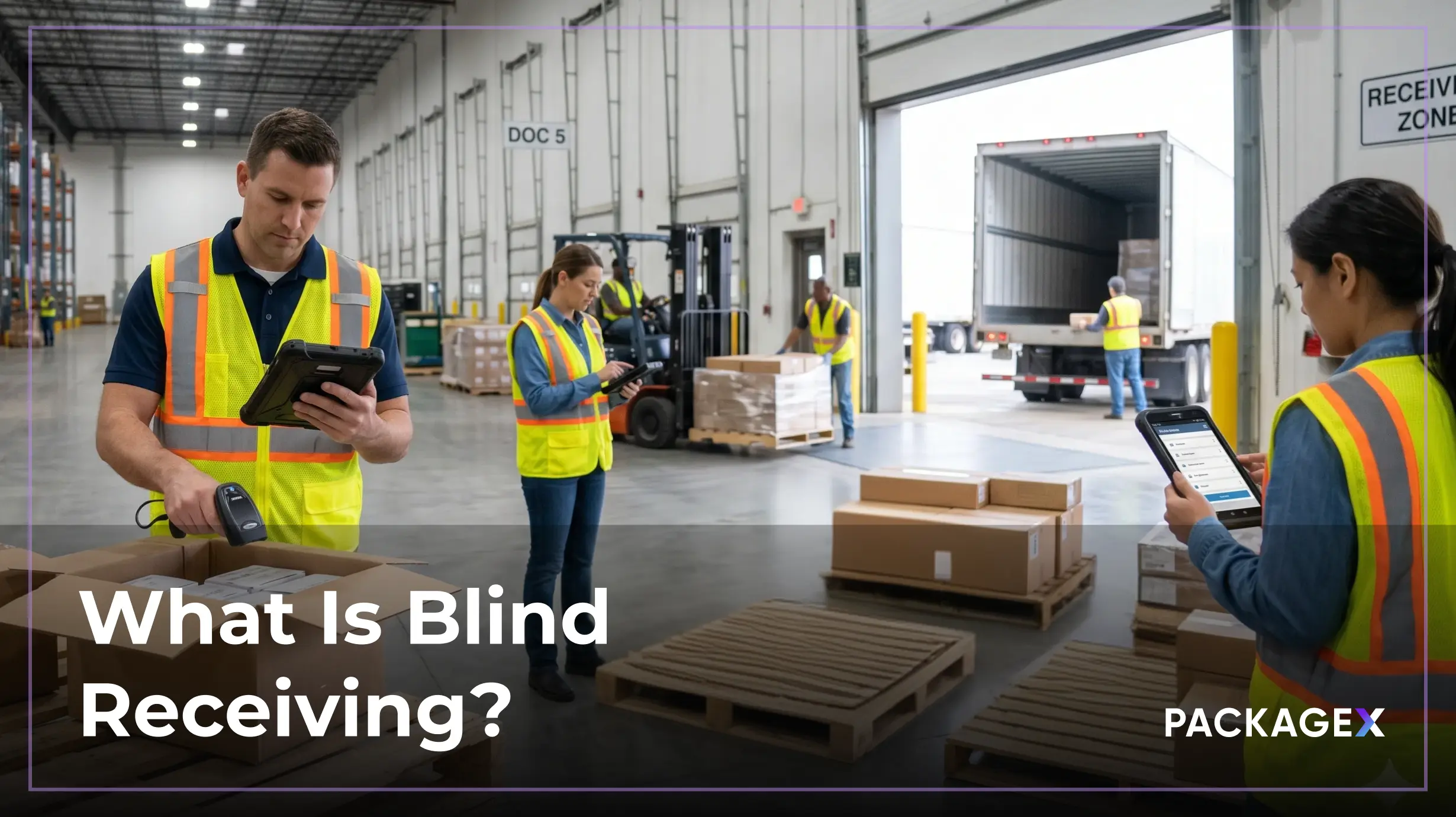
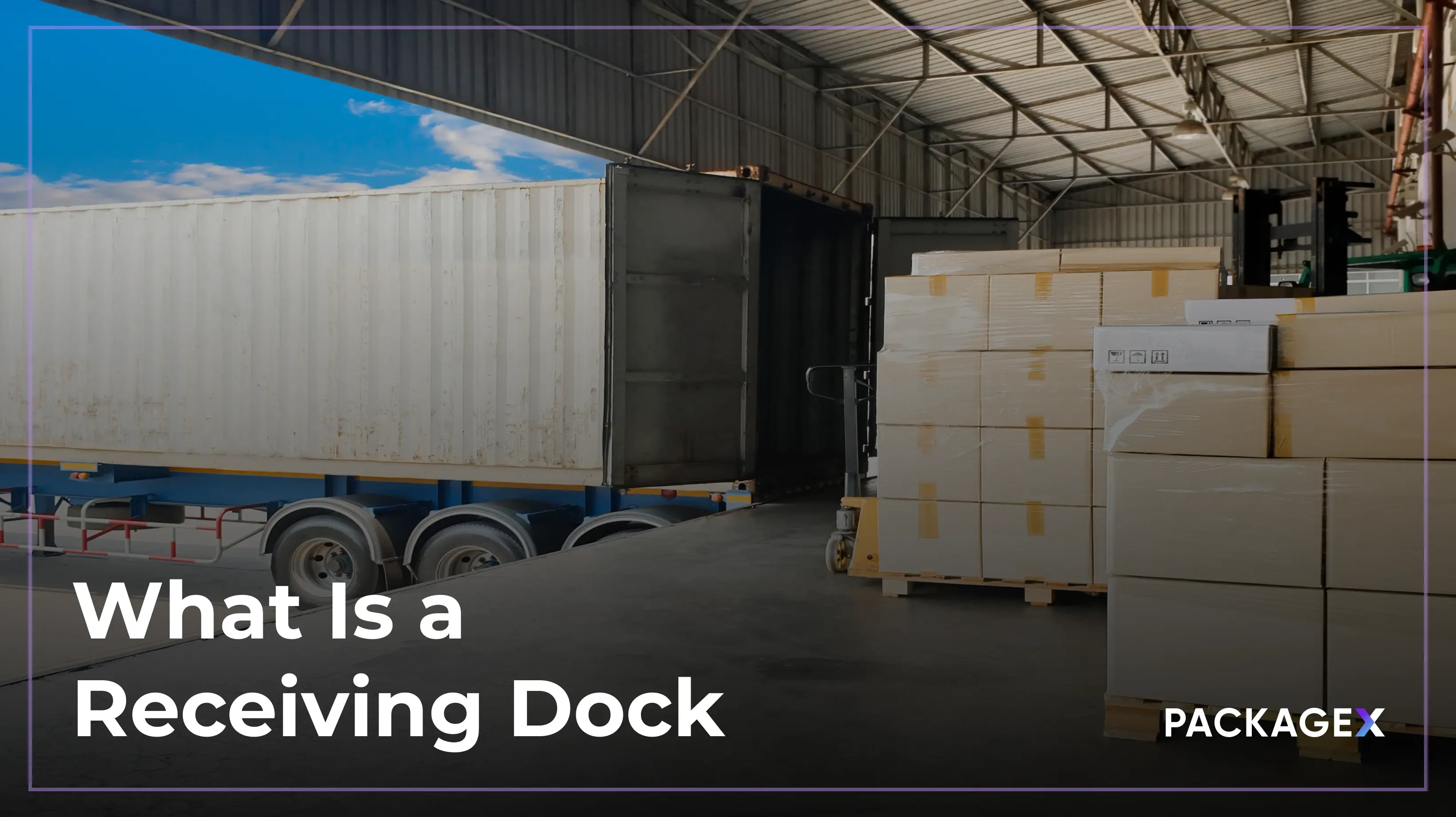
Did you know most warehouse inventory errors occur in receiving? Any error in the receiving can have a 10-fold impact on the other warehouse operations. Storing inventory in a warehouse is a comprehensive process that must be done correctly to ensure the success of fulfillment operations. How a business receives inventory in a warehouse affects other areas of the retail supply chain, such as inventory management, picking, packing, and shipping. A poor warehouse receiving process can cause stock control issues and high operational costs.
It indicates that receiving in warehouse is a critical part that maintains the integrity of the inventory systems and ensures the product availability to the customers. As per a survey conducted by Peerless Research Group, warehouses’ receiving dock and storage areas are the most congested zones. Therefore, businesses must invest in warehouse automation to optimize the receiving processes. In this article, you will learn about the warehouse receiving process in detail and some valuable tips to improve the receiving operations.
What Is Warehouse Receiving?
It is the first step of an eCommerce order fulfillment process and refers to the delivery, unloading, and storage of inventory in a warehouse. A well-maintained receiving process makes inventory management and fulfillment simpler, cost-effective, and efficient.
Warehouse receiving is beyond purchasing inventory and delivering it to the warehouses. It comprises several key steps that must be performed accurately so that the right items in the right quantity can be stored and delivered. The standard warehouse receiving procedures include the following:
1. Completion of Pre-receiving Tasks
Every business owner should complete all the pre-receiving tasks like proper documentation before sending inventory to a warehouse. At this stage, you decide the quantity of each item and the number of countries in which it will be shipped. Also, you determine the packaging requirements of each item, including labeling criteria, the number of packages loaded per pallet, and package size or weight.
2. Receiving and Unloading Stock
In the next step, the warehouse receiving staff meets the shipper and unloads the cargo. The receiving staff of any warehouse should discuss their shipment-related concerns with the delivery driver. Typically, the trucks should be packed in reverse order from back to front so that warehouse workers can quickly unload the inventory. Sometimes, you might require equipment like forklifts or pallet jacks to unload the cargo.
3. Counting and Confirmation of Inventory
Once the cargo is unloaded, the staff at the receiving area verifies the content of each delivery, such as the quantity, the SKUs, the overall condition of the shipment, and the integrity of the seals. Stock counting and inspection is a time-consuming process that can be automated through inventory management software.
4. Organizing and Storing Inventory
The final step of receiving in warehouse is inventory storage and organization. It is done once all the inventory is unloaded and confirmed. However, this step is performed differently for each business based on the type of its warehouse, the size, and the number of items.
Generally, the inventory is stored on a palette, shelf, or bin, depending on the size and quantity of products.
How to Improve Warehouse Receiving Process?
There are numerous ways to optimize warehouse receiving process. One of the best ways is to invest in warehouse automation because it optimizes all the time-consuming tasks typically performed manually by workers. Also, the global warehouse automation market is expected to surpass $30 billion by 2026, indicating that warehouse automation is the key.
Below are some best practices you can implement to streamline receiving at your warehouse.
Use Inventory Management Systems
If you are an eCommerce business owner, inventory management systems can optimize your entire supply chain by automating the receiving process. By deploying an inventory management system, you get valuable insights into inventory counts and stock levels. Also, it helps you get accurate numbers for inventory accounting.
Monitor Your Inventory Metrics
Tracking important inventory metrics is another way to optimize warehouse receiving. You can do it by using technology for inventory management. Some primary inventory metrics that you need to track include:
Average storage cost per unit
Total number of pallets or shelves in use
Amount of inventory stored at each location
Conduct Inventory Inspections
Regular inventory audits are essential to highlight serious inventory imbalances before they get out of hand. Sending damaged or incorrect inventory back can cost you a lot of money. Therefore, make sure each item is checked. Here, various inventory management tools can help you as they provide real-time updates on stock levels and make inventory tracking easier.
Document Verification
Another way to optimize the receiving process is to double-check all the documents. Make sure the receiving inventory matches the purchasing order.
How PackageX Improves Warehouse Receiving?
In today’s world, technology has changed the way businesses work and is driving them to become bigger and better. The same is the case with warehouses and dark stores. You cannot optimize receiving in warehouses without deploying the right technology.
PackageX helps business owners digitize warehouse receiving through its integrated apps and APIs. It provides you with a complete warehouse management system on a single platform where you can streamline all your inventory workflows, get real-time visibility for inventory tracking, map different steps of your receiving process and generate labels for efficient storage.
{{returns-webinar}}
Conclusion
Receiving is one of the most critical operations in warehouse logistics that involves the delivery, unloading, and storage of eCommerce inventory. By optimizing it, you can have more accurate stock counts, fewer stockouts or dead stock, and efficient storage for inventory. However, it is only possible when you invest in warehouse automation technology and follow the best practices to streamline the warehouse receiving process.
The eCommerce retail space has changed a lot. A few years ago, delivery expectations were low as customers were willing to wait up to 8-10 days to get their shipment. Back in 2005 when Amazon Prime launched 2-day shipping, it was considered an indulgent luxury. But this luxury changed consumer delivery expectations forever.
Consumers nowadays are increasingly discerning and have higher expectations regarding shipping. They want fast and cheap shipping options today. The data from a 2021 consumer survey revealed that 33% of the consumers have higher expectations for fast shipping and 42% of consumers expect 2-day shipping for their orders. However, shipping large and bulky items is a little trickier and complicated for several reasons. One of them is the overwhelming number of carriers that compete for your business. Choosing the right carrier that benefits you the most and fits your needs better than others for shipping large items can be challenging.
So, what should you consider when choosing a shipping carrier?
We have put together this guide to help you pick the suitable carrier for shipping heavy items and learn about the cheapest way to ship heavy items.
Three Major Carriers in the USA
Numerous carriers offer shipping services in the U.S., but USPS, UPS, and FedEx are the three major carriers delivering millions of packages each day. Let's look at some statistics showing the level at which these carriers operate.
4 Factors to Consider While Picking a Carrier for Shipping Large Items
Every business has a unique model and different shipping needs. The right carrier for you depends on the characteristics of your business. Therefore, it is better to consider various factors before choosing a shipping carrier from the vast list of options.
Below are the four major filters you should apply to your carrier picking decision.
1. Price
The shipping service price is the major obstacle that you need to address. The cost for shipping bulky items is comparatively higher, driven by the following factors:
Speed – How fast will the heavy shipping boxes be delivered?
Service - What level of tracking and delivery service is available?
Size – Is your shipment heavy or large?
Surcharges – Is there any additional fee.
If you want to ship large and heavy items faster with a higher level of tracking, you will have to pay more. Is your business model capable of subsidizing expensive shipping while earning a profit? Are your customers willing to pay more for shipping large items? Do you have to pay any extra residential fees or fuel surcharges? Only you have the answer to these questions as you are familiar with the realities of your day-to-day operations. Therefore, pick the carrier after thoroughly comparing their rates and services. PackageX Ship provides access to a variety of national carriers and on-demand couriers. Also, it allows you to view and compare their shipping rates based on the delivery time.
2. Delivery Expectation
The delivery expectations of the business also play an important role in deciding the carrier. You can choose a slower shipping service if you are running a monthly subscription-based business where you ship items on a predictable schedule. However, if you are running an eCommerce business, you must choose a carrier that offers fast shipping with better tracking and delivery confirmation. The target market in the retail and eCommerce industry expects to get orders in just one or two days. Therefore, invest in shipping carriers accordingly.
3. Shipment Weight
If you are shipping heavy items, the cost will go up automatically. An item weighing a pound or less can be shipped through USPS's First-Class Mail. However, for heavier items, you need to choose other costly services.
For instance, you need to ship furniture or equipment for lawn care. All these items are large and bulky, so you have to pay a high shipping cost. The right carrier and the service for shipping heavy items depend on the place from where you are shipping and where you need to ship.
4. Destination
The destination is also a significant filter to apply when choosing a carrier for shipping large items. Some carriers charge more if delivering heavy items to rural communities. However, some carriers hire local carriers to complete the last-mile deliveries. It directly impacts the shipping costs for businesses and their customers.
What Is the Best Way to Ship Heavy Items?
Enlisted below are some best practices for shipping large and heavy items.
Make sure your shipment is securely packaged and ready to ship.
If your items are placed on a pallet, ensure they are in good condition. In case your items are over 150 lbs and are to be shipped internationally, they should be secured to pallets with steel straps.
Use boxes that have stitched and stapled seams because they are stronger than those that are glued.
If your items are big enough, choose freight shipping over parcel shipping because it will be cheaper. Understanding your costs and how they will have an impact on your revenue is very important.
Shippers should diversify with multiple carrier options. Having multiple carriers or providing your customers access to various carrier options creates an optimum shipping experience at the right cost.
Every carrier has different rules. Choose the right carrier to ship large items by applying the filters mentioned above.
{{returns-webinar}}
Conclusion
Shipping large items is more complicated than shipping small and lighter ones. The higher cost, additional surcharges, weight limits, and dimensional weight complicate the process, but you can optimize it using a modern and tech-forward solution like PackageX. It offers apps and APIs that can streamline your shipping operations. You can generate shipping labels from various carriers and couriers in seconds and compare their rates before choosing the most suitable option.
Shipping costs usually eat a major chunk of your profit whether you are a small business owner or run a multi-chain company. As shipping rates for more oversized items vary from carrier to carrier, you should choose a carrier after in-depth research, making the right choice for your business.
Freight shipping is a common phenomenon of transporting goods, commodities, and cargo in bulk by ships, trucks, or aircraft. Two common branches of freight shipping are full truckload (FTL) shipping and less than truckload (LTL) shipping. These terms are often thrown around in the shipping and logistics community, but not everyone knows what they actually mean.

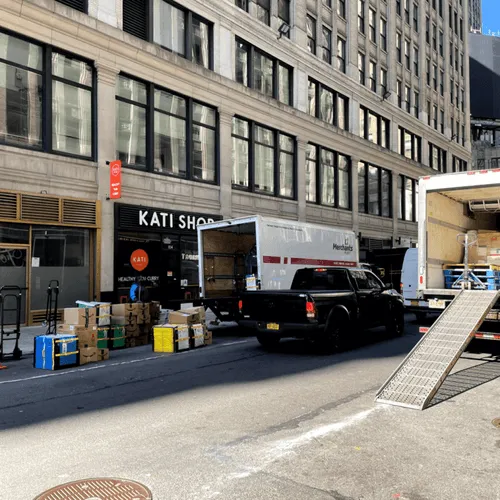
The truckload market in the USA grew to $196.34 billion in 2021. Out of which, the size of the LTL market grew to $80.16 billion in 2021. It is a clear indicator that the American economy is stretching, and more freight is moving as part of widespread supply chains. Most industries rely heavily on trucking to maintain their supply chain. Some of these significant industries include the following:
Dairy, Fruit, Vegetables, and Nuts – 92%
Lumber and Wood Products – 91.9%
Agriculture products – 82.7%
Pharmaceutical products – 65%
Both LTL and FTL shipping can meet the needs of a business, but which one is the most suitable depends on the size and weight of your shipment, delivery timelines, and freight classification. In this blog, we will define what is LTL and FTL shipping and what is the difference between LTL and FTL freight.
What Does LTL Stand for?
Less than truckload (LTL) shipping refers to the transportation of freight that does not fill the entire truck. You can start the shipment with as low as 100 pounds. It is usually ideal for shipments with 1 to 6 pallets or less than 12 linear feet. LTL shipping is very beneficial for the shippers as they can reduce their shipping cost by only paying for the portion of the trailer that takes up the freight. Similarly, other LTL shippers pay the cost of using the remaining trailer space.
What Is FTL Shipment?
The term FTL stands for Full Truckload, meaning you must hire the entire shipment even if your goods do not occupy the whole trailer. A full truckload can weigh 20,000 pounds or more, and only one shipper’s freight is transported on the truck. The shipper reserves the full capacity of the truck in FTL shipments.
LTL vs. FTL Shipping: What’s Right for You?
Several factors come into play when deciding which model of freight shipment is suitable for your business needs. Let’s have a look at some significant pointers that determine when to use FTL and when to use LTL.
You should use FTL shipping if:
You are shipping more than 12 pallets at a time.
Your shipment is fragile and delicate.
You need firm pick-up and delivery appointments.
Your delivery dates are highly time sensitive.
You should opt for LTL shipping if:
You have 12 or fewer pallets to ship.
You want to save shipping costs.
Your shipping and delivery timing is flexible.
FTL vs. LTL: Five Key Differences
LTL shipping is primarily about cost-saving. If you have a few pallets to ship, it is wise to opt for LTL freight shipment. This section will discuss five key differences between LTL and FTL shipping.
1. Freight Handling
In FTL trucking, the product is driven straight to the destination for delivery. However, in LTL freight, the product is loaded and unloaded several times in and out of the trucks and warehouses before reaching the destination. In simple words, LTL logistics involves increased handling, which translates to potential damage and exposure. Therefore, shippers should properly pack and protect their shipments for the LTL mode of freight shipping.
2. Accessorial Charges
From pick-up to delivery, you have all the attention of the driver in full truckload because it takes several days for a driver to transport an FTL shipment. Therefore, FTL carriers are forgiving with accessorial charges. But this is not the case in LTL shipping. You only pay for the small portion in a trailer, and anything that causes disruption results in extra charges.
3. Commodity Specifications
In FTL freight, the carriers are not concerned with freight class or commodity specifications. However, knowing the freight class is necessary for LTL. All the LTL carriers utilize a freight classification system devised by the National Motor Freight Traffic Association to sort out commodities and decide pricing. There are 18 different freight classes ranging from Class 50 to 500.
4. Product Reweighing for Accuracy
In FTL shipping, once the shipment is loaded, the driver may stop at a weighing station to ensure the truck is under 80,000 lbs. Apart from that, there is rarely a chance of any other product inspection. However, LTL carriers reinspect products for weight at different steps. First, the carriers inspect the product at the original terminal, where they move through a dimensioner that scans pallets for weight and dimension verification. In case the results differ from the specifications listed on the bill, the shipment will be reweighed.
5. Trailer Specifications
The trailer specifications are slightly different in full truckload and less than truckload. In FTL shipment, carriers typically have 53’ trailers with swing doors. The width of the trailers is 102,” and the clearance height is 110”. On the other hand, in LTL shipping, the carriers use trailers with roll doors and clearance height up to 96”.
{{returns-webinar}}
How Can You Improve Your Shipping Operations?
Leveraging technology is the best and the simplest way of improving freight shipping operations. By utilizing an all-in-one shipping solution like Ship, shippers can view and compare rates on a single platform. Also, they can generate shipping labels from national carriers and on-demand couriers within seconds for regular or same-day shipping. When all your shipping operations are streamlined and automated, it becomes easier to manage FTL or LTL shipping. In addition to this, the PackageX platform also helps you track your FTL or LTL shipments.
Conclusion
LTL and FTL shipping are two major types of freight shipping and a crucial part of every supply chain. If your shipment is 12 linear feet or less, it is better to choose LTL shipping because it is a great way to reduce cost and improve efficiency simultaneously. There are many similarities between LTL and FTL freight, but there are some critical differences between the two that every shipper should know. However, the final decision of choosing FTL or LTL depends on your cost, timing, and handling requirements for your shipment.
Ever wonder how an online order gets from a warehouse shelf to your doorstep?
The answer lies in pick and pack fulfillment, a process that involves selecting items from inventory, packing them, and preparing them for shipment. It’s a core part of order fulfillment that directly impacts speed, accuracy, and customer satisfaction.
Despite its importance, picking and packing can slow things down. Over 50% of warehouse labor is spent on manual work. Which adds time and cost. That’s why now companies are investing in smarter solutions.
With good inventory management and the right technology, businesses can quickly pick, pack, and ship orders. Businesses can streamline fulfillment, reduce errors, and scale operations.
In this blog, we’ll learn what is pick and pack fulfillment? How does it work, and what methods do leading businesses use to streamline it?
Here is a comprehensive guide that explains everything you need to know, so you can optimize your pick and pack fulfillment strategy for the years ahead.
What is Pick and Pack Fulfillment?
Pick and pack order fulfillment occurs in a warehouse when an order is placed from an e-commerce store. It refers to a process during which customer orders are sourced from inventory, processed, and prepared for delivery.
It involves three key steps: Picking, packing, and shipping.
Picking: Picking is finding and retrieving the right quantities of each product from its location in the warehouse using a picking list.
Packing: Packinginvolves placing items into boxes along with documentation and appropriate packing materials to prevent any damage.
Shipping: After packing, the order undergoes labeling and sorting before being shipped to the end user via a designated carrier.
How Does Pick and Pack Fulfillment Work?
Many e-commerce stores get pick and pack fulfillment services from a 3PL provider or manage their own order fulfillment. In both cases, the process is the same.
Let's see how the picking, packing, and shipping processes work!
1. Order Receiving
The first step of the process is order receiving. E-commerce sales channels are typically integrated with warehouse management systems. A warehouse fulfillment software creates a packing slip when an order is placed online.
2. Order Picking
The warehouse worker then uses that packing slip and picks the items from the warehouse shelves for order fulfillment. It is the core step of the pick and pack service where inventory storage strategies and pick and pack methods play a vital role, as they determine the efficiency of this step.
3. Order Packing
Once the picking is done, the order is sent to the packing station, where it is packed safely, sealed, and labeled for delivery.
4. Order Shipping
Here, the carriers sort the orders on the loading dock. After that, the orders are ready to be picked up by the carriers.
Order shipping might seem simple, but it is a complex science. It is necessary to have sufficient knowledge of efficient pick and pack fulfillment methods to run the business smoothly, whether it is a million-dollar online store or a small e-commerce shop.
What Are Pick and Pack Fulfillment Methods?
Some of the basic pick and pack warehouse methods that many e-commerce businesses use for order fulfillment are listed below:
Picking Strategies
There are four different ways to perform pick and pack warehouse operations, which include:
Piece Picking: Piece picking involves taking the packing slip for a single order and moving around the warehouse to pick items off the shelves. Once everything is picked, the order is taken to the packing station. Piece picking is the simplest pick and pack method for small businesses.
Batch Picking: Batch picking is suitable for businesses with a large number of orders that need to be organized into batches. Each batch contains items found in the same area of the warehouse. For example, if one item is needed in numerous orders, it is wise to pick those orders together to avoid walking back and forth in the warehouse.
Zone Picking: Zone picking is another pick and pack method appropriate for large fulfillment warehouses. In this technique, pickers stay in a warehouse zone and pick the items in their zone. After that, the order is passed onto the next zone, and as it moves through all the zones, it is sent to the packing station.
Wave Picking: Wave picking combines batch and zone picking, where workers pick items within a zone for batch orders, compared to a single order. After that, the batch is passed to the next zone for further picking.
Packing Strategies
Efficient and strategic packing is a critical component of order fulfillment in e-commerce. Common packing strategies include:
Cartonization: Cartonization is the art of selecting the optimal packaging size for each order. By utilizing the right-sized packaging, businesses can minimize excess space, reduce shipping costs, and protect products during transit. Advanced software solutions analyze order dimensions and recommend the most appropriate box size for each shipment, streamlining pick and pack warehouse operations.
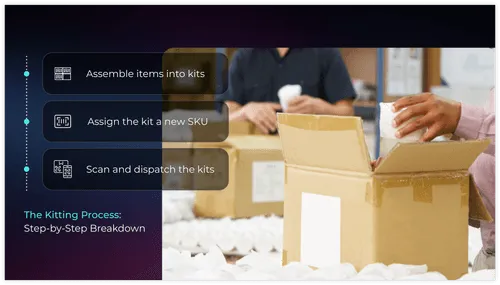
Kitting: Kitting involves bundling multiple products into a single package. This strategy offers several benefits, including increased customer value perception, reduced individual packaging, and enhanced cross-selling opportunities. By combining items, businesses can create attractive product bundles that encourage larger purchases and improve customer experience.
Branded Packaging: Branded packaging adds a touch of personality to each shipment. It allows businesses to reinforce their brand identity. Customized boxes, tissue papers, stickers, or thank-you cards bearing the company's logo and colors can significantly enhance brand recognition and build customer loyalty.
Eco-Friendly Packaging Options: Pick and pack fulfillment can also support sustainability goals. By using recyclable or biodegradable packaging materials, businesses can reduce waste and appeal to environmentally conscious customers.
Benefits of Pick and Pack Fulfillment
The benefits of pick and pack fulfillment are numerous and can significantly impact the efficiency and success of a business. Here are some key advantages:
Faster order processing: A well-organized pick and pack fulfillment system speeds up the entire order processing, from receiving to shipping. This leads to faster deliveries and happier customers.
Lower labor and operational costs: Pick and pack warehouse services reduce manual steps and optimize workflows. This cuts down on labor hours and overall fulfillment expenses.
Improved inventory control: Real-time inventory updates from a pick and pack warehouse help keep track of stock levels and prevent overstocking or running out of products.
More accurate orders: Using a structured pick and pack fulfillment process helps reduce errors. Customers get the right items, which lowers returns and increases satisfaction.
Flexible and scalable operations: A pick and pack warehouse can adjust to changes in demand. Whether you're shipping a few orders a day or thousands during peak season, the system scales with your needs.
Lower shipping costs: By consolidating items and packing efficiently, pick and pack fulfillment cuts down on shipping charges, especially when orders have multiple SKUs.
Better customer experience: Faster delivery, fewer mistakes, and reliable service all lead to better reviews, higher retention, and a stronger brand reputation.
How to Improve the Pick and Pack Warehouse Fulfillment?
After becoming familiar with the basics of pick and pack, businesses need to learn how to improve the order fulfillment process at their warehouses. Optimizing picking and packing methods is essential to streamlining order fulfillment. Here are some valuable tips to optimize the pick and pack process.
Invest in a Warehouse Management System (WMS)
A warehouse management system (WMS) controls all the processes from when the product enters the warehouse to when it is shipped. Therefore, investing in a warehouse management system like PackageX is a wise option for businesses with a large inventory or high sales volume.
Focus on Automating as Many Processes as You can
Automation is crucial in logistics, especially in a multistage process such as order fulfillment. Businesses can increase accuracy and speed by automating their pick and pack fulfillment processes. Also, with automation, they get access to important data and insights that can be used to track progress and make improvements.
Design Warehouse for Optimal Efficiency
Based on the warehouse size and number of orders received, much time can be wasted moving from one storage bin to another to fulfill each order.
Therefore, the most efficient way to optimize picking and packing is to design the warehouse for maximum efficiency by:
Placing top-selling products closer to the packing stations.
Keeping a stock of items typically sold together in neighboring storage zones.
Organizing the inventory from top-selling to low-selling.
Keep Your Inventory Updated
Keeping inventory updated and in stock is critical for efficient order picking. A robust inventory management system, such as the one offered by PackageX, provides real-time tracking, enabling teams to monitor stock levels and receive low-inventory alerts before issues arise.
How PackageX Can Help Optimize Pick and Pack Fulfillment?
PackageX simplifies the entire pick and pack fulfillment process, helping businesses speed up order processing, reduce manual errors, and scale operations without complexity. Whether you're managing a small warehouse or fulfilling thousands of orders a day, PackageX brings automation and accuracy to every step.
Here’s how PackageX can help:
Real-time inventory tracking to avoid stockouts and overstocking.
Automated order picking with smart workflows and barcode-based validation.
Faster and more accurate packing with digital packing slips and order details.
Easy integration with e-commerce and shipping platforms for end-to-end logistics.
Scalable pick and pack warehouse services without the need for extra overhead
PackageX offers a modern, API-first logistics fulfillment system that’s built to streamline pick and pack warehouse operations, from receiving inventory to shipping the last package out the door.
FAQs
What is the warehouse pick and pack process?
The warehouse pick and pack process involves selecting ordered items from inventory (picking), then packing them securely for shipment. It’s a key part of order fulfillment that ensures products are correctly retrieved, packed, and shipped to customers efficiently.
What are the benefits of outsourcing pick and pack services to a third-party provider?
Outsourcing to a third-party logistics (3PL) provider or fulfillment center offers several advantages. It gives businesses access to expert staff, advanced technology, and optimized infrastructure. This results in faster processing, improved accuracy, and cost savings, while allowing teams to focus on core business operations. It also adds flexibility to scale during peak seasons.
What technology is used in pick and pack fulfillment?
Pick and pack fulfillment relies on tools like warehouse management systems (WMS), barcode scanners, order management software, and automated sorting systems. These technologies help improve order accuracy, speed up processing, and provide real-time visibility into inventory and shipments.
Can pick and pack services handle international shipping?
Yes, most pick and pack fulfillment providers support international shipping. They handle customs documentation, local regulations, and proper labeling to ensure orders arrive smoothly across borders. This is especially useful for e-commerce businesses with a global customer base.
Warehouse efficiency relies on three coordinated functions: your workforce, your customers or orders, and your inventory. Sounds simple, right?
However, it is not that straightforward in real. Warehouse efficiency is not about keeping the shelves stocked and delivering products to the customer on time only. Some warehouse ideas to boost productivity to improve customer experience, saving costs, and establishing a better working environment. There is a strong connection between warehouse efficiency and customer retention. Any loopholes in warehouse optimization can lead to a drop in customer retention rate, impacting your ROI.
Whether you have a small warehouse or a large one, you should standardize your processes and find new solutions to increase warehouse efficiency. The global warehousing and storage industry will reach USD 654920 million by 2028, reflecting the need for warehouse optimization and automation. There are several ways to improve warehouse efficiency that can significantly impact your profit margin and productivity.
Here are the eight necessary steps for improving warehouse efficiency and producing the required results.
1. Leverage Warehouse Technology
Today, more than 80% of warehouses lack any automation. Warehouse management systems (WMS) and ERP systems with a strong WMS module can boost efficiency by suggesting the best routes for picking or putting items away. Artificial intelligence can significantly can make warehouse management more accurate by automating various tasks, such as sorting and inventory management. This automation not only streamlines operations but also reduces the chances of errors, making the entire process smoother and more reliable. Furthermore, the system generates automated pick lists that can be sent to mobile devices and readers, reducing errors and reducing waste of paper and time. RFID and barcode readers can enhance the accuracy of transactions and increase picking accuracy. You will have a cleaner and greener warehouse.
2. Improve Warehouse Storage
Compared to a decade ago, warehouses are now over one-third larger and nearly three times as voluminous. Due to the increasing number of SKUs and other factors, larger footprints have increased facility costs.
Rather than expanding the footprint of your warehouse, consider better utilization of storage space. Increasing the height of the storage units and investing in the right equipment can allow you to store more in the same area rather than adding to expansion costs. Additionally, consider the types and variations of shelving depending on the materials you have in your warehouse for best results. Keep shelves neat and orderly by using standardized bins.
3. Give Customers More Pick-up and Delivery Options
Warehouses bear the burden of inventory. Offering in-store pick-up (BOPIS) and delivery can allow companies to shift a load of inventory to the retailers and warehouse distribution centers. Target offered pick-up options to its customers and revealed that 15% of their online purchases are now picked up.
You can sell products online even if your company doesn't have a brick-and-mortar storefront. A fulfillment center, such as the one operated by Amazon, can sell, store, and deliver goods to retailers. For improving warehouse efficiency further, Amazon has even introduced lockers where customers can pick up their orders instead of waiting for them to be delivered.
You can offer customers the option to select their preferred method of receiving their orders. This can include curbside pickup, contactless delivery, or flexible delivery windows, catering to their specific needs and preferences.
4. Review Your Inventory
Delivering products to customers does not reduce the time product lingers in your warehouse. Many companies are still holding on to a lot of inventory. Over the last five years, the inventory on hand based on an average sales day has increased by 8.3%. Therefore, you need to review and optimize your inventory because dead inventory in your warehouse costs money. For this purpose, you can analyze the metrics and perform an audit to identify the static inventory. Common metrics required to review inventory include:
The average number of days to sell inventory
Inventory turnover rate
Return on investment (ROI)
Gross profit on products
Holding inventory for a long time reduces warehouse efficiency and eats at your profit margin. So, you need to review your inventory and improve warehouse efficiency and productivity.
5. SaaS vs. Licensed On-Premises Systems
Investment in new order management systems, enterprise-wide or WMS that can be integrated occurs only every 5-10 years due to the extensive implementation process and investment involved. A SaaS subscription model can help you acquire a new system at a lower price.
There is, however, a difference between the long-term costs of SaaS versus buying the software once and requiring annual support of traditional software. Compare the detailed warehouse functions in SaaS WMS. You should find more effective functions for improving warehouse efficiency and decreasing warehouse costs.
6. Track Warehouse Efficiency Metrics
Warehouse productivity and efficiency can only be improved if you know:
Which key metrics do you use to measure productivity and how to improve warehouse operations?
Where does your baseline sit (i.e., where do you start from)?
What is your target?
What are you doing to track individual performances against those targets?
The warehouse efficiency metrics used by each company can differ, but they must be easily measurable. It won't be very useful if you spend a week trying to compile that data.
You need to either evaluate your systems or assess different warehouse efficiency measures. Consider breaking down your metrics. Taking productivity as an example, how do you measure it? Can several metrics measure it? If so, how? After that, identify key metrics that you can improve.
How to Measure Warehouse Efficiency
To holistically measure your warehouse performance, include the following practices in your regular procedures:
Regular operational audits: These audits help evaluate warehouse operations, equipment, staff, and technology. Whether you do these internally or by third-party experts, this practice can highlight bottlenecks and potential risks.
Set KPIs: Establish key performance indicators (KPIs) like receiving cycle time, space utilization, and put-away productivity. These metrics give you a clear picture of your warehouse's performance and help you track progress and identify areas for improvement.
Track inventory accuracy: Your recorded inventory should match the physical stock to prevent issues like stockouts or overstocking.
Monitor equipment efficiency: Keep a record of equipment maintenance and downtimes. This log will help you minimize downtime and ensure that your machines are running smoothly and efficiently.
Assess and optimize warehouse layout: Regularly assess your warehouse layout to accommodate product demand, seasonality, and inventory turnover. This helps reduce unnecessary travel time and ensures that products are easily accessible.
Get employee feedback: Listening to their suggestions can give you insights and identify problems to improve warehouse operations.
7. Automate Your Picking Process
Another way of improving efficiency is automating the picking process in warehouses. Using manual pickers for product delivery to the packaging and shipment area of the facility is not a scalable approach, especially for growing businesses. It affects warehouse productivity and efficiency significantly. With automation in the picking process, you can improve the pick rate to 300 pieces per hour.
For this purpose, you need to invest in sorters and conveyors that can move products within the facility quickly. As a result, the order picking productivity of your fulfillment center will drastically increase.
8. Don’t Stop Optimizing
Once you have your measures and benchmarks in place, you will want to refer to them regularly for improving warehouse efficiency.
To keep your workforce ahead of the curve, keep an eye on training, leadership, and technology developments. Get feedback from your customers on your service and improve warehouse efficiency where needed. Optimization to keep up with the latest trends is paramount in a constantly changing eCommerce environment.
{{returns-webinar}}
Wrap Up
These warehouse efficiency tips can help you streamline workflows, automate repetitive tasks, and minimize wasted time and resources. It takes more than just getting products out of the warehouse on time and keeping everything in its designated place for an effective operational warehouse. The objective is to maximize productivity to improve the customer experience and return on investment eventually.
A firm commitment to improving warehouse efficiency plays a crucial role in your business's growth and sustainability. You can increase your warehouse efficiency by leveraging technology in your warehouse management operations. With the help of PackageX apps and APIs, you can automate your warehouse logistics operations and increase speed, productivity, and efficiency.
FAQs
What are the factors that contribute to the efficiency of warehouse operations?
Warehouse efficiency is influenced by several factors, such as the size and layout of the space, using smart robots for picking tasks, the skills and experience of the staff, the level of customization and complexity of your Warehouse Management System (WMS). You should also take care of any limitations in the existing technology infrastructure.
How do you work faster in a warehouse?
To work faster in the warehouse, start by strategically placing your best-selling items in easy-to-reach locations. Group similar orders together to save time and divide the warehouse into zones for more organized picking. Maximize the pick face area by making items more accessible and keep similar-looking items separated to avoid confusion. Using a simple app can help guide your workflow efficiently. As you pick, sort items along the way, and consider adding a bit of fun by gamifying tasks to keep things engaging and motivating.
It's a sign that your eCommerce store is outperforming, and your business is booming. However, it is also a challenge when meeting customer needs because the most in-demand items are not always available immediately. This is where backorder comes to play.
Backordering is a common tactic in retail that helps you retain customers, outclass your competitors, and build hype. Moreover, it also keeps the flow of online orders uninterrupted while you wait for stock fulfillment. But it has its own share of risks. Late deliveries, unfulfilled expectations, and unsatisfied customers are some consequences if back orders are not managed properly.
Therefore, this guide will help you understand what does backordered mean and how you can deal with backorders successfully.
What Is a Backorder?
A backordered item refers to an out-of-stock product that is expected to be delivered once its restocked. So, the customer can buy the item now, but they will receive it at a future date. Retail or eCommerce stores are selling products on backorder with a guarantee to deliver the item to the purchaser as soon as it is replenished. It is like pre-ordering – you allow the customers to continue ordering because you expect a restock shortly. In this way, you do not lose customers due to stock unavailability.
Backorder vs. Out-Of-Stock
You might confuse back orders with out-of-stock items. However, both are different.
Out-of-stock items do not have any replenishment date, which means they do not have any inventory available and cannot be sold. On the other hand, backordered items have a date for resupply, and they can be sold online. It can take a while, but it will surely be shipped to the customer. Simply put, it is the difference between "This item is no longer available" and "This item will be available after ten business days."
What Are the Common Causes of Backorders?
There can be several factors that contribute to a backorder. Some significant causes include:
Products that sell way better than anticipated
Increase in demand that you didn't expect
Inefficiencies in inventory management that lead to understocking
Supplier problems that cause a delay in inbound shipments
How to Manage Backorders?
You must devise a solid strategy for successfully handling backordered items to avoid losing customers. Here's how you can manage such orders efficiently.
1. Decide Products for Backorders
The first step in managing back orders is deciding whether a sold-out product is suitable for backordering or not. You can do this by having:
An accurate estimate of the product restocking date
Sufficient stock for backorders fulfillment
A reliable way of recording backorders
An efficient way of fulfilling orders when the product is restocked
2. Forecast Order Demand
Sometimes it's easier to predict when an item will be in high demand. For instance, swimwear will get popular in summer, and stationery or school supplies will become popular at the end of the summer. Therefore, prepare for such situations and keep extra stock in your warehouses readily accessible. When you encounter an unforeseen spike in demand, your backordering process should be organized to deal with it efficiently.
3. Update Your Listings
You should make the backorder status of a product clear to everyone visiting your listings. Consider adding a status or tag like "available on backorder" to the product along with the estimated delivery date. It will prevent customers from having unrealistic expectations about product arrival and placing back orders mistakenly. Similarly, if you are no longer taking backorders for a product, make it visible too.
4. Work with Multiple Suppliers
To manage backorders efficiently, you should engage multiple suppliers. You can reduce the customer's wait time by working with at least two to three suppliers who provide similar products. When one supplier runs out of a product, you can order the same item from another warehouse. In this way, you can manage your backorders effectively without losing customers.
5. Keep Your Customers Informed
If you want to retain customers through backorders, you need to keep them informed. Send them a confirmation email that confirms their order and restates the estimated delivery date. Similarly, there are cases when customers mistakenly place a backorder or do not understand what is a backorder. For such cases, you should allow customers to cancel their orders or join the waiting list.
6. Keep a Record
Keeping a history is also essential for effective backorder management. You should have a record of customers placing backorders, the time of their order, and the quantity of the product they ordered.
An accurate and properly managed record provides valuable insights about
The priority of orders that need to be fulfilled
The required fulfillment capacity
Whether you have sufficient stock to meet the demand
{{returns-webinar}}
7. Ship Products Separately
Customers may place orders containing both in-stock and backordered items. In such circumstances, you should adopt a strategy of shipping orders separately. Ship the in-stock products immediately and send the backordered products once they are available. However, it involves two separate shipping costs.
8. Identify the Inventory Gaps
You should also focus on identifying the gaps in your inventory. Once your inventory management system informs you about a product delay, find the cause and solution to the problem, which can be ordering more products or finding other ways of shipping.
Final Thoughts
Backorders are not always ideal, but they help you make the best of a difficult situation. You can turn backorders into profits by adopting smarter ways to manage them. PackageX can help you optimize and automate the inventory operations associated with backordering through its apps and APIs. As a result, you will be able to manage your stock efficiently and have real-time visibility.
We live in the digital economy era where eCommerce and the retail sector are experiencing digital transformation every day. Thanks to the ever-changing consumer expectations and shopping behaviors. With over 33% of the global population shopping online, eCommerce has become a $6.8 trillion industry in 2025, and it's projected to surpass $8 trillion by 2027. Today, more than 2.77 billion people worldwide make purchases through dedicated eCommerce platforms and emerging channels like social media stores, reflecting how digital-first shopping behaviors are reshaping the global retail landscape.
New shopping models have now been developed to meet modern customer needs as the world of online retail is highly competitive. The omnichannel shopping approach, already adopted by eCommerce giants like Walmart, Amazon, and Target, represents a new trend called Buy Online, Ship-to-Store (BOSS) that is rapidly growing. This approach bridges the gap between Digital Commerce and in-store shopping, putting the customer at the heart of the retailer’s digital transformation strategy.
Let’s analyze this emerging in-store shopping trend that combines digital orders with pick-up in-store.
What Is Buy Online, Ship-to-Store (BOSS)?
BOSS online is a purchasing method that allows consumers to buy the product online even when it’s out of stock. However, instead of paying and shipping the product to their address, they get it shipped to the store and pick it up from the store.
BOSS is technically a subset of BOPIS that takes the idea of BOPIS one step ahead. Both channels start with online orders and end with a consumer in the store, but the logistics associated with BOSS retail are slightly different. As the retail sector continues to alter its omnichannel format, BOSS is expected to grow as the most suitable way to meet consumer demand and minimize the percentage of lost sales.
How Does BOSS Work?
Buy online, ship to store is a backend process that limits the need for stock in hand and allows for a smaller store footprint.
So how to ship online orders through BOSS?
You select the product you want to order on the retailer’s website (even if it’s out of stock).
After completing the order, you choose delivery to the nearest store.
As the chosen product is not available at the store, it is shipped from the warehouse or other nearby stores. Therefore, it can take a few days for the product to arrive.
Once your chosen product arrives at the store, you are notified to pick it up at your earliest.
Advantages of BOSS Retail
There are numerous significant benefits of buy online ship-to-store, which include the following:
Shipping to the store is much cheaper than commercial direct-to-customer shipping. It saves a considerable amount of packing and labor costs.
Sellers can also reduce returns with buy online ship to store retail.
It optimizes your inventory and space by reducing the risk of stock-outs.
The BOSS strategy also attracts customers to the store, increasing the possibility of conversions.
It also eliminates the pressure off the stores and retailers to offer discounted items at the season end.
Best Practices to Handle Buy Online, Ship-to-Store
Omnichannel retail approaches like BOSS require an incredibly connected supply chain that is supported by automated order and inventory management systems. Let’s look at some best practices that can help eCommerce store owners and retailers handle the boss ordering.
Digitization is the Key
Through digitization in logistics, retailers can handle orders with great speed and accuracy, keeping their customers satisfied.
So, what does digitization include?
Digitization in logistics includes having an efficient and innovative package management software supplemented with the latest OCR technology.
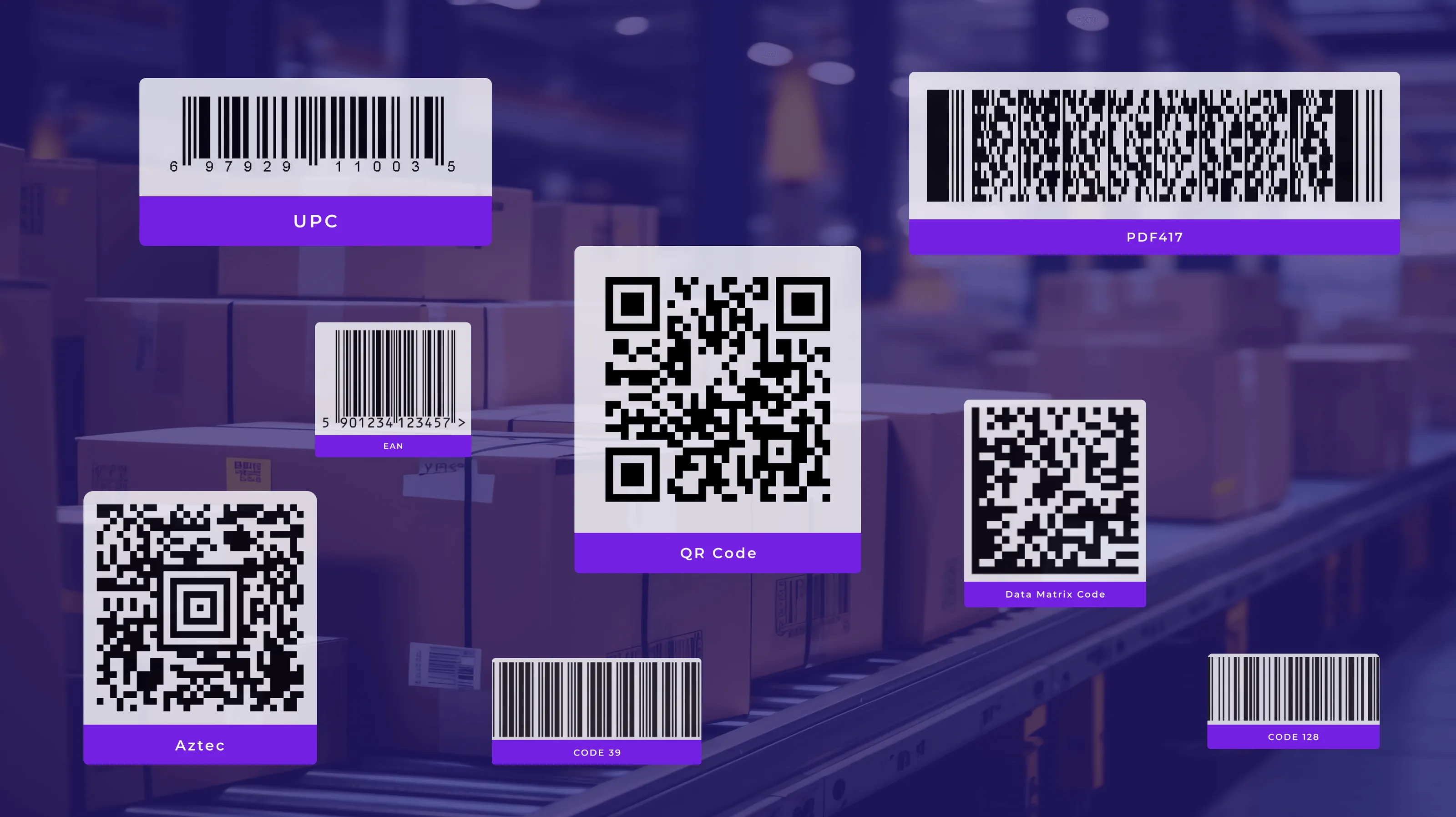
As retail goods cannot be tracked, ordered, or registered without barcodes, it is crucial to have smart OCR software to scan barcodes accurately. Therefore, focus on digitizing your BOSS retail operations.
Have a Specified Pick-up Area
Another suitable way to run the BOSS model at your eCommerce store is to have a designated area for pick-up. You can easily direct BOSS orders to this area, making it convenient for the customers to retrieve their packages without hassle. Furthermore, you can also use parcel lockers to provide a self-serve way to your customers for order pick-up. Therefore, focus on an organized distribution method at your store.
Keep the Customers Informed
Communication is crucial in buy online, ship-to-store format of online shopping. You need to keep the customer in the loop when processing the order. The consumers expect an email from the store telling them about the estimated time of the order’s arrival, its tracking information, and an email/text notification when the order is ready for pick-up. Also, you can educate your customers about where to go in-store to get the items in this email.
{{returns-webinar}}
Key Takeaways
Logistics and eCommerce are interconnected. Businesses or companies that want to capture online sales opportunities using the buy online, ship-to-store method should ensure speed, flexibility, and precision in their supply chain. For this purpose, you need to invest in smart logistics solutions like PackageX that automate order, stock, and inventory management at your store. Our platform comprises easy-to-use apps and APIs that conveniently streamline your in-store processes.
Today's supply chain management and logistics are complex, increasing the demand for real-time visibility and continuous monitoring of shipment chains. Goods-centric tracking and tracing of items is needed to increase visibility and control in various logistics operations of a business or company.
It is critical for a supply chain manager to know about the shipment's location, the estimated time of arrival (ETA), and any possible disruption or current and past status of the shipment to manage and control their fleet, orders, and goods.
According to a recent study by MDPI, lack of visibility across the extended supply chain is one of the biggest challenges for companies. Therefore, track and trace in logistics are essential to increase transparency across every step of the supply chain. The current technological advancements have enabled manufacturing sites, e-commerce businesses, and warehouses to track and trace shipments over their entire life cycle.
This blog will shed light on the concept of tracking and tracing in logistics and explore its benefits in detail.
Key Takeaways
Track and trace technology in logistics enhances supply chain visibility and transparency, enabling real-time monitoring of shipments and building trust among partners and customers.
It helps reduce transportation and operational costs by optimizing routes with GPS and intelligent routing, which lowers fuel consumption and transit times.
The technology improves customer service by providing accurate delivery schedules and easy shipment tracking, leading to greater customer satisfaction.
Track and trace systems strengthen inventory management by providing real-time data, reducing manual inventory tasks, and enabling better planning.
It increases shipment security by monitoring and instantly notifying any disruptions, reducing losses and damage risks.
Track and trace technology identifies bottlenecks in the supply chain, allowing logistics managers to proactively address delays and optimize workflows.
PackageX offers end-to-end shipment visibility, real-time tracking with accurate ETAs, automated notifications, and standardized processes to modernize logistics and enhance supply chain transparency.
What Is Track and Trace?
Track and trace are two fundamental components of the supply chain that allow various logistics providers and companies to determine the location and status of the goods.
Track refers to the process of following the trail produced by the shipment's movement. On the other hand, Trace involves tracking the package movement and even the package's temperature. In simple words, track and trace is a way to record the movement of parcels during transportation.
What Is the Aim of Track and Trace in Logistics?
Track and trace aim to create transparency in the supply chain so that logistics providers, partners, and customers can know about the shipping status and exact location of goods.
Modern track and trace systems rely on several technologies to keep shipments visible throughout the supply chain.
GPS (Global Positioning System):
Provides accurate, real-time location data for vehicles, containers, and cargo in transit.
RFID (Radio-Frequency Identification):
Uses radio signals to identify and track products or pallets tagged with RFID chips, reducing manual errors.
Barcode Scanning:
Barcode scanners captures shipment details at checkpoints, making it easier to confirm movement and update logistics records instantly.
Digital IT Systems:
Advanced platforms process this data, integrate with supply chain software, and give logistics managers actionable insights.
Together, these technologies improve shipment tracking, enhance supply chain visibility, and support efficient logistics operations.
Benefits of Track and Trace Technology
Visibility in supply chain operations is essential to improve logistics workflows, save time on manual tasks, increase profits, and reduce production waste.
Some of the significant benefits of track and trace in logistics include the following:
Trust reinforcement
Cost reduction
Superior customer service
Improved inventory management
Better security
Identification of bottlenecks in the supply chain
Real-time information about the delivery status
Trust Reinforcement
The most important rule of a business is to enforce trust within your partners and customers. The same is the case in the logistics business. You need to reinforce trust by promoting transparency within your supply chain through tracking and tracing.
Tracking and tracing in logistics offers you peace of mind and keeps your partners and customers informed about the status of their shipments. Also, it builds trust between the supplier and the purchaser.
Cost Reduction
The advanced track and trace technology also help minimize the cost associated with the transportation of the consignment. You can effectively mitigate the traveling and transportation costs by finding quicker routes using GPS-based applications. These applications utilize intelligent routing and create efficient work routes, which reduces fuel costs.
Superior Customer Service
Another significant advantage of track and trace in logistics is superior customer service. It helps you achieve better efficiency and quick delivery, improving customer service. Your customers will be able to track shipments easily, and you will have all the information and precise delivery schedules.
Improved Inventory Management
Staying informed about your inventory levels throughout the supply chain strengthens your inventory management and planning.
With the help of track and trace, you can improve your inventory management and reduce the time it takes to locate goods and perform manual inventory checks. In this way, your employees can perform other essential tasks.
Better Security
In logistics and distribution, a lot of things are at stake. When a shipment gets misplaced, it is not just a material loss on the client's radar but also a loss of reputation for you. Track and trace technology provides better security for your shipments, captures every minute detail, and sends out instant notifications about the shipment status through text or email.
Identification of Bottlenecks in the Supply Chain
Track and trace in logistics also help you identify bottlenecks in the supply chain operations. Utilizing an advanced track and traces solution allows you to understand where things are consuming too much time. For instance, you can change the route if a shipment tends to be in transit for a longer time on a specific route.
Similarly, if a particular logistics center takes hours to process your shipment, you can communicate and figure out how to make things easier and quicker.
Real-Time Information About Delivery Status
Inefficient deliveries lead to a lack of transparency in the supply chain. It becomes difficult for the logistics managers to determine the location and status of transported shipments and goods. As a result, they get deprived of real-time information about the goods, such as:
The current location of the order
The estimated time of delivery
Are goods kept at an accurate temperature?
Are goods delivered to the customer without any damage?
Has the shipment been received successfully?
Are there any missing deliveries?
Is the shipment delayed?
With the help of track and trace in logistics, managers can keep track of the shipments at any time because they get all the real-time information. They can timely detect whether the shipment is being misplaced, damaged, or delayed. Consequently, they can resolve all the problems proactively, ensuring zero disruptions in the supply chain.
What is the Future of Trace and Track in Logistics?
As per Markets and Markets, a research firm, the global market for track and trace technology is expected to reach approximately 12.27 billion USD by 2030 with a compound annual growth rate of 12%.
Although tracing and tracking is not a new concept in logistics, its usage is still limited, leading to a lack of visibility in the supply chain and real-time information.
However, as the demand for more information increases among retailers, manufacturers, logistics service providers, and customers, the more critical tracing and tracking become in logistics.
In the future, many other technologies like IoT and blockchain will be used to create a more comprehensive and optimized solution for tracking and tracing.
Why PackageX is an Ideal Choice for End-to-End Shipment Visibility?
In today’s logistics and supply chain industry, real-time visibility is a necessity. PackageX provides advanced track and trace solutions that give operators complete control over their shipments. From dispatch to last mile delivery. By capturing accurate data at every step, it helps businesses maintain supply chain transparency and respond quickly to potential disruptions.
With PackageX, logistics providers can:
Track shipments in real time with accurate ETAs and automated notifications.
Standardize processes across multiple warehouses, carriers, and regions.
Improve accuracy with digitized documents and automated status updates.
Strengthen security by detecting issues before they impact delivery.
These solutions allow global supply chain companies to enhance efficiency, safeguard freight, and deliver a reliable customer experience while reducing costs.
Conclusion
Track and trace in logistics have become a must have for all shippers and carriers. It has numerous benefits, including simplified finding, tracking, and data collection from every supply chain step.
Moreover, it helps businesses save cost and time, increase supply chain transparency, improve efficiency, and offer a superior customer experience. Therefore, you should consider deploying smart track and trace solutions, like the ones provided by the PackageX platform, to modernize and standardize your logistics operations.
FAQs
What is the purpose of the track and trace system?
The purpose of a track and trace system is to provide real-time visibility across the supply chain. It helps logistics operators monitor shipments, confirm accurate delivery times, and reduce risks. By improving transparency, businesses build trust with customers and partners.
What is track and trace in logistics?
Track and trace in logistics refers to the process of monitoring goods from origin to destination. It records shipment movement, delivery status, and key data points like location and condition. This improves supply chain efficiency and ensures customers receive reliable updates.
How does track and trace improve supply chain visibility?
Track and trace improves visibility by giving logistics providers continuous updates on shipment status. Operators can identify delays, detect risks, and adjust routes proactively. This level of control supports better planning, reduces costs, and enhances customer satisfaction.
Why is track and trace important for logistics companies?
For logistics companies, track and trace is critical to managing fleets, orders, and warehouses efficiently. It ensures accurate delivery schedules, prevents loss, and strengthens security. With digital tracking, companies can streamline operations and maintain a competitive edge.
Inventory management is a prime concern for any business that deals with products, be it eCommerce, retail, or wholesale. The financial success of a business depends on accurate and efficient inventory management; therefore, it's complicated. Especially if you own a small-sized business, the problems that arise due to human errors or inventory theft would never let your business grow or make a profit. It is one of the significant reasons small businesses struggle to have the required stock at the right time without overstocking or understocking the best-selling products.
Also, performing the outdated inventory management practices manually consume your staff's productive hours, putting a damper on efficiency. Therefore, small-sized businesses must have an innovative, modern, and automated inventory management system. However, it is quite alarming that small businesses still do not utilize inventory management systems and do not have a proper mechanism to track inventory.
The principles of inventory management are the same whether you are a large organization or a small business. Here's how you can set up inventory management for small businesses.
Inventory Management Statistics
Only 22% of the companies maintain a proactive supply chain network.
43% of small businesses are not tracking their inventory.
21% of the small businesses report they don't have inventory.
67.4% of the supply chain managers use Excel spreadsheets to manage inventory.
Inventory stockouts cost retailers approximately $4.6 billion in lost Black Friday sales in 2021.
U.S. retail operations possess 63% supply chain accuracy, which causes delays and re-stocking issues.
What Is Inventory Management?
Inventory management is a fundamental part of the supply chain that refers to acquiring, storing, and selling a company's stock, including raw materials, work-in-progress goods, and finished products. With effective management, you have the exact amount of inventory when needed. Also, you do not have to deal with the slow-moving goods aging in the warehouse.
Poor inventory management harms the reputation of a small business and results in a warehouse full of deadstock, costing storage money. Therefore, businesses need an effective inventory management strategy to withstand fluctuating demands and possible disruptions.
Suitable Practices for Small Business Inventory Management
Issues related to inventory management are neither new nor born out of the COVID-19 pandemic. However, the pandemic has shown what can happen when inventory planning, management, and tracking are not well-thought-out. The traditional unit-based policies for safety stock are outdated and too static to address the sudden disruption in supply and demand that we witnessed over the last year. eCommerce has significantly replaced the physical channels, achieving ten years of growth in just three months. In the U.S. only, the marketplace eCommerce sales are projected to hit $357.26 billion in 2022, making up 34.6% of all online sales.
Here are some valuable tips on how to set up inventory management for small businesses.
1. Invest in Inventory Management Software
Small business owners should invest in cutting-edge technologies like inventory management software or barcode inventory system. Good inventory software can help you:
Track your inventory. You can easily evaluate how much stock you have, which stock is selling fast, and when your next shipment arrives.
Evaluate sales to forecast demand accurately
Plan material requirements
Keep the right amount of stock available to meet demands
FIFO is an asset valuation, and management method in which stock acquired first is sold, used, or disposed of first. New stock goes back, and the old stock is displayed at the front. It is a practical approach to the stock rotation that impacts all sorts of merchandise, especially perishable goods. Businesses that adopt FIFO inventory management are more profitable considering the fluctuations in the economy and the risk of increasing manufacturing costs.
3. Identify Slow-Selling Goods by Analyzing Sales Data
Another way of inventory management for small businesses is to identify slow-selling products and get rid of them.
There can be numerous reasons for a product to move slowly. For example, high-ticket inventory goods stay longer on the shelf, or an item might not be as popular as predicted. Therefore, small business owners should use a sale to finish the remaining stock and stop ordering that product in the future to hold the cost down.
4. Integrate Inventory Management System with POS
The inventory management software for small manufacturing businesses should be integrated with point-of-sale (POS). In this way, you can provide your employees with real-time inventory access that allows them to stock levels and goods locations. Your floor associate should have an inventory barcode scanner that instantly informs them about the items on the shelf, in the warehouse, or in a store.
5. Regularly Conduct Stock Audit
Effective inventory management depends on regular stock audits. Many businesses prefer a complete audit once a year to analyze if their current stock matches the digital count. However, some conduct frequent checks to identify fast-moving goods. In both ways, stock auditing is the best way to highlight costly errors like employee theft and mislabeling. Therefore, small businesses should conduct stock checks regularly.
6. Know Your Risks
Understanding your risks is a part of inventory management for small businesses because every supply chain is prone to disruption. Anything from vendor instability to weather can disrupt the supply chain. Some common risks include:
Market size and share
Economic factors
Supplier reliability
Financing
Regulation compliance issues
Weather
Natural disasters
Business owners should consider these risk factors when devising an inventory management strategy.
{{returns-webinar}}
Improve Inventory Management with PackageX
If you are looking for a high-tech inventory management solution for your business, PackageX is the right platform for you. We offer a modern, comprehensive, and cloud-based inventory management software that automates all the basic inventory operations. It provides real-time visibility into your inventory and improves staff efficiency and productivity. So, if you want to make your business profitable, you need to optimize your inventory management system.
Pandemic has changed the dynamics of the global shipping and logistics industry. The global parcel volume exceeded 131 billion in 2020 and is expected to reach 266 billion in 2026. In the US only, the parcel volume grew exponentially year over year since the Covid outbreak, with 20 billion package volume in 2020, up 37% from the previous year. A similar impact was observed in office mail and package delivery worldwide. Let's take the example of a commercial real estate company that offers shared workspaces. They received approximately 488,633 packages in 2020 and 948,438 in 2021 (approximately 2x more than 2020) as per the data obtained from the PackageX platform.
On average corporate mailrooms receive approximately 1000 packages every day, and this number will continuously grow with time, thanks to the rise in "online shopping." Office mailrooms have become busier as employees ship their personal packages to their workplaces. Many commercial office spaces lack the resources to manage personal and business packages efficiently.
Therefore, you need to develop a clear mail and delivery policy that defines the rules for personal package delivery at the office and the responsibility of every employee regarding mail handling at the office.
Here's the detailed guideline on developing a mail and delivery policy for your offices with an in-depth analysis of the pros and cons of allowing personal packages at work.
The Need for Mail & Delivery Policy
Employees find it easier to ship their personal packages to offices than to their homes. One of the reasons is that packages are not left unattended at the front door of homes during the day, reducing the risk of package theft. While it is convenient for employees, offices need to weigh those conveniences because extra delivery traffic drains office resources. The ripple effect of online shopping causes package pileups in the office mailroom, which takes up a lot of space.
Moreover, it also brings up privacy and security-related issues. For this purpose, an office should have a solid mail and delivery policy to address these issues preemptively. It will help the staff and employees understand the expectations regarding the packages that circulate through the office. Also, the front desk and mailroom staff will have a clear action plan to deal with any possible violations of official mail and delivery policies.
Pros & Cons of Allowing Personal Packages
Employers can allow or prohibit employees from getting their personal packages at work. This decision is primarily based on the pros and cons of personal package delivery at offices.
Let’s have a look at some significant pros and cons of allowing personal packages in the workplace.
Pros:
It takes stress off the employees as porch piracy is at an all-time high. Their packages are not left at the door unattended, and they get them on time.
It allows you to turn your office mailroom into an employee perk.
The employees feel valued when their company facilitates them in taking care of routine errands while still at work.
Cons:
Offices will be liable if any package goes missing or is damaged.
It is hectic for the mailroom staff to handle so many packages.
Storage issues occur as the packages pile up.
Higher risk of inefficiencies or snags in smooth logistics operations.
Confusion between personal and business packages.
Chance of receiving inappropriate materials at the workplace.
Mail and Delivery Policy Considerations
In case you decide to allow personal package delivery at the office, the official mail and delivery policy should include the following guidelines:
What will be the mechanism for package handling?
Identification of the place from where employees can pick up packages.
Development of a verification or security procedure before releasing packages to the recipient.
Set a threshold for personal packages that can be delivered to the office. In this way, you can reduce the number of personal packages at your office.
If you have set a limit for the number of personal packages, you need to decide how to flag an employee for over-shipping.
How will employees verify their identity in companies where front desk staff might not know all the employees personally?
What kind of notification system will be used to notify employees about their personal or business packages?
Who will monitor the enforcement of your office's mail and delivery policy?
What will be the consequences of policy violations?
Define Risk & Privacy Expectations
Most offices do not want to be held responsible for any possible damage to the delivered packages. Also, they do not want their front desk staff to spend time finding lost packages for the employees.
Therefore, you need to clarify in your mail and delivery policy that the office is not responsible for employees' mail or packages. Employers should give their staff a clear indication of "no privacy" for the packages sent to the workplace. The law also supports the employer's right to open the package sent to offices if it's not marked as "Personal or Confidential."
So, when you create your official mail and delivery policy, make sure to include mail privacy expectations in it.
Training & Communication for Package Handling
There should be a dedicated section in your policy to specify how mailroom managers or administrators should handle mail and packages. You should clearly define the package management process that includes notifying recipients about their packages. Smarter companies are now using automated package management systems like PackageX Receive to streamline their logistics operations. Apart from mail sorting, you should also train your staff to recognize suspicious packages.
How to identify suspicious packages?
As per the Department of Homeland Security, the following packages should be considered suspicious:
Bulky, uneven, and rigid packages
Package with misspelled or badly written labels
A package with no postage or excessive postage
Leaks, stains, powders, and materials protruding from the package.
If your office receives a suspicious package, your staff should know what to do. There should be an emergency response plan that instructs the staff on how to handle the situation and who to notify. The administrator must verify the harmlessness of a package by checking the return address.
{{returns-webinar}}
Optimize Package Management with Software
Regardless of your mail and delivery policy, you should have an automated package management system at your office. It lessens the burden of your front desk staff and streamlines the process. Products like Receive, Ship, and Track enable you to digitize your package receiving, shipping, and tracking operations with better accuracy and more security. You can notify the recipients about their packages through text and email notifications along with easy scanning, matching, and logging through the powerful OCR technology of the PackageX platform.
Conclusion
Mail and delivery policy in offices is created to establish expectations of employees regarding personal and business packages being shipped to offices. It should provide clear guidelines to ensure fair practices and legal compliance. Corporate offices or flexible workspaces should have a clear mail and delivery policy to summarize employees' responsibilities regarding package handling. Some important considerations that should be kept in mind while developing the policy are listed above. However, you should keep reviewing and updating your policies according to your company's needs.
Multi-tenant buildings and apartment complexes are experiencing an upsurge in package deliveries every day. The pandemic squeezed ten years of digital sales penetration into three months. While the eCommerce growth has started to settle, it tuned everyone to order more online. Likewise, the work from home is not going away, and multi-tenant buildings will never see a reduction in package volumes. These trends have rewired consumer behavior and expectations of fast, reliable, and effortless delivery. In 2020, almost 25 billion packages were delivered by USPS, UPS, FedEx, and Amazon in the US, averaging about 70 million packages per day.
The last yard of the final mile delivery at multi-tenant buildings has become a massive pain point for building owners and property managers. Last yard delivery refers to the final part of last mile delivery where the delivery person reaches the destination building and drops a bag or pallet of packages at the front desk, mailroom, or concierge and leaves. It becomes a building's responsibility to log, notify, store, retrieve, and hand over the package to the recipient.
This package problem challenges the status quo as multi-tenant buildings are not equipped to handle the skyrocketing package deliveries. However, package volume is not the only logistical headache. The pen and paper methods and outdated and legacy package management solutions are not designed to deal with the recent spike in package volume. The inefficiency in how packages are dropped, insufficient storage solutions, delays in package management and pick-up also contribute to the widespread problem multi-tenant buildings face. As a result, both tenants and building staff suffer.
In this article, we will dig into the challenges associated with the last yard package delivery at multi-tenant buildings and offer valuable insights on how to solve them.
Some Facts First
1 out of 8 Americans lives in an apartment ~41 million individuals.
Each apartment (or a door), on average, gets about 11 packages a month based on data from PackageX.
Apartments in the US receive about 2.6 billion packages annually carrying goods worth more than $100 billion at this current rate.
Carriers like USPS, UPS, FedEx, and Amazon mark their job as complete when they deliver packages in bulk at a building.
Carriers typically leave bags or pallets of packages with the concierge, mailroom, central receiving, or put them in lockers.
Buildings typically log, store, and notify the tenants or recipients of packages' arrival. They sometimes move packages between buildings, deliver packages to the door, or wait for tenants to pick up their packages, either assisted or self-service.
20% of tenants are not satisfied with the package management at multi-family buildings.
A 2021 analysis by Swiftlane shows that almost 50% of tenants report package theft.
Around $5.4 billion worth of packages were stolen from multi-tenant buildings in 2020.
1 in 5 tenants believe that package management is one of the essential amenities.
Challenges Associated with Package Delivery
Buildings are becoming part of the extended last mile.
Delivery isn't complete until the package is in the hands of a tenant or a recipient.
Buildings offer package services to their tenants as part of the rental amenity or a selling proposition.
The multi-tenant buildings and their staff are struggling under the weight of climbing packages volume and deliveries. 68% of the building staff spend up to 4 hours a week managing fast-growing delivery volumes.
Packages are lost, delayed, or stolen after the carriers drop them off, mainly due to pen/paper methods, lack of protection, outdated tech at front desks, mailrooms, package rooms, etc.
A 2019 analysis by the New York Times reported that over 90,000 packages were stolen every day in NYC, and roughly 205,000 packages were stolen every day in 2020.
Buildings think it should be carriers' or delivery drivers' responsibility to ensure package delivery to their tenants.
On the other hand, carriers have to do multiple deliveries each day, and they cannot spend time dropping these packages at each unit (sometimes they can't go up) or put them one by one in a third-party locker.
Tenants have limited access to the package room, and they cannot get to the packages when they need them.
In the end, who suffers?
The tenant or a recipient whose delivery is lost, delayed or stolen. In many instances, the sender ends up re-shipping if it's replaceable, and that’s mostly retailers.
Two Key Questions
Two key questions should be considered before moving towards the solution to resolve all the challenges associated with the last yard delivery at multi-tenant buildings:
Who should ensure packages get to the tenant or recipient in a multi-tenant setting or an apartment complex? Should the liability for the last yard delivery management live with a carrier, building, or a sender?
As a tenant of a multi-tenant building or a residential complex, are people willing to pay some extra amount in their rental to get the best package management experience? Or do they think their rental is enough to get the best package receiving and pickup experience?
What Are Tenants' Preferences?
Tenant priorities are changing with the change in their behavior. Among all the amenities that tenants request, package management is at the top now.
What do tenants prefer when it comes to final mile package delivery?
It is an important question that reflects the willingness of a tenant to pay some additional amount in their rental for secure package delivery.
According to Multifamily Executive’s Concept Community statistics, 28% of tenants consider package lockers very important. In addition, 70% of the renters expect this service to be free. As per Wakefield Research Survey and National Multifamily Housing Council (NMFC) Research, 31% of residents would pay $5 to $10 extra per month for improved package delivery.
It shows that tenants expect a smooth, efficient, and technologically advanced package reception and delivery at multi-family buildings. According to the NMHC/Kingsley Apartment Resident Preferences Report, 84% of tenants want secure, self-service, and 24/7 package access, and they might pay an additional amount for this service. Here multi-tenant buildings need to play smart and upgrade their logistics workflows by opting for automated package management solutions.
What Is the Solution?
To ensure successful delivery to the tenant or recipient, multi-tenant buildings need to upgrade their package management system. After all, it is the responsibility of the building to make sure the tenants receive their packages safely. There are multiple ways you can streamline the last yard package delivery at your building without burdening your staff. Some smart solutions include the following:
Package management apps
Parcel locker systems
Third-party package delivery services
Package Management Apps
Automated package management apps like PackageX Receive speed up the package processing and send instant notifications to the residents. In this way, the on-site teams at the multi-tenant buildings save a lot of time as packages are processed and logged in seconds. Also, the package is safely delivered to the resident.
As the carrier delivers the package to the building mailroom, the on-site team scans the package label with the app. After that, an email or a text message is sent to the resident to notify them with a picture of the delivery. Once the recipient retrieves the package from the mailroom, the delivery is marked complete by the building staff.
Package management apps instantly notify residents about their packages and ensure visual chain of custody by digitizing the package logging process as a paper-based system or barcode scanner-based solutions are no longer effective. Moreover, it is a cost-effective solution compared to parcel lockers or smart package rooms.
Parcel Locker Systems
Another way multi-tenant buildings or apartments can ensure final mile delivery is through parcel lockers. You can connect your parcel lockers with apps like PackageX Receive and Label OCR API to scale the package management operations. According to the NMHC/Kingsley Package Delivery Survey conducted in 2018, 57% of apartment managers believe that self-serve package lockers are the most suitable way to handle final-mile package delivery to the tenants. The carrier delivers the package to the locker, triggering an email or text to the resident. As the tenant receives the notification and the secure access code, they can retrieve their package conveniently at any time.
Moreover, a package locker system also helps you tackle issues like package theft and storage. You can eliminate face-to-face contact between residents and community managers by using lockers.
However, parcel lockers are not scalable and flexible. Finding a suitable location to put the lockers in an area accessible to carriers and residents 24/7 without needing a staff member is a challenge. Also, all packages do not fit into the lockers, and residents do not pick up their packages on time, leading to pile-ups.
{{returns-webinar}}
Third-Party Package Delivery Services
Multi-tenant building owners can also use a third-party package management service to enable direct delivery to the residents. This mode of package delivery has become popular due to its approach of managing packages offsite and delivering them directly to the residents.
The most significant advantage of this service is that residents get the parcels at their doorstep. They do not have to visit the community office every time they have an incoming delivery. Similarly, on-site teams also do not have to log deliveries or notify tenants. But even in this case, packages are to be delivered to the building mailroom because, at times, the delivery person cannot reach the recipient directly at their doorstep.
However, all these solutions come with a cost that residents have to pay. Buildings that offer package management services charge tenants an extra amount in their rents. Many tenants feel irritated about paying for a service that should be an expected amenity, but some are willing to pay higher rent for a better package management experience.
Conclusion
Multi-tenant buildings are a part of the extended last mile, and ensuring last yard delivery at such buildings has its own share of challenges. However, these issues can be resolved if multi-tenant buildings take full responsibility for secure package delivery to the resident. Carriers cannot deliver packages at each unit as they have multiple deliveries to make. Therefore, buildings have to devise a modern strategy and use advanced logistics solutions or software to ensure packages reach the tenant safely and the delivery is completed.
This is a part of a series of data-based analysis on packages received by universities & colleges in 2021. The coworking analysis can be found here. If you’ve read that piece already, please skip over the next two sections to “01 – Number of Received Packages.”
Students have always been more tech-savvy than most & this shows in the data. Their online shopping behavior has resulted in more packages received at the campus mailrooms but they’re also more prompt in picking up their packages compared to recipients in other industries.
The Data
The data comprises of over 1.6 million packages processed by the PackageX platform across 40 countries.
The Stats
One thing is for certain – package volumes are increasing regardless of country & industry. This change in shopping behavior seems to be irreversible & here to stay.
01 - Number of Received Packages
Despite the sporadic lockdowns, whether partial or whole in some countries, the overall trend of packages received by education increased through till September. The only dips happened during the holiday seasons.
Analysis
The average number of packages received per student & faculty member varied from its lowest of 1.08 per month to 3.5 per month. This is a very large range and an operational nightmare for most universities & colleges.
Compared to all non-education organizations on the PackageX platform, this range is much larger which is reflective of the seasonality of campus housing occupancy.
Key Considerations
How can campus mailrooms build enough flexibility in their operations to manage X number packages in one month and 3.5X in another without wasting precious resources such as space & manpower?
How can you effectively plan your mailroom operational requirements based on seasonality?
02 – Same-day Package Pickups
Same-day pickups percentage is the number of packages that were picked up by the recipients on the same day they were received by the mailroom as a percentage of overall packages received.
Analysis
The same-day pickup rate did not deviate much throughout the year except for the outlier month of June which can be attributed to the summer break.
Compared to other industries, same-day pickup rates are on par with others with major deviations coming in during major holiday seasons.
Key Considerations
How does your same-day pickup rate compare with your peers?
Is your automated notification & reminder strategy based on data showing the best times to remind recipients?
What’re the best practices that education organizations can adopt to increase this metric and reduce mailroom storage requirements?
03 - Notify to Pick up Time Comparison
This metric is the duration spent from the time that a recipient is notified through an email or text to the time that they pick up that package.
Analysis
Except for the holiday months, students & faculty have shown to be prompt in picking up their packages in comparison with other industries. The holiday months data is skewed somewhat by students & faculty members receiving packages at the campus but not being available for the next x number of weeks to pick them up.
Focusing only on the blue columns, however, a disparity emerges which again points to the seasonality. The shortest time from notification to pickup was ~30 hours while the longest was ~99 hours. This is a 3.3X difference which shows how much flexibility campus receiving centers need to build into their operations such as storage & manpower.
Key Considerations
The longer packages stay in the mailroom, the more the chances of losing or misplacing them. How can universities & colleges put in place processes & mechanisms to safely store & retrieve packages?
Students & faculty members are usually quick in picking up their packages, but the seasonality adds to campus mailroom storage requirements. Are there any policy changes that can incentivize swifter collection of packages?
How does your campus fare in comparison to the average annual pickup time of 51 hours – which is a little more than 2 days.
{{returns-webinar}}
Key Takeaways
Here’re the key takeaways that campus services managers, housing facility supervisors & mailroom managers should consider in their 2022 planning:
Benchmarking your operations is the first step to improvement. Use the above three metrics to understand where you stand & where’s the biggest gap.
Root cause analysis – increase in recipient complaints about lost or misplaced packages can be for a variety of reasons. Rather than just opting for whatever is receiving the maximum buzz in the industry, analyze the cause of the symptom & then brainstorm possible solutions.
Recipient experience – We live in a mobile-first world. How is your receiving center connected to your students & faculty right now? In the past two years, how’ve your mailroom operations changed to cater to the change in students & faculty online shopping behavior?
Revenue opportunity – there’s potential to differentiate your mailroom services and offer premium services such as Digital Mailrooms. Allow your recipients to receive their mail digitally or physically regardless of their location by offering scan & send services. Another key Digital Mailroom service is the ability to forward received packages.
Community – connect & talk to peers to share & learn new best-practices.
About PackageX
PackageX is a comprehensive logistics management platform with a host of first-party & third-party apps. PackageX Receive (formerly called Mailroom) is the premier inbound package management solution that automates key processes such as data entry (through its AI-powered OCR), notifications & reporting. Used by 100+ organizations across 17 countries, the PackageX platform is the logistics platform of choice for modern campus shipping & receiving centers.
These are some common comparisons made in the logistics industry. However, another comparison is added to the list, i.e., inbound vs. outbound logistics.
Inbound and outbound logistics are two crucial components of a supply chain that contribute to the success of any business. While both the terms have different meanings in different industries, they refer to receiving and sending in logistics.
Take a read of the article to know about the difference between inbound and outbound logistics.
What Is Inbound and Outbound Logistics?
Outbound and inbound logistics are two common processes associated with the movement of goods throughout the supply chain. They might be similar in nature, but inbound logistics deals with supply while outbound logistics deals with fulfilling demand.
Inbound Logistics
Inbound logistics refer to the movement of goods and supplies from the manufacturer to a fulfillment center, warehouse, or retail store. It connotes the activities related to sourcing, storing, and providing raw materials to the product department. Inbound logistics are fundamental to firms associated with the manufacturing business.
The following are the steps involved in inbound logistics:
Sourcing/procurement.
Ordering/purchasing.
Transportation.
Receiving.
Material handling.
Storing and warehousing.
Inventory management.
Distribution.
Tracking.
Outbound Logistics
Outbound logistics refer to the movement of goods from the company to the end consumer. It involves collecting, storing, and distributing the final product with the flow of related information from the manufacturing site to the consumer. It connotes all the activities usually associated with the outflow of merchandise from the seller to the buyer, including selection, organization, and transportation.
The following are the steps involved in outbound logistics:
What Is the Difference Between Inbound and Outbound Logistics?
Now that you are familiar with the definitions of inbound and outbound logistics let us find the key difference between them. Although both outbound and inbound logistics define the movement of goods, the major difference between them is simple.
Inbound logistics encompass processes linked to incoming goods, i.e., receiving the product from suppliers and manufacturers. It involves procurement and handling of raw materials, sourcing, purchasing, storing, and supplier returns.
On the other hand, outbound logistics deal with product delivery to the customers and end-users. It includes inventory management, order management, packing, and distribution processes.
Inbound vs. Outbound Logistics: Comparison
The comparison chart below will help you understand the difference between inbound and outbound logistics.
Differentiating Parameters
Inbound Logistics
Outbound Logistic
Definition
The process of raw material movement from the suppliers to the manufacturing plant.
The outward movement of final products from the company to the customer.
Linked to
Raw material handling and procurement.
Customer service and distribution channel.
Deals with
Resources and raw material deployment within the manufacturing plant.
Delivery of the finished product from the business to the end-user.
Interaction
Between suppliers, vendors, and distributors.
Between distributors, wholesalers, retailers, and end customers.
Direction
Inward
Outward
Focus
Supply
Demand
Inbound Logistics Example
Let’s discuss an inbound logistics example for an e-commerce business. For example, you are a tablet computer manufacturer. The raw materials that will come to your plant for further processing are categorized as inbound activities. Your raw materials include steel, glass, iron ore, silica sand, etc. Once you have all the necessary supplies in the factory, you can proceed with the manufacturing process. Once your product has been finalized, your chain will need outbound logistics activities.
Outbound Logistics Example
Let’s use the same example to describe outbound logistics. Once you have manufactured your final product, that is, tablet, your outbound logistics cycle starts. You will get orders from dealers and customers to send more tablets. For this purpose, you will have to arrange transportation to deliver the tablets to the end-user.
How to Improve the Inbound and Outbound Logistics Activities?
With the changing dynamics of logistics, you need to keep improving your outbound and inbound logistics activities. Here’s how you can improve them:
1. Always plan your inventory
Do not overstock or order more materials than the requirement. Try to forecast your future requests by analyzing your previous orders.
2. Keep a record of your orders
You can plan your budget successfully for the future by keeping track of your orders. If you have all your shipping orders in one place, you can easily calculate your average transportation cost.
{{returns-webinar}}
3. Opt for a suitable transportation service
Several businesses and individuals are overpaying in shipping costs because they have chosen the wrong transportation service. Therefore, choose a shipping service wisely.
4. Integrate smart logistics management software
Nowadays, several logistics management software and apps can help you optimize and digitize your logistics workflows. One such product is PackageX Receive, which allows different businesses, warehouses, mailrooms and manufacturing sites to improve their outbound and inbound logistics. Its AI-powered OCR-enabled apps can speed up the entire process, providing end-to-end traceability for the packages.
Final Thoughts
The supply chain efficiency relies on well-managed inbound and outbound logistics. Any negligence can give companies a tough time in product sourcing and delivery to the end-users. As inbound and outbound logistics are two key components of the supply chain, you need to focus on optimizing them for a better experience.
Understanding the distribution channels and every step of the process is essential, but you can’t go far without using the right tools. Therefore, invest in the right tools and technologies that ease the burden of outbound and inbound logistics management.
Technological advancements coupled with the multitude of benefits offered by supply chain management solutions bode well for the logistics market growth. Also, e-commerce proliferation and the ensuing demand for multi-channel distribution have aided the logistics market globally. These factors are also expected to contribute to the 6.5% CAGR during 2021 – 2029.
Package management, handling, and shipping are crucial components of logistics operations. With the changing customer shopping behaviors, expectations, and the current scenario after the pandemic hit the world, industries are switching to modern and automated package management systems.
Let’s have a detailed analysis of the state of packages that reveal the vast scope of the industry. For this purpose, we will utilize the data extracted from the PackageX platform for the year 2021.
Global Logistics Market Outlook
According to statistics, the global logistics market was worth 9525.1 billion USD in 2021. However, it is expected to reach 13,326.3 billion USD by 2027, with a compound annual growth rate of 5.7% between 2022 to 2027.
Some common reasons for this predicted growth rate are:
Increasing global trade activities
Advancements in technology and transportation
The rise in trade-related agreements
Moreover, the Asia-Pacific region is predicted to lead the logistics market in the future, but the US is also not far behind in the race. The USA is currently one of the top ten leading global logistics markets and has the third-highest market for 3PL companies.
State of Packages - The Data
The data we will use for the analysis comprises over 3 million packages that were processed using the PackageX platform in 2021 across 40 countries. We will breakdown the data into four sections including:
Total number of scans – It refers to the number of packages scanned using the PackageX app.
Total notified – It shows the number of packages for which the recipients were notified.
Total picked – The number of packages picked after the recipients were notified.
Same-day pickups – The number of packages picked on the same day of arrival.
Year
Total Scan
Total Notified
Total Picked
Same-day Pick-ups
2021
3,040,700
2,873,882
2,748,396
1,115,948
Analysis Based on Geographical Area
Since online shopping is booming considering the COVID-19, the package volume is increasing in every country and industry.
Let’s see how many packages were processed in different countries using the PackageX platform.
Countries
Total No. of Scans
Total Notified
Total Picked
Same-day Pickups
Australia
21,364
19,116
18,818
7042
Canada
2,388
1904
2046
972
Hong Kong
49,246
46,448
49,938
22,892
India
6
6
0
0
Norway
6,910
6052
4518
254
Spain
11,508
11,020
11,352
8304
Taiwan
46
278
274
164
United Kingdom
20,478
19,282
15,652
1096
United States
2,928,754
2,769,776
2,645,798
1,075,224
The highest number of packages were scanned in the USA, reflecting the massive scope of logistics in the country.
Analysis Based on Industries
Various industries are using the PackageX platform to manage their package volume. It reflects their increasing interest in modern and automated package management for streamlined logistics operations and accelerated business growth.
Industries
Total No. of Scans
Total Notified
Total Picked
Same-day Pickups
Corporate Offices
13,316
10,938
10,064
7540
Coworking
74,998
95,390
89706
30,996
Higher Education
506,654
444,606
420,066
227,380
Hospitality
1,801,838
1,724,764
1,694,856
627,296
Residential Real Estate
422,142
422,352
364,180
135,602
Retail Sector
64,600
33,862
59,216
43,106
Among several industries, the hospitality sector witnessed a surge in package volume. Therefore, the highest number of packages were scanned, picked, and notified in hotels.
Key Considerations
All the data above reveals a new narrative for customers and businesses. The companies and industries associated with logistics need to upgrade their strategy and operations for the coming years if they want to thrive. The following are some critical considerations for the businesses:
Integrate a modern package management software like PackageX Receive into your existing systems and opt for new technologies to enhance accuracy and efficiency.
Eliminate manual data entry from your workflows to save time and eliminate errors.
Constantly work out to improve the recipient experience by providing end-to-end parcel tracking.
Inventory can make or break the business; therefore, manage your inventory efficiently.
Keep your customers informed through emails, texts, viable tracking numbers, and other package-related updates.
Learn from your competitors and keep looking out for new modes of logistics management and staff training programs.
{{returns-webinar}}
The Future of Logistics Industry
The logistics industry is not going anywhere. It will keep improving with a greater level of automation, digitization, and standardization in the future. Advanced technologies like AI (Artificial Intelligence), machine learning, and augmented reality are transforming logistics workflows. With the predicted growth of the global economies, the logistics market is likely to expand. According to the stats, the 3PL providers will occupy a large portion of the market. In 2017, 3PL companies in the USA accounted for 168.4 billion dollars, which is predicted to reach $266.1 billion by 2027.
Are You Prepared?
Logistics is a complicated industry that requires great attention to detail. It is rapidly growing with every passing year, which means logisticians must be prepared to excel for successful survival in this fast-paced technological world. Only those with ambition and tenacity will get new opportunities and financial success. So, make sure you are on the winning side!
Supply chain management is a complicated endeavor that ensures the company's financial and distribution models are as good as possible. The supply chain management market is projected to reach $52,632.37 million by 2030 with a 10.7% CAGR, reflecting great potential.
However, a considerable amount of effort is required for the establishment and maintenance of a supply chain network. It entails a long list of actions, including establishing strategies, building partnerships, and deploying technology. These are some of the critical steps that can help you fulfill the goals of supply chain management.
But, before you begin to manage your supply chain effectively, it's necessary to understand what is the goal of supply chain management. In this article, we will discuss five high-level objectives of supply chain management that any business must take into consideration.
What is Supply Chain Management?
Supply chain management refers to the management of operations that move the products through the supply chain, i.e., from the supplier to the end consumer. All these processes make sure that products arrive at the right time and in the right quantity to meet the customers' expectations. Any business looking to maximize its profits should have a well-managed supply chain, and it's possible when you make your strategy around the strategic goals of supply chain management.
Now you must be wondering what those goals are. Let's have a sneak-peek into some high-level supply chain management goals.
Top Five Goals and Objectives of Supply Chain Management
The top five supply chain management goals include the following:
Ensure efficiency
Optimize and standardize logistics
Focus on improving quality
Increase flexibility
Monitor financial success
Ensure Efficiency
Efficiency is a fundamental aspect of supply chain management and refers to fulfilling orders timely by using the least amount of inventory. While operational efficiency is necessary, efficiency between all the links in the supply chain is also crucial. Therefore, manufacturers, wholesalers, and retailers must collaborate to increase the efficiency of the operations.
Inventory, logistics, and transportation management can become complex if companies lack ERP, MRP, and APS systems. For this reason, manufacturers should prioritize increasing visibility within their operations and with their suppliers and retailers. In this way, you can achieve the goal of ensuring efficiency in your supply chain management.
Optimize and Standardize Logistics
Another key goal of supply chain management is optimizing logistics. There are various ways to optimize your logistics, and deploying modern technology is the best way to do it. Due to the advancements in industrial-grade technology and cloud-based supply chain management software, you can easily optimize and streamline logistics.
Products like PackageX Mailroom can help you achieve these supply chain management goals and objectives. Its OCR-enabled software eliminates manual data entry as AI does all the work for you and provides end-to-end tracking on all inbound and outbound deliveries. Using technologies like artificial intelligence and machine learning, you can automate your logistics operations and increase the productivity of your staff.
Focus on Improving Quality
The main goal of supply chain management is to manufacture products and deliver them to the end consumers. However, providing the product is not the only goal; the quality of that product also matters. You should provide consumers with a product that offers the best value possible. Therefore, focusing on improving the quality of the product should be a shared goal between you and your supply chain partners.
One way to improve the quality of the products is to collaborate with the customers to identify their needs. They will highlight the inefficiencies in the product and provide you with an opportunity to correct them. In this way, you can produce a product that will be of value to your customers.
Increase Flexibility
Supply chain management is all about adapting to change. As the current business environment is highly volatile, supply chain management can help organizations adapt to the challenges of globalization, changing consumer expectations, and economic instability.
The firms that fail to foresee the changes in their supply chain are destined to perish. Therefore, businesses should aim to increase flexibility by creating adaptive operating models. It helps the companies scale up or down their operations rapidly in response to sudden changes in demand. In simple words, a responsive and flexible supply chain will react to changes with minimum disturbance.
Monitor Financial Success
Contributing to the organization's financial performance and monitoring financial success are some of the obvious goals of supply chain management. The traditional approaches revolved around cost-cutting strategies focused on reorganizing stock levels to reduce labor, inventory carrying, and freight costs.
However, today firms are leveraging the supply chain to enhance sales and market penetration. Their key objective is to increase the competitive advantage and shareholder profit. You can have an in-depth understanding of the supply chain management's organizational value with a dual focus on cost-control and revenue development. If a firm focuses on financial goals, it can evolve from day-to-day operations to a strategic process managed by supply chain professionals.
{{returns-webinar}}
The Bottom Line
You can get multitudes of benefits by incorporating supply chain management goals into your business. It will decrease the costs dramatically, improve the operations and reduce disruptions. In case you want to know what is the goal of supply chain management, give the goals mentioned above a read. They will help you take a step in the right direction when creating a productive supply chain management strategy.
The unprecedented rise in shipments and hybrid work has changed the dynamics of how coworking companies manage & deliver their mailroom services.
Here’s a data-based look back on the year 2021 with a few lessons for mailroom & package management in 2022.
The Data
The data comprises of over 1.6 million packages processed by the PackageX platform across 40 countries. Approximately a million of these packages were received by coworking mailrooms while the rest were distributed between education, residential & commercial real estate, corporates, manufacturing & others.
The Stats
One thing is for certain – package volumes are increasing regardless of country & industry. This change in human behavior seems to be irreversible & here to stay.
01 - Number of Received Packages
Despite the sporadic lockdowns, whether partial or whole in some countries, the overall trend of packages received by coworking increased throughout the year.
Analysis
If we look at the volume of the scanned packages in 2021, there was a drastic increase. In January, approximately 54,000 packages were scanned. However, this figure more than doubled to 112,000 at the year-end.
In coworking spaces, each member received around 41 packages in 2021. This number is 41% lower than the average number of packages received by individuals in other sectors.
Key Considerations
How can coworking mailrooms build enough flexibility in their operations to manage X number packages in one month and 2X in another without wasting precious resources such as space & manpower?
How can you effectively plan your mailroom operational requirements based on seasonality & your own business growth?
What can be learnt from other industries in terms of processes & systems who manage higher fluctuation and volumes of packages?
02 – Same-day Package Pickups
Same-day pickups percentage is the number of packages that were picked up by the recipients on the same day they were received by the mailroom as a percentage of overall packages received.
Analysis
The same-day pickup rate did not deviate much throughout the year. Given the doubling of package volume in December compared to January (refer to the section above), this means that mailrooms required considerable more storage space in Q4 2021 & Q1 2022.
Compare to non-coworking spaces, the overall rate for same-day pickups within coworking was 4 to 10% less.
Key Considerations
How does your same-day pickup rate compare with your peers?
Is your automated notification & reminder strategy based on data showing the best times to remind recipients?
What’re the best practices adopted by other industries that coworking can adopt to increase this metric and reducing mailroom storage requirements?
03 - Notify to Pick up Time Comparison
This metric is the duration spent from the time that a recipient is notified through an email or text to the time that they pick up that package.
Analysis
In January 2021, the pickup time after notifying the member was 45 hours (about 2 days), but it increased to an average of 136 hours (about 5 and a half days) in September 2021.
In December it lowered to 63 hours (about 2 and a half days) on average.
This can be put down to increase in remote & hybrid work though the same did impact other industries too.
This duration is significantly higher to non-coworking organizations (shown in orange in the graph above).
{{returns-webinar}}
Key Considerations
The longer packages stay in the mailroom, the more the chances of losing or misplacing them. How can coworking spaces put in place processes & mechanisms to safely store & retrieve packages?
Remote & hybrid work are here to stay. What steps should be taken so that these remote employees are still connected to their packages & mail items being received in the mailroom?
Again, the benchmark with non-coworking shows great disparity. What’re those organizations doing differently to reduce this metric?
Key Takeaways
Here’re the key takeaways that coworking community managers & workplace experience managers in other industries should consider in their 2022 planning:
Benchmarking your operations is the first step to improvement. Use the above three metrics to understand where you stand & where’s the biggest gap.
Root cause analysis – increase in recipient complaints about lost or misplaced packages can be for a variety of reasons. Rather than just opting for whatever is receiving the maximum buzz in the industry, analyze the cause of the symptom & then brainstorm possible solutions.
Customer experience - the competition in coworking will get even more intense in 2022 and beyond. The only profitable way to compete is by enhancing member experience. How’ve your mailroom operations changed to cater the change in your members’ behavior such as working remotely?
Revenue opportunity – there’s potential to differentiate your mailroom services and offer premium services such as Digital Mailrooms. Allow your recipients to receive their mail digitally or physically regardless of their location by offering scan & send services.
Community – connect & talk to peers to share & learn new best-practices.
In recent times, the increasing use of digital media has increased the demand for digitized documents. Digitally stored papers have significant advantages over their ‘real-world’ equivalents, particularly in the amount of physical space they take up and the security that comes with their use.
Many firms and organizations are looking to automate and streamline their digitalization pipelines, and optical character recognition is becoming increasingly vital. For example, businesses require invoice automation or handwriting recognition to ensure accuracy and efficiency. These businesses make considerable use of optical character recognition artificial intelligence.
The global text recognition technology market is projected to cross USD 12.6 billion in the next four years. The OCR industry will foresee a growth of 13.3% during the forecast period.
What is Optical Character Recognition?
Optical Character Recognition, or OCR, gives us various options for viewing, finding, and recognizing text in images and labels. When we think of optical character recognition, we automatically think of a lot of paper.
From confidential personal documents to legal documents, not only do they take up a lot of space, but they can cause you problems if lost. This is where OCR comes in and acts as an essential part of document digitization. OCR Machine Learning is a group of computer vision problems where handwritten or typewritten text from a digital image is processed into a text readable by machines. Your system then performs a function to process, save, and edit the output as a text file or as part of data entry software.
Since the rise of machine learning text recognition in 2014, people have tried several traditional techniques to solve the OCR Machine Learning problem via computer vision. However, it is essential to explore new methods to make our models robust to these variations so that businesses can deploy their machine learning applications at scale.
What is Deep Learning Character Recognition?
With advancements in deep learning and machine learning text recognition, additional solutions to the OCR problem become available. This means there are now numerous ways to convert analog text to a digital format.
Deep Learning is considered one aspect of the OCR model, which encompasses a group of algorithms based on neural networks. The machine’s functionality is inspired by the way the human brain functions.
Deep Learning & Machine Learning Text Recognition
In-text recognition technology, people typically use recurrent layers and transformers, proven successful techniques for accurate results.
Long Short-Term Memory (LSTM) and Gated Recurrent Unit (GRU) are the most common and widely used recurrent layer systems. In this field, the concept of transformers is relatively new. Previously, we have seen transformers being used in Natural Language Processing (NLP). With the same idea, the use of transformers in computer vision applications has shown a lot of promise.
It will not be wrong to say that deep learning has completely transformed the field of OCR. There has been a lot of progress in this subject in the recent few years. Some of the techniques employed by an OCR system have also been employed in other fields.
Types of OCR
Yes, Optical Character Recognition has more than one meaning. The text recognition technology can also perform other tasks like reading license plates, street signs, and no-robot captchas.
Let’s have a look at different types of OCR:
Types
Definition
Intelligent Word Recognition (IWR)
The algorithm in IWR recognizes handwritten and cursive texts. An ideal option if you are looking to capture an entire handwritten word than individual characters.
Intelligent Character Recognition (ICR)
ICR works similarly to IWR, but it is more focused on recognizing single characters than picking up the entire text. The OCR model evolves through deep learning character recognition to provide accurate results.
Optical Character Recognition (OCR)
The OCR recognizes typewritten text but is known for capturing one character at a time.
Optical Word Recognition (OWR)
OWR scans typewritten text word by word. It is often called OCR, but the algorithm is slightly different.
Optical Mark Recognition (OMR)
OMR is a method of collecting data from humans by identifying marks or patterns on paper.
OCR for Beginners
The entire OCR services engine comprises two elements for text detection and text recognition. These components are sometimes combined end-to-end, with the OCR engine taking an entire document as input and producing accurate and error-free output.
To create this solution, OpenCV may be used to process the photos, which will then be passed into a Tesseract OCR engine, which will extract the text from them.
Let’s learn a little bit about these technologies:
1. OpenCV
OpenCV is a library designed to work with C/C++ and Python programming languages. OCR utilizes this framework as a platform for text recognition technology which is frequently used to extract text and valuable data from images.
The library has predefined functions and can perform erosion, dilation, edge detection, slicing, and more. The goal is to produce an accurate result from a sample image.
2. Tesseract OCR Engine
Initially released by HP in 2005, Tesseract OCR Engine is an open-source library widely used for machine learning text recognition. It gained immense popularity when Google started developing the engine beginning November 2018.
The OCR engine can scan, identify, and detect text in various languages. The processing is relatively quick, and the image's textual output is instant. This library is used by many scanning applications which rely on its extraction algorithms.
How Optical Character Recognition Works?
Optical character recognition artificial intelligence works on a Convolutional Neural Network (CNN) model. This OCR model utilizes embedded text recognition technology to extract and process text found in images. What makes OCR an amazing technology is its ability to recognize text from different images with the same font. This is where deep learning character recognition does wonder. The majority of the systems have implemented Tesseract OCR Engine to recover text from images.
Sounds simple, right?
It is not if we look in-depth at how optical character recognition works in its truest meaning. To accomplish OCR machine learning, the process starts with a text localization followed by character segmentation. Once all of this is done, the OCR performs character recognition to find the final missing pieces. The Tesseract OCR is in charge of all of these stages. When employed on printed text, the OCR engine is highly accurate.
So, what’s next?
Getting Relevant Information
Whether you use OpenCV or the Tesseract OCR Engine, the primary goal is to get relevant information using text recognition technology. If we specifically talk about invoices, the OCR model can easily help you recover crucial data such as the total amount and date of purchase. Imagine getting all this data with a simple scan.
{{returns-webinar}}
Accurate Results
Talking about the same example as given above, the ratio of the correct number of words acquired from the textual image can be characterized as text retrieval accuracy. Higher accuracy reflects the efficiency of pre-processing processes and the OCR's ability to extract relevant data.
How Can PackageX Help You With OCR Machine Learning?
Are you looking for a similar solution for your business? Whether you manage a warehouse, mailroom, or locker provider solution – OCR technology can be a game-changer making things easier and hassle-free for your staff. PackageX offers OCR API to help you improve your business processes and enhance customer experience. The OCR machine learning has become an invaluable tool in the past few years. Your business can easily process and extract crucial data from text vision to data validation, face, or document recognition with PackageX logistics solutions.
We believe in the potential of optical character recognition, so our objective is to assist businesses with their digital transformation.
In the US,most businesses do not track inventory or use manual systems. Manual inventory tracking and control processes are time-consuming and prone to error. That's where automated inventory systems come into play, revolutionizing how businesses manage their inventory. With this technology, businesses can streamline operations, optimize inventory levels, and make more informed decisions.
What is Automated Inventory Management?
Automated inventory management refers to using technology, specifically software systems, to streamline and optimize the processes involved in tracking, controlling, and managing inventory. It replaces manual, time-consuming tasks with automated processes, reducing human error and improving efficiency.
In an automated inventory system, various tasks such as recording inventory levels, tracking stock movements, generating reports, and analyzing data are performed automatically by the software. This eliminates the need for physical inventory counts, manual data entry and calculations, saving time and reducing the risk of inaccuracies.
According to Future Market Insights, the inventory management software market is set to reach an estimated value of $3291.1 million by 2028, growing at a CAGR of 11.2%. These numbers highlight the increasing importance and adoption of automated inventory management systems across industries. As businesses recognize the need for efficient inventory management, they are turning to technology-driven solutions to enhance their operations.
How Does an Automated Inventory Management System Work?
Using a hypothetical scenario, let's explore how an automated inventory management system works.
Imagine a retail store that sells clothing, accessories, and footwear. They have an extensive range of products and want to efficiently manage their inventory to ensure optimal stock levels, prevent stockouts, and improve customer satisfaction. This is how an automated inventory system will work:
An automated inventory system uses scanning technology to track inventory items.
When new inventory arrives, the barcodes are scanned and entered into the system.
Real-time updates occur as items are scanned at the point of sale, deducting sold items from available stock.
The system integrates with order management, forecasting demand, and managing suppliers. It generates reports and analytics and integrates with the retailer's POS system for seamless data flow.
Alerts and notifications can be set up to proactively manage inventory, such as low-stock alerts prompting the store to reorder the item.
7 Advantages of Using an Automated Inventory Tracking System
An automated inventory system is a game-changer for businesses in effectively managing their inventory. By replacing manual processes with automated technology, businesses can streamline operations, reduce errors, and gain valuable insights into their inventory management.
Here are seven key advantages of using an automated inventory tracking system.
1.Automation of manual tasks
Implementing an automated inventory system eliminates the need for time-consuming manual tasks such as data entry, stock counting, and record-keeping. By automating these processes, businesses can save valuable time and allocate resources to more strategic activities.
2.Accuracy with automation
It is a known fact that automation brings accuracy and minimizes the chances of human errors. When businesses utilize an automated inventory system, they can ensure control and precision, two crucial factors in running a successful operation.
Automation also reduces any potential loss of sales that could have occurred while using a manual inventory system. Businesses can save valuable resources in the long run by investing in an automated inventory control and tracking system.
3.Increased efficiency and productivity
Automated inventory tracking systems streamline workflows and boost overall operational efficiency. Businesses can reduce delays, improve inventory turnover, and maximize productivity by automating tasks like order management and demand forecasting. An automated inventory system can save up to 95% of the time spent on manual data entry if it uses OCR technology that scans and captures every piece of information mentioned on the label.
4.Early problem detection
An automated inventory management system enables businesses to identify potential inventory issues early on. With real-time monitoring and alerts, businesses can proactively address stock shortages, product expiration, or discrepancies in inventory counts. This early problem detection prevents disruptions in supply chains, ensures seamless operations, and enhances customer satisfaction.
5.Real-time insights and tracking
One of the significant advantages of an automated inventory system is access to real-time insights and tracking. Businesses can monitor inventory levels, sales patterns, and demand fluctuations in real-time, enabling them to make data-driven decisions. These insights help optimize stock management, identify trends, and effectively plan for future inventory requirements.
6.Reduced overhead costs
Manual inventory management processes can be resource-intensive and prone to inefficiencies. By implementing an automated system, businesses can reduce overhead costs associated with manual labor, storage expenses, and inventory errors. The improved accuracy and efficiency of the system contribute to cost savings and improved profitability.
7.Increased customer satisfaction
Accurate and efficient inventory management directly impacts customer satisfaction. With an automated system, businesses can ensure product availability, faster order fulfillment, and reduced instances of stockouts. Meeting customer demands promptly enhances their experience, fosters loyalty, and drives positive word-of-mouth referrals.
How to Choose an Automated Inventory Management System?
Choosing the right automated inventory management system is crucial for businesses to streamline their inventory processes effectively. Enlisted below are some crucial factors to consider when selecting:
- Automatic reordering
Look for a system that offers automatic reordering capabilities. This feature ensures that inventory items are replenished automatically when stock levels reach a predefined threshold. It helps prevent stockouts and ensures seamless operations.
- Inventory alerts and notifications
An automated system should provide inventory alerts and notifications. These alerts can be customized to trigger when inventory levels are low, items are expiring, or there are discrepancies in stock counts. Such notifications help businesses stay proactive in managing their inventory.
- Automated order management
An automated inventory management system should integrate with order management processes. It should be capable of automatically processing and fulfilling customer orders based on available inventory. This integration improves order accuracy and speeds up order fulfillment.
- Seamless integration with other apps
Consider a system that seamlessly integrates with other business applications like accounting software, e-commerce platforms, and point-of-sale systems. Integration ensures smooth data flow across different systems, minimizing manual data entry and improving overall efficiency.
{{returns-webinar}}
- Inventory forecasting
Choose a system that offers inventory forecasting capabilities. Advanced algorithms and historical data analysis enable accurate predictions of future demand, allowing businesses to optimize inventory levels, reduce excess inventory, and make informed purchasing decisions.
- Reporting and analytics
Look for a system that provides comprehensive reporting and analytics features. The ability to generate customizable reports and access key inventory metrics allows businesses to gain insights into inventory turnover, stock aging, and supplier performance. These insights facilitate data-driven decision-making and continuous improvement.
How Can PackageX Optimize Your Inventory Management?
When evaluating automated inventory management systems, consider PackageX Inventory as a solution. This comprehensive software combines inventory, fulfillment, and shipping functionalities, providing a holistic solution for optimizing logistics workflows. This integrated approach eliminates the need for separate systems and allows for seamless coordination between inventory management, order fulfillment, and shipping processes.
With features such as AI-powered OCR scanning for seamless data extraction, detailed tracking and logging of shipments, streamlined order fulfillment processes, and dispatch planning with shipping label generation, PackageX enhances accuracy and efficiency throughout the inventory management process. Its flexibility allows for inventory operations in various locations, and the ability to track individual items through their lifecycle provides valuable insights for better inventory control. Choosing PackageX Inventory empowers businesses to streamline operations, improve efficiency, and gain a competitive edge in inventory management practices.
The use of data has become more critical to businesses for analyzing their weaknesses and strengths to improve performance. Keeping track of inventory is therefore essential. Many manufacturing plants around the world have struggled with inventory management.
Inevitably, questions arise. Are there enough stocks to be kept on hand? Are there ways to keep costs down while still managing our inventory effectively? Is it possible to have a better understanding of our inventory situation at any given time?
Inventory management is the foundation for any business that sells products. Data management is an important tool for companies to run smoothly and manage their expenditures. Therefore, automated inventory management system software is the best way forward to keep track of all your inventory items and, ultimately, enhance the profitability of your business.
The pandemic caused moderate disruptions to 56% of retailers. You may wonder if your company can keep up with recent digital innovations and the current economy. With Inventory by PackageX, you don't have to stress. By optimizing inventory usage, increasing output on bottlenecks, providing visibility, enabling data-driven insights, and synchronizing supply with demand, you can save money and increase revenue altogether.
Manual Vs Automated Inventory System – What’s the Difference?
Data on the manual inventory is kept on inventory sheets, and each item is manually noted. Many still employ it today. The manual inventory system involves a person manually maintaining and updating each record, increasing the risk of human error. Furthermore, this system is also susceptible to data loss because inventory sheets can get torn up over time, lost, or replaced. In contrast, an automated inventory system is controlled and managed by a software. It is safe, more efficient, more secure, and almost impossible to lose data. A growing number of people are now using automated inventory systems to manage their inventory and data.
Advantages of an Automated Inventory Management System
Mentioned below are some major advantages of an automated inventory management system:
1. Reordering and In-Stock Information
Employees and customers can instantly determine if an item is in stock or not using computerized inventory. Inventory and sales are synced, keeping an eye on what is in stock and what isn't. The reordering process is facilitated, and customers receive better service. The system tracks new orders placed with vendors and tracks them if inventory has fallen below safety stock requirements. Customers are also informed of new product deliveries.
Logility Survey reveals that 36% of supply chain professionals say inventory management optimization is a driving force behind their analytics initiatives to balance supply and demand.
2. Data Insights and Cloud backup
Another key advantage inherent to automated inventory management software is forecasting and planning. Computerized inventory management software helps companies track inventory on hand, how much they need to reorder, and when. Reports for forecasting and strategic planning are also generated using this data collection system.
Business owners review trends in selecting the products to sell in certain months or during certain cyclical seasons. Backing up data regularly is essential to preventing data loss. Additionally, cloud-based management of inventory levels makes it easier to centralize inventory management from multiple outlets. A feature that holds a strong place in the debacle of manual vs automated inventory systems.
Inventory by PackageX can be integrated right into your system. You can manage your business's or campus' inventory across buildings, offices, and campuses. Retailers can automate their inventory management in a streamlined manner yet remain robust enough to scale with their businesses. The software’s real time tracking, intuitive dashboard, and AI scanning along with many other features will be the only right approach for all solutions.
3. Efficient Waste Tracking System
Your profits can be increased by preventing expenditures and decreasing daily wastage. Software that maintains an automated inventory will keep track of every item that is brought in and discarded in real time.
You can use the statistics to determine which items can be replaced on your list to reduce daily waste. Over time, you could save a lot of money. Utilizing an automated inventory system is an ideal way to minimize waste and maximize usage over time.
4. Multi-location Control
Being able to know what's in stock and maintain a standard inventory spreadsheet is difficult enough even when all inventory is in one place. The advantage of using automated inventory management is that once multiple warehouses and consignment warehouses enter the equation, it is possible to integrate inventory levels across all locations.
Drawbacks of an Automated Inventory System
There are certain drawbacks of an automated inventory management system which include the following:
Prone to System Crash
One of the main concerns of any computer system is its vulnerability to a system crash. Several technical problems can lead to the loss of information, including a corrupted hard drive and power failures. To protect against system failure, owners must regularly backup their data. A lack of data access is at minimum hampering business operations.
Risk of Hacking
Cybercriminals, or hackers, are always on the hunt to obtain information about a company or a customer. In conjunction with point-of-sale and accounting systems, the inventory platform is indeed a valuable resource that can be exploited to obtain significant financial data or sensitive information about suppliers and consumers. However, updating security systems and antivirus software can still counteract this potential problem.
Manual Inventory Process – A No-Brainer?
Simplicity is the hallmark of the advantages of a manual inventory system. Manual inventories are often perceived as static, but they are reliable unless they are lost or lost. Additionally, they are easily readable and understood.
While manual tracking is limited in its ability to analyze sales data, it may be the only advantage of a manual inventory system if you are starting in your business and do not have a variety of large or varied product lines. A computer-controlled inventory management system can facilitate tasks and analyze data rapidly within a short timeframe.
In comparison to an automated warehouse management system, a manual inventory process is more labor-intensive. The benefits that can be reaped from an automated inventory system will affect not only your team but the entire organization.
Small businesses with limited stock may benefit from a manual inventory process. But as businesses become more complex with growth, controlling inventory through a manual process becomes challenging. Using barcodes or QR codes becomes a much more reliable and convenient method of inventory control than manually sorting through inventory sheets.
{{returns-webinar}}
Bottom Line – Manual vs Automated Inventory System
Having a well-managed inventory is integral to a company's health, as it helps limit the possibility of stockouts and inaccurate records. Today's market is becoming highly competitive. In the long run, success goes to those who adapt to current conditions and make changes accordingly.
Globalization is accelerating at present, and technology is increasing in importance. The needs of consumers have changed dramatically, and they want more efficient services and products. A company that is in sync with these dynamic circumstances is sure to succeed in any industry.
Are you tracking stock movements and locations within a warehouse, planning inventories, tracking trends, or both? Questions that will determine the best module for you! It is important to identify the features that your business needs before getting into the ground of a manual vs automated inventory system.
Ever since Amazon teased drone delivery concept back in 2016, the drone delivery system is the future of e-commerce. But is it?
Analysts are still questioning if drones are the future of e-commerce. If we look at how some companies are approaching drone package delivery, the market is expected to grow to USD 39,013 million by the end of 2030. This is a staggering CAGR of 53.8% from USD 528 million in 2020.
Even when we see newer technological advancements with each passing day, the drone delivery system still seems fancy to consumers. One reason could be Amazon failing to deliver on its promises where it envisioned to take over the packaging industry by storm. This does not mean if Amazon could not do it, no one could!
Three major companies including Alphabet’s Wing, have gained approval from the FAA to use drones for delivering parcels. This unlocks so many opportunities for existing and upcoming businesses competing to capture the untapped market.
The Rise of Drone Delivery
According to a study conducted by McKinsey, nearly 80% of deliveries will soon be made by autonomous vehicles including commercial drones. Over the past couple of years, an increase in interest has been seen in drone delivery of packages.
It is believed that those retailers who incorporate drones for their logistic needs will ultimately bypass the need for 3rd party companies, minimize delivery times, avoid delay in traffic and reduce costs in the short and long term. Moreover, it enables the retailer to offer a completely personalized solution.
What is Last Mile Delivery?
Consumers anticipate their deliveries and are often frustrated when they only track the progress in real-time to see it’s out for delivery. Last Mile Delivery is exactly as the name suggests – it is a process from when a package is dispatched from the warehouse and enroute to reach its destination. Inefficiency in last mile delivery can hamper a business’ progress when competing in an already saturated and cutthroat market.
The costs are higher as last mile delivery takes up to 53% of the overall shipping cost. And, with the recent ‘free delivery’ concept, if businesses are not efficient enough, they are losing customers to their competition.
How Is Drone Package Delivery Shaping the Future of Last Mile Delivery?
The drone delivery system is a game-changer and can shape the future of logistics in the coming time. Here is how it is impactful when it comes to fulfilling last mile deliveries.
Quicker Turnaround Times
The major problem consumers have with online shopping is waiting and delivery times. Even though online shopping is convenient but anticipating a parcel is hard. With drone delivery, companies are looking to improve their delivery times.
As the delivery system will be flying high in the air and free from road congestion, businesses can easily commit delivery turnaround times of 30-60 minutes, depending on the territory. Furthermore, they’ll have optimized routes planned and integrated to reach the desired set point. This is a win-win for both businesses and customers.
Cost-Efficient Delivery Method
Whether businesses partner with third-party logistics companies or plan to handle customer deliveries on their own, there is a lot of money involved. From acquiring a fleet of vehicles to managing human resources such as riders and delivery persons, a drone package delivery system can easily reduce overall logistics costs to a great extent.
Moreover, with better delivery times, the shipping costs can potentially reduce, resulting in a boost in sales for businesses. Analysts believe that delivery drone technology can work alongside existing modes of transportation to ensure cheaper and efficient merchandise fulfillment.
Less Labor Dependent
Implementing drone delivery as your primary shipping method can help businesses be less labor-dependent. This eventually reduces overall operational costs where a single drone can handle multiple deliveries with faster turnaround times instead of relying on multiple people covering the same area to meet committed delivery times.
Environment Friendly Technology
Using vans and trucks for delivering parcels daily means environmental pollution. With drone delivery, companies plan to reduce their carbon footprint by using Unmanned Aircraft Systems (UAS) to deliver packages. According to a study published by Nature Communications, companies using vans or trucks to deliver a package are responsible for creating 1 kg of greenhouse gas emissions. Replacing this with UAS and drone delivery can help the environment and tackle climate change issues.
{{returns-webinar}}
Challenges of Drone Delivery
Even though businesses are implementing this system to enjoy its benefits, the delivery method is still in its infancy. There are numerous challenges if we talk about the drone delivery system, primarily getting approval from the Federal Aviation Administration (FAA) to fly the UAS. Drone systems offer convenience but come with a fair share of challenges. While autonomous with a planned optimized route, it takes a couple of trial-and-error runs to successfully land a drone in a known or unknown environment. Furthermore, dropping packages safely from height is another challenge. Consumers expect their packages to be delivered safe and sound. However, these challenges can be catered to with efficient software and training to the person supervising UAS.
Package Management in the Modern Era
Currently, automation is slowly taking over package management and package room software like Mailroom by PackageX are aiding the process. The software is responsible for inbound deliveries and delivers the packages and mail to the right recipient. The powerful OCR technology helps scan everything that is on the label and processes packages in 7 seconds. Isn’t it amazing how technology is revolutionizing the last mile delivery?
Final Remarks
Reduced delivery times and costs are two of the primary reasons drone delivery is the future of logistics, especially last mile delivery. Companies are constantly looking for ways to get consumers’ packages faster at their desired location. And, with the drone delivery system, they seek to achieve just that.
The future of package delivery is greatly dependent on technological advancements. The parcel industry has seen a constant boom over the years. After the pandemic, global parcel volumes received another boost.
According to Statista, the number of shipments worldwide was 131 billion parcels in 2020. Most likely these numbers will face a continued upward trajectory. By 2026, the expected parcel volumes will be approximately 266 billion according to the current growth trends.
As the parcel industry continues to grow, package delivery also needs to transform to keep up with the increasing customer demands. Following are a couple of trends to look for that may define the future of package delivery:
Smart Parcel Lockers
Smart Parcel Lockers are efficient technological parcel locker solutions. Affiliated smartphone apps make it easy to manage these lockers from the palm of your hand.
Automated notifications alert customers when their parcel is ready for pick up. Users can also arrive at the smart locker and scan a QR code to access their package.
Smart Lockers come with many different advantages such as:
They offer complete control over the delivery. Users can be aware of their package status at every stage through automated locations.
They are available 24/7 and are easy to access at prime locations.
They offer a better, faster, and considerably more flexible service.
They have a high level of security as nobody can open these lockers without the secret code they receive.
They receive, log and track packages without involvement from staff that reduces errors.
Overall, smart lockers have already started to shape the future of package delivery. They are a robust solution that many companies have already implemented.
Package Delivery Drones
Shipping by drones is to be a major placeholder in the future of delivery services. Companies like Google and Amazon have already started exploring the option of drone delivery, with Amazon introducing Amazon Air.
Irish company Manna has already implemented drone technology quite effectively. Moreover, shipping by drones is likely 90% cheaper than delivery by conventional car-based services.
According to Statista, in 2025, drone sales are likely to triple as compared to 2020. Furthermore, forecasters expect that the drone delivery market will be worth around 1.68 billion US dollars in 2023.
Forbes explains how orders delivered through drones will be exponentially faster and reach recipients within half an hour of placement. A lot of that has to do with the fact that drones travel through the air. In this way, they avoid all traffic-related issues. Moreover, drone delivery is especially useful in the post-pandemic world as it offers contactless delivery and a reduced risk of transmission.
All these benefits point to drones being extremely prominent in the future of parcel delivery.
Autonomous Cars
According to a report from PMI, the autonomous vehicles market was worth 68.7 billion US dollars in 2019 and will continue to expand to around 196.2 billion by 2029.
Many companies like Tesla, Gatik, and Amazon are testing self-driving vehicles, which will massively contribute to innovating the future of eCommerce delivery. The increased demand for contactless deliveries has also accelerated the need for shipping through autonomous cars. If implemented properly, it could be a game-changer for the shipping industry.
It includes expected benefits like lowered costs, freight and delivery times coupled with improved fuel efficiency. Moreover, with autonomous vehicles, customers can track their packages every step of the way.
Since autonomous vehicles are not human, they can work long hours with fewer breaks. They also use less gas and maintain better engine health. Ultimately, these vehicles offer an effective and cleaner supply chain.
Package Delivery Robots
Delivery robots comprise containers on six wheels that drive the parcel over to your location. Their most prominent benefit is that they are a fast delivery option. They can allow customers to receive their packages extremely quickly.
Shipping through a delivery robot is also a cost-effective solution, as seen by Starship Technology Delivery Robot, which only requires customers to download the app and pay a monthly subscription of 10 dollars. The chances of the robot reaching its destination without failure are also extremely high.
These robots are also fitted with alarms that notify the company in case of any disturbance. Furthermore, they come with GPS, a programmed map, speakers, and microphones to communicate effectively.
However, despite their many advantages, the package delivery robots still require a lot of research and come with some security concerns. As these robots are usually dependent on Wi-Fi or Bluetooth, connection issues can surface.
Still, delivery robots have a major role in the future of delivery services.
{{returns-webinar}}
Conclusion
The parcel delivery industry has continued to expand and become more innovative over the years. As package volumes grow in size every year, delivery methods also need updating to accommodate increased demands. The future of package delivery would be significantly influenced by technology. Delivery drones and robots, self-autonomous cars, and smart package lockers are more likely going to be prominent in the future of e-commerce delivery.
These new delivery methods aim to be faster, more efficient, and cost-effective. However, due to logistics issues, these nifty ways of package delivery still have a long way to go before they become the new normal. Meanwhile, customers can benefit from good digital package management solutions like Mailroom by PackageX. It’s an efficient system that helps customers receive their packages without the hassle and with complete transparency!
With the onset of ecommerce and multiple shipping options, consumers placing an order online want it quick. They want the order to arrive at their doorstep within two or three days. Logically then, next-day delivery options get an even bigger pat on the back.
Same-day delivery has become very important to consumers. A survey by Retail Touchpoint states that 88% of people are willing to pay more for same-day delivery. According to a study by Invesp, around 51% of retailers offer same-day delivery, which you are up against. If you are running an online store, you must have your supply chain in top shape to ensure no delivery delay.
There are a few things to keep in mind, though, and once you have a firm grip on the detail, you will have your customers returning for more. Let's dive deep into it then!
Causes of Delivery Delay
There are multiple package delivery problems that businesses and customers come across on a daily basis. These problems can contribute negatively to a business’s customer service. Similarly, there can be. Multiple reasons for the delivery delay. Let us first examine the cause of delayed delivery. After all, if we know the problem, only then can we solve it!
1. Current Events
This is the one we are most familiar with these days. Current events, political events, and social circumstances all contribute towards a delayed delivery. Take the COVID pandemic as an example. Companies had to lay off workers, reduce the number of workers working in their warehouses, and reduce the shipping volume. All this means delayed deliveries for a few days.
2. Holiday Season
Generally, the holiday season brings about a whole host of sales and a remarkable increase in shipping volume. With this seasonal increase in packages, warehouses and sorting centers can get clogged and have trouble catering to this influx.
3. Weather Conditions
Snow, hail, rain, or just a good old-fashioned hurricane, all these weather events can cause mayhem. This is out of our control, though, so all you can do is look out for the weather forecasts and plan in advance.
4. Data Entry Errors
You will often see these with your orders. Misspelled addresses or just wrong ZIP codes entered by the customer are far too common. Sometimes, there can also be an error from the shipping agent or operator. This can make it difficult for the shipping company to send the package to the correct address, resulting in delayed delivery.
5. Technical Glitches
This is something we all dread, a technology breakdown. When your shipping software breaks down or the website has a glitch, all your shipping operations can come to a screeching halt. Unfortunately, this is something which gives the wrong impression to the customer and is better to avoid.
6. Inadequate Logistics
If you have a logistics setup that is insufficient for the product demand, you will get delays. Your warehouse simply can't process the volume, and the orders will lag by days. This is something that most companies overlook, but perhaps it is the essential factor of all.
How to Solve Delayed Delivery?
With the causes sorted out, now it's time to look for solutions to delivery delays.
Automate Your Warehouse Management Software
To give your customer the best service, you need the best yourself. Introduce automation within your warehouse so that a computer does maximum work. This not only reduces the chances of error but also speeds up the process. Mailroom by PackageX is the ultimate solution to your problem. Its OCR-enabled app processes up to 50 packages in one go. Faster processing means your package is sent out to the customer almost as soon as the order comes.
Moreover, a digital warehouse system gives you a real-time picture of your operations. This allows you to keep a real-time track of your deliveries.
Keep Track of Your Inventory
Some products of yours might be selling like hotcakes, while others may be a bit mellow. Be sure to regularly update your inventory, almost in real-time, so that you have an accurate picture of how much you can sell. It will be a great disappointment if a customer orders an item that is out of stock in your inventory. This would mean only one thing, a delivery delay.
You can plan for such a scenario. As soon as your stock is getting low, you can replenish it before it entirely runs out.
Go For a Fulfillment Service
This tip might only be for high-volume shippers. If your shipping quantity is large enough and across a vast area, you could use a fulfillment service. This means that you can use their warehouses located across a particular region, enabling you to get to the customer faster.
For example, if you sell in the US and have your main warehouse in New York, you can have a fulfillment service for your delivery. They can have a center in the southwest, northwest, and eastern coastline. This way, if there is an order from California, the southwest fulfillment center can send out the order rather than coming from New York.
By employing this method, you have reduced the chances of a delivery delay!
{{returns-webinar}}
Plan in Advance
Planning is key to a lot of things, and that rings true here as well. If you have a holiday season coming up or a big sale lined up, plan for it. Keep your inventory levels high, place your product across your selling regions, and have your technical systems be ready for the influx of orders.
Reduce Delayed Delivery, Keep the Customer Happy!
You have to provide your customers the service they want. Only then can you take the top spot in the market and make a name for yourself. Reducing delivery delays is one method to do just that and an effective one. Keep the above points in mind while auditing your delivery process and remove any possible loopholes. Happy shipping!
With the boom of eCommerce, the dynamics of the logistics industry are rapidly changing. People prefer online shopping over visiting a physical store since the latter is very convenient. Now, everything available to the consumer is just one click away. The process takes a few clicks and ta-da! You get what you want.
According to a report by Statistica, over 2.14 billion people worldwide are expected to shop online. The number has increased since it was 1.66 billion in 2016. This trend shows no signs of slowing down. With the increase in online shopping, the relevant problems also increase and need an instant solution. Why?
More and more people are buying online because it is a very convenient process. Consequently, they expect smooth and quick package delivery. Thus, it is essential to ensure a swift package delivery process.
If any of these metrics are not fulfilled, or a package is lost or broken, you will most definitely face a disgruntled customer. An unsatisfied customer will result in bad reviews and directly affect your business. Hence, it is vital to look at these problems in detail. So, what are the typical package delivery or courier delivery problems, and how to solve them?
Let’s delve deep into the issues!
Package Delivery Problems
Package delivery problems are diverse, ranging from logistical issues to packaging workflow. Each of these problems needs to be looked at individually. Some of the package delivery problems are:
Lack of Visibility
Delayed Deliveries
Lost or Stolen Packages
Wrong Delivery Address
Damaged Packages
1. Lack of Visibility – Do Not Keep the Customer in the Dark
Ensuring visibility of any package's complete chain of custody is vital to assure timely delivery of the package. One thing that customers love to have is the visibility of their package, and it is critical. Without it, a business can become a victim of countless inefficiencies. Such inefficiencies can potentially lead to a delivery delay or losing shipments.
Easy-to-navigate dashboards on desktop and mobile applications allow a recipient to track their package from start to finish. This provides a sense of transparency for the whole process. Moreover, if the customer has any plans tied to the delivery, they can accurately plan them since they know the exact delivery times.
2. Delayed Deliveries – Do Not Keep the Customer Waiting
Late delivery is a problem for both the sender and the recipient. The recipient doesn’t want to wait longer than what is committed. Furthermore, late deliveries can immensely harm your brand image. Moreover, you can experience a drop in your sales if you do not have an efficient delivery system. It is often noted that your delivery time is directly related to your customer retention. Quicker delivery times, better customer retention.
Delivery times are not always in the sender’s control. The choice of the shipping carrier, location, and weather conditions all play their part in the delivery timelines. Therefore, it is crucial to choose the most effective shipping carrier to ensure adherence to strict timelines. Conversely, the choice of shipping carrier also has to be seen through the financial lens.
3. Lost or Stolen Packages – Keep the Packages Safe
In the absence of an efficient package management solution, packages are easily misplaced. Some extreme case scenarios include packages getting stolen. Porch pirates are always on the outlook to steal packages. What is the result? Bad customer experience and negative impact on the brand image. It is very embarrassing for customer support as well when they are clueless about the packages.
A possible remedy to this dilemma is to reach out to the customer on the day of their delivery. Another measure is to confirm with the customer if they have received the package or not. Both these measures not only ensure that the customer has got the package, but also enhances brand reputation and customer satisfaction.
4. Wrong Delivery Address – Get It to the Right Person
To err is human. Sometimes packages are delivered to the wrong address where they are not supposed to be delivered. It could be human error, or sometimes the customer enters the incorrect address. In this case, the business usually, as they should, settle for reimbursement to the client. If this has occurred due to the sender’s fault, it can negatively effect brand image and result in customer loss. All these problems arise when the package management system is inefficient, and the business does not use a package management software.
Employing an up-to-date package management software and shipping workflow can virtually eliminate these problems.
5. Damaged Packages – Get the Package in Perfect Condition
What is worse than waiting for a package? Receiving a damaged package. The packages should be taken care of, and they should come with a ‘handle with care’ label. This is not the only label that is required. Every package should have a custom label accordingly. Take care of these things before the package goes out for delivery. Taking care of the package before it goes out for delivery saves you from the customer’s wrath and overhead costs.
Other measures which can be taken to prevent damage to a package are airbags, cushioned packaging, Styrofoam balls, and paper balls.
{{returns-webinar}}
What is The Solution to Package Delivery Problems?
The use of cutting-edge technology is essential to make package delivery smooth. This also gives a competitive advantage to your business. In the world of cutthroat business competition, you should make use of the latest technology. So, what is the solution to these problems? An efficient package management software.
An efficient package management solution will help you eliminate all these problems. Such management solutions give you and the recipient complete visibility of the product. In case of a wrong delivery address, such software allow you to hold the package until the correct information is extracted. How else do these software help?
They help you locate the package quickly and deliver it to its intended recipient. Not only this, but these management software help you keep the packages organized. Having an organized package storage means easy retrieval of packages with fewer wait times for the customer.
Wrap Up!
All these factors collectively result in improved customer experience – giving an edge to your business. It is essential to keep up with the industry standards and stay on the top of your game in modern times, and these solutions will help you do just that!
USPS is one of the largest postal services in the US, recording a staggering parcel volume of around 7.6 billion in 2021 as per USPS. As it has continued to grow and change, it has steadily increased the amount of tracking information given to its customers.
USPS is likely doing this out of necessity as consumer expectations for visibility into the delivery process continue to increase. Retaildive reported that 70% of consumers said that the ability to track their orders was one of the three things they considered when buying a product from an eCommerce store. For postal services, keeping users updated about their parcels is a key focus as it builds both shopper and seller trust.
In the case of USPS, while some of their tracking statuses and notifications are pretty straightforward, others can be tricky to understand. One example is their “Shipment received, package acceptance pending” notification.
What Does “Shipment Received Package Acceptance Pending” Notification Mean?
At a high level, it’s when a package has been physically accepted by the USPS clerks but hasn’t arrived at the sorting facility. This is when the shipper/sender receives the “shipment received package acceptance pending” notification.
Stages Leading to the Package Acceptance Pending Notification:
Postmasters physically accept your package or shipment of packages and the information is put into the USPS system.
This activates USPS tracking and the sender receives the “Shipment Received, Package Acceptance Pending” notification first.
USPS receives a large batch of shipments consisting of smaller units from the seller. While the large shipment gets scanned in bulk, the individual items take time to get scanned. This is why senders get the “package acceptance pending” notification.
When the individual package gets scanned, the tracking status will change to “Accepted at USPS Origin Facility. This is when the package will move between the USPS sorting centers.
Shippers receive further updates once the shipment gets sorted. The sorting process decides the time and route of the shipment.
When the parcel reaches the processing and distribution center called “Sectional Center Facility”, the sender will receive a new tracking status.
There are around 195 sectional center facilities in the U.S. They serve as a processing and distribution center for Post Offices in certain geographic areas which are defined by the first three digits of the zip codes in those offices.
What Can You Do About This?
Since packages take time to be processed at the sorting facility, it’s not unusual to receive this status for up to 48 hours. If it persists beyond that, contacting USPS customer care can help you find out exactly where the package is.
In rare instances, the USPS can neglect to ship your parcel, which may cause delays. If you haven’t received an update about your package in more than 15 days, there is a chance it has been lost or broken. Ultimately, the “shipment received package acceptance pending” notification means that the package has taken the first step necessary to be delivered to the recipient.
Here are some guidelines, we recommend you follow when going through the shipping process with USPS to avoid lost packages or other issues:
Things You Should Do
Things You Shouldn’t Do
Apply for USPS’s shipping insurance
Avoid sending breakables through USPS
Include landmarks or other distinguishable location markers with your address.
Don’t give out company addresses as the delivery destination.
In case of fragile items, ensure proper packing to avoid damages.
Avoid sending important documents and expensive valuables through courier services.
How Long Does It Take for USPS to Accept the Package?
Usually, it takes around 1 to 4 days which is approximately 24 hours to 96 hours to receive the package acceptance confirmation. Most cases get done within the one-day timeframe and it takes four days in rare cases.
{{returns-webinar}}
Use Shipping Software to Track Your Package
Using intelligent shipping software like PackageX Ship can make your shipping and tracking operations flexible and easy. It allows you to know wherever the package is at all times and notifies the recipient of their package status through automated notifications. Moreover, you can generate shipping labels within seconds, eliminating the need for manual label generation.
Conclusion
USPS enables users to receive a number of notifications so they are aware of their package status throughout the delivery. “Shipment received package pending” notification gets sent when parcels are scanned in bulk but not individually.
If your parcel is marked delivered but the shopper/recipient hasn't received it, make sure to have them check everywhere; including the back door and garage. If they still cannot locate it then contact USPS customer care for it may have been delivered to the wrong address. Moreover, a shipping solution can help you navigate lost packages more seamlessly.
Why Does Last-Mile Delivery Matter To Carriers And Customers? Delivering a package to its destined address is not as simple as it seems. There are several stages involved in the logistics process. Every step needs to be coordinated with the other for smooth package delivery. Technology plays a significant role in facilitating the process.
Moreover, at every stage, delivering goods timely is of critical importance. Package security also must be kept in mind when a parcel leaves until it arrives at its destination.
While we are discussing the stages, the last step of logistics is also regarded as last-mile delivery. A report from Frost and Sullivan states that up to 40% of the logistics costs are associated with last-mile delivery. Given the importance of last-mile delivery, industry giants have been using importance of last mile delivery to ensure safe package delivery. The use of a management solution minimizes the operational costs and helps you keep track of the chain of custody of the parcels.
What is last-mile delivery, and why is it so crucial for businesses? Let's delve deep into it.
What is Last-Mile Delivery?
Last-mile delivery refers to the last step of any package delivery process before it reaches its destination. It could be to an office, educational institute, a hotel, or any other location. It is the most critical step, and the one that the sender wants to ensure is quick, efficient, and safe. But why is last-mile delivery essential?
It is essential to ensure efficient last-mile delivery to keep up with the increasing demand for fast shipping. Last-mile delivery concerns e-commerce stores the most, especially food and retail industries. Furthermore, it is the most expensive and complicated leg of the logistics process.
Why is Last-Mile Delivery Important?
The process of manufacturing a product and showcasing it in the market is dependent on the last-mile delivery. First-mile delivery is a back-end process and does not deal directly with the end consumer. The last-mile delivery is the forefront that engages with your customer.
Think of a scenario where last-mile delivery is out of the picture; first, the customer will spend on the product and then physically pick up the product. It will not only add to its cost but time as well.
Think of yourself as a consumer? Would you prefer shopping from a store that provides last-mile delivery or a store where you must visit to pick up your package? You have your answer.
Factors to Choose Last-Mile Delivery Service
Now, what can help you make last-mile delivery smooth since it is one of the pillars of your business. The use of technology! You can also use a last-mile delivery service that can make the delivery process convenient. A few factors can help you choose an exemplary last-mile delivery service and amp up your delivery process. Let's have a look!
1. Secure Delivery
Being a last-mile delivery service brings a particular element of trust with it. When consumers hand over their goods to a delivery service, they expect complete security of their packages.
Timely delivery and in a safe manner are the two factors which hold almost equal importance to you. There is no point if your package arrives on the dot, but it is damaged. Even though a last-mile delivery service strives to reduce lost package instances, some still can slip through. What to do if this happens?
To cater to this scenario, companies can often offer insurance benefits with the delivery offer. Moreover, an additional surcharge adds up to the final billing amount. It can work either as part of the total or under a different head. This method can go a long way in putting a customer at ease with complete peace of mind.
2. Efficient Management
Even if a last-mile delivery service has all the tools required for an efficient platform, it still needs to be managed effectively. Without sound management practices, you will run into more problems with the delivery service.
Some key areas that need to be kept in mind while choosing a delivery service are staff scheduling, smooth process workflows, friendly company outlook, and customer complaints. A last-mile delivery solution helps with that.
Without able management over the different functions of the delivery service, there can be chaos. At every stage of the process, there can be disruptions and roadblocks. These can be harmful to your business.
3. Reduced Operational Costs
In the end, it is a numbers game. You need to go for a last-mile delivery service that provides the lowest cost with the highest gain.
Be careful; you do not want to go for the cheapest option and then regret it later. If the cost is too low to be accurate, then the service probably has cut a few corners here and there.
A delivery service can provide you unbelievably low rates. The downside is that it might lack adequate package security, timely deliveries, status updates, etc. Hence, you need to take a holistic view of the price point which a last-mile delivery service provides.
From a service provider's point of view, the delivery costs have to be kept low enough to keep you competitive. If the cost is high for you and the consumer, there won't be any takers for your business. That is why it is essential to manage and allocate resources and keep costs down efficiently.
4. Customer Satisfaction
A happy customer is a paying customer. It is crucial to fulfill all the customer demands and keep them satisfied. Only then will they return for your services.
Customer-centric services help to address customer issues directly. One such method is by having a functional customer review and complaint portal. Furthermore, you should promptly address the customer complaints.
Another example of a customer-oriented feature is giving customers the flexibility to choose the timing and location of their delivery, along with pictorial proof. They might also be able to delegate pick-up to an acquaintance if they are unavailable.
{{returns-webinar}}
Benefits Of Using a Last-Mile Delivery Solution
Let's see some of the benefits of last-mile delivery solutions:
• Smooth Shipping and Delivery Processes
Modern last-mile delivery solutions make the whole delivery process a piece of cake. You can schedule deliveries, keep track of them, and prepare for pick-ups in advance.
• Flexibility
A functional delivery solution will accommodate your needs and requests. You can reschedule deliveries, delegate pick-up authority, or put in other last-minute requests. It is possible by two-way communication between you, the consumer, and the delivery service.
• Structured Delivery Management
With every step of the delivery process digitized and recorded, you can plan the complete journey. You can plan routes with no delays; the management can send out customer alerts and more.
• Safe deliveries
Pictorial proof of delivery, complete chain of custody, and real-time tracking ensure that your package now never gets lost. The idea of safe deliveries brings great ease of mind to a consumer while also reducing the risk for a service provider.
Conclusion
Last-mile delivery is integral to the package delivery journey and can often make or break the customer experience. Modern last-mile delivery solutions are increasingly incorporating technology into their products. It paves the way for a better and efficient future of last-mile delivery.
For customers, a progressive last-mile delivery solution can make their shopping experience that much better. For a service provider, a robust solution ensures that their business manages to meet customer requirements.
Porch pirates have become a recurring nuisance for many people. Just last year, 1.7 million packages were reported lost or stolen per day. As a result, services and items worth $25 million or more were wasted. In 2020, over two billion people bought goods or services online. This increase in online shopping over the years makes the threat of porch pirates that much more concerning.
On average, 40% of package theft usually happens in apartment buildings. Porch pirates are one of the primary reasons why some people avoid online shopping. Around 41% of consumers say that they have avoided shopping online at times for fear of package theft. The problem of porch pirates has just become more significant after the pandemic.
What Is a Porch Pirate?
A person who steals newly delivered packages from other people’s porches is known as a porch pirate. For porch pirates, stealing packages is a crime of opportunity. There is always a chance that small packages can contain something valuable that can be resold, for example, watches or phones.
Package theft increased dramatically after the pandemic, as depicted by the peak in Google searches related to stolen packages. One of the reasons for this is the massive increase in online shopping after COVID-19.
How Can We Use Technology to Prevent Porch Pirates?
Package theft prevention is at the forefront of the mind of every online shopper. Luckily for us, we can use technology to our advantage when dealing with porch pirates. Here’s a list of ways you can use technology to help avoid package theft:
Using package tracking applications.
Pick-up your package yourself.
Ensuring proof of delivery on your packages.
Installing security cameras.
Using package lockboxes.
Installing video doorbells.
Putting up signs advertising your security system.
1. Use Package Tracking Application
Package tracking applications can be an excellent way of preventing package theft. The software allows recipients to see where their package is at all times via notifications. Through these apps, users can know when to expect their package, which can help them pick it up promptly.
Through these digital trackers, users can also easily find out their package’s last known location. So, in case it goes missing, you know where to start looking for it.
2. Pick-Up Your Package Yourself
One more way of avoiding package theft is by picking up your package directly from the mailroom upon arrival or have it delivered when you are present. The best way to do this is by opting for nifty applications like PackageX mailroom.
The app notifies you as soon as your package arrives at the mailroom. You can get the mailroom to hold your package, have it discarded, or schedule a delivery for it at a better time as opposed to it being left on your porch.
3. Use a Mailroom App to Ensure You Receive the Package Yourself
Another advantage of using an automated mailroom is that it sends out automated notifications to the recipients upon package arrival. If the package has arrived at the mailroom of their building, apartment, business, etc, recipients can pick it up or have it delivered to them. Through these apps, you can also ask the company to hold the package for you if you can’t make it in time.
These measures ensure that your package is not left alone on the porch reducing the number of stolen packages.
4. Install Security Cameras to Catch Porch Pirates in Action
There are many excellent security cameras available on the market nowadays. These cameras can send you notifications on your phone in case any audio or motion is detected. Some of them are equipped with night vision, giving you 24/7 video coverage.
Moreover, many solutions nowadays provide cloud storage and backups of the video feed. This way, you can keep an eye on your package and know who picked it up in case you are not at home.
5. Use Package Lockboxes to Conceal Your Deliveries
One of the biggest reasons for package theft is that porch pirates can see your newly delivered unsupervised items on the porch. Lockboxes can be installed in conjunction with your mailbox because not only do they hide your package from plain sight, but they also provide maximum security.
Some of them come with easy slots for delivery and require a key for package retrieval. Others that stay locked at all times need you to coordinate with your delivery person so only they and you can access it.
6. Installing Video Doorbells to Catch a Thief’s Identity
Video doorbells are easy to install, are motion-activated, and come with multiple features. Some also offer an excellent vantage point that can more clearly catch a thief’s identity than an overhead camera. However, they are not very good theft deterrents because they aren’t as clearly visible as security cameras.
7. Putting Up Signs Advertising Your Security System to Deter Thieves
If you don’t have a well-functioning security system in place, putting up faux signs advertising it can also do the trick. Most porch pirates are looking for a momentary thrill and aren’t too knowledgeable about security systems. Window and yard security signs can sometimes be enough to scare them off.
These package theft solutions can significantly help reduce the number of stolen packages from your porch!
What to Do If a Porch Pirate Steals Your Package?
No matter how many package theft solutions you employ, sometimes you still end up getting robbed. Here’s what you can do if a porch pirate steals your package:
• Check the Package’s Delivery Status
Before taking any steps, make sure that your package is marked delivered. If not, you can either choose to wait or contact the shipping company.
• Get in Touch with Your Retailer
By contacting the retailer, you can find out their stance on lost packages. While most retailers deal with packages on a case-by-case basis, you might be able to get a refund or a replacement if you present your case.
• Get in Touch with Your Carrier
Usually, carriers don’t take responsibility for the package once it has been delivered, but you can still file a claim or request a mail search with some of them.
• Check Your Security Cameras
Checking footage for the last 24 hours and looking for activity can help you spot the thief. If this happens, you can file a police report for further assistance. Neighborhood security cameras can also help in this.
{{returns-webinar}}
• File for Purchase Protection
Some credit card companies have package protection benefits. If you file a claim within the first 120 days of losing your package, you might get a replacement or reimbursement.
• Claim Insurance
Some homeowner’s insurances cover mail theft. However, filing an insurance claim is only ideal for high-value packages.
• File a Police Report
Letting the police know that your package has been stolen as soon as possible can help battle package theft in your neighborhood.
Conclusion
Package theft is closely linked with porch pirates and is a growing problem. If you want to be able to safely retrieve your packages, some package theft solutions are needed. These solutions to package theft include the use of technology like security systems and applications that help you track your package delivery when it arrives at the mailroom. Quick reporting and filing claims after your package have been stolen can also help you minimize your losses. And increase the chances of package retrieval.
These days, emails are used for most communication; however, snail mail is still needed to send out certain types of letters. The mailing process includes delivering letters and packages, acceptance by the recipient, collection, and processing. But, how long does it take for mail to arrive?
Regular mail can take a maximum of 7 days to arrive. However, there are different delivery services through which you can send your mail quicker. Whereas priority mail can come quickly, forwarded mail can take slightly longer to arrive.
The postal services market has been influenced by major trends like the use of drones for delivery. Moreover, mobile phone integrations have been introduced to provide customers with additional services. The postal services market reached USD 208,550.8 million in 2019. Though it has decreased in the following year due to the pandemic, we expect to see an increase in the market value again, expected to reach USD 200,766.9 million in 2023.
When Will My Mail Arrive?
When will my mail arrive? That is a question that we ask ourselves when we are waiting for our mail. Though the average delivery time for mail is 2.5 days in the USA, it can take around seven days for regular mail to arrive, depending on the state it is being sent to. The delivery can also get delayed if there are public holidays like Christmas.
During the holiday season, the postal services receive an overwhelming number of mails which causes delays. Other situations like the COVID pandemic and strikes can also cause delays in receiving mail. So, the delivery service may take more than the regular delivery days.
In this era of cutting-edge technology, digital mailroom services can help mail recipients in ensuring that their mail is not lost, and to make mail management much easier. Mailrooms are used to ensure that mail is delivered in time and safely to your corporate offices, apartments, universities, and flexible workspaces. Mailrooms can also keep the mail safe and hold it until it is convenient to be picked up. Moreover, with a digital mailroom, the mail is scanned, and a notification is sent with a single click to the recipient for mail pickup.
Will My Priority Mail Arrive Quicker?
There are special delivery services that you can use to have quicker deliveries. The service providers offer priority mail with additional charges and a shorter delivery period. It takes around 2-3 days for priority mail to arrive. The delivery service is offered six days a week.
Customers can send priority mail based on the size and weight of the mail. Mails that weigh more than 13 ounces are covered by priority mail. Priority mail can also be tracked, giving you complete information about the location of your mail.
Mail Forwarding: What You Should Know
Forwarded mail can take around 3-12 days to arrive. It is best to put in a request about forwarding mail so it can be processed as soon as the package arrives. You can submit a temporary change of address or a permanent one where your mail can be forwarded.
Mails can be forwarded temporarily for six months if you are moving to another place. The service can also be extended for up to 12 months upon request. However, for a more extended period, you need to update your address in the system. State mail like newspapers and priority mail can be forwarded without any additional charges.
Mail forwarding has become very easy with digital mailrooms. Recipients can request mail forwarding with a single tap on their smartphone app. They can have all or some mail forwarded to another address by choosing from the scanned versions that they can access online.
{{returns-webinar}}
Digital Mailrooms: Automate Your Mail Delivery And Processing
To speed up the mail delivery time, mailrooms have now been using automated software solutions. Digital Mailrooms can receive your snail mail and send it to you on the same day after scanning, or hold it for whatever time necessary. You can also receive your mail in your inbox just like regular emails.
Digital mailrooms use software solutions like Mailroom by PackageX that let the mailroom staff efficiently handle mails. It is delivery management software that mailroom staff can use to send automated notifications to recipients when their mail arrives without any manual data entry. The mailroom staff can scan a package label, and let the software do the rest.
Using Mailroom by PackageX, you can reduce the cost and improve operational efficiency of your mailroom. Users have been able to achieve same-day deliveries, reduce pick-up times, and eliminate lost package instances. Furthermore, mail recipients can choose to forward mails with a single click, unlike the regular mail forwarding request that takes around ten days to process.
Conclusion
Snail mail remains an essential form of communication. But to provide quick access to mails, mailrooms have to be automated to perform efficiently. Mailroom management software is the answer to automating complex and tedious processes involved in receiving, sorting, and sending mails.
It has become an essential tool for businesses where there are excessive incoming and outgoing mails. This software can either be cloud-based or web-based, depending upon its capabilities and design. Whatever the case may be, you can be assured that the implementation of such a system is going to improve your mailroom operations by leaps and bounds.
If you are in the manufacturing or retail business, then you must have heard of barcode types. That bit of information comes with a lot of questions.
For example: What is a barcode? Which one is best suited for your business? How many different barcode language types are there?
We are going to answer all of your questions in this article.
A printed series of parallel lines used to enter data into a computer system is called a barcode. Shop items usually come with a label on their packaging. This label contains lines and different numbers that are used to gather information about the product.
According to Market Research Future, the global barcode software market is expected to expand significantly. The estimated projections are valued at $2.47 billion in 2025 to $5.17 billion by 2034. This growth represents a compound annual growth rate (CAGR) of 8.55%. These numbers speak for themselves.
These barcodes are scanned at the counter, and the product's price and description are displayed on the computer screen. However, there are many different types of barcodes available, which makes it difficult to identify them.
Here is a comprehensive breakdown of everything you need to know about barcodes.
Key Takeaways
Barcodes are machine-readable images of parallel bars and spaces that encode data for quick product identification, inventory tracking, and data capture across industries like retail, logistics, and healthcare.
The global barcode software market is growing rapidly, with an expected CAGR of 8.55% reaching $5.17 billion by 2034, reflecting increasing adoption.
Popular barcode types include UPC for retail goods, Code 39 for automotive and defense, Code 128 and GS1-128 for logistics, and Codabar for photo labs and shipments, each suited to specific applications and data capacities.
EBarcodes come in linear (1D) and matrix (2D) forms, with 2D barcodes like QR codes capable of storing more complex data and supporting error correction, increasingly scanned via mobile devices.
Barcode technology involves printers, scanners (laser, CCD, imaging), and databases that decode barcodes into product information, enabling automation and reducing manual entry errors.
PackageX’s barcode-based inventory management software uses real-time scanning to enhance stock tracking, reduce errors, and improve operational efficiency and customer service.
What is a Barcode?
A barcode is a machine-readable image composed of a series of parallel black bars and white spaces of varying widths that encode data. Typically rectangular or square, barcodes are used for quick product identification. Also for inventory tracking and data capture. Across various industries, including retail, logistics, and healthcare. They work by using optical scanners or cameras to detect the pattern of bars and spaces. Which represent binary data that computers decode into meaningful information such as product numbers, prices, or other attributes.
How Barcodes Work?
Here’s how a barcode works:
Encoding Information
Barcodes consist of black bars and white spaces of varying widths, where the width typically represents binary values (0s and 1s).
The sequence of these bars encodes numeric values, often representing digits from 0 to 9, which form a unique identifier for each item.
Data Interpretation
When scanned, a computer connected to the scanner reads the barcode pattern and matches it to a database.
This database contains detailed information. About the item, enabling the system to perform calculations or checks to identify the exact product.
The product information, such as name, price, size, color, and other attributes, is then displayed or used for processing.
Applications in Different Settings
In warehouses, barcodes can encode multiple attributes. Such as item size, color, and storage location. This helps companies maintain real-time inventory visibility. It is also useful for efficiently fulfilling orders or conducting stock counts across supply chains.
In retail inventory management, barcodes provide quick access to product details. For instance name and price, enabling fast and accurate checkout.
Barcodes support tracking throughout a product’s entire lifecycle. From manufacturing and distribution to sales, service, and repair.
Benefits
Barcodes automate data entry, minimizing manual errors.
Barcodes consist of several essential components that work together to encode and communicate data efficiently:
Bars and Spaces:
The primary visual elements of a barcode are composed of parallel black bars and white spaces of varying widths. These represent binary data (0s and 1s) used for encoding information.
Quiet Zone:
The clear, empty margin or white space surrounding the barcode on all sides. It ensures the scanner can distinguish the barcode from other printed information or background.
Numbers (Human-Readable Digits): Usually printed below the bars in linear barcodes, these digits represent the encoded data. They are presented in a human-readable format, such as product codes or prices.
Number System Digit:
In certain barcodes like the Universal Product Code (UPC), the first digit categorizes the type of product or item.
Manufacturer Code:
A unique sequence assigned to a manufacturer or company, helping to identify the source of the product.
Product Code:
A unique identifier created by the manufacturer to distinguish specific products or variants.
Check Digit:
A calculated digit at the end of the barcode that validates the accuracy of the scanned data, helping to detect errors in reading.
Understanding Barcode Standards and Variations
A standard format for barcodes does not exist. However, they do come with particular characteristics depending on how they are created.
Different types of barcodes differ in the following ways:
Size
Capacity
Material used
Linearity
Requirement of a checksum
The size of the barcode usually depends on its application and the machine used for scanning it. The capacity of a barcode refers to all the character combinations it comes with. It depends on the character set it supports.
The width of the barcode's narrowest bar can be a measure of its density. The amount of area that can be scanned on the barcode tells its linearity. Some barcode formats come with a standardized portion. To check whether the retrieved information is correct. That is called checksum.
It is used to verify that the retrieved information is correct. It is the number at the far right of the barcode. Barcode scanners perform calculations on the digits of the checksum to ensure the right results. Which typically triggers a beep sound if verified.
Understanding these different barcode types can help in choosing the most suitable barcode format for specific applications.
What Are the Most Common Barcode Types?
One of the most commonly used barcode types is UPC (Universal Product Codes). This barcode is used for labeling retail products. It's found on almost every sale item in the market and all grocery stores in the US. It consists of a 12 digit numeric-only number. Every product is assigned its unique number by GS1, making up the first six digits of the barcode. The product's manufacturer assigns the next five digits. Each product has a unique UPC that its manufacturers use for identification.
These barcodes help them digitally scan to retrieve and track the product. Many excellent management software like PackageX come with the technology to scan these barcodes. In order to track mail and packages. It helps users easily keep an eye on where their item is and when they will receive it.
Other commonly used barcode types include:
Code 39
Code 128
GS1-128
Codabar
EAN-13 and EAN-8
ITF-14
Code 39
Code 39 allows the use of digits and characters. Its name was derived from the fact that it could only encode around 39 characters. However, that number has now increased to 43. It is most commonly used in the automotive industry and the United States's department of defense.
Code128
This barcode was invented more recently. It can encode all the characters of the ASCII 128 character set. It can encode numbers, characters, and pronunciation marks, allowing you to use a broad range of characters. That's why it is a powerful barcode that can store almost any kind of data. Mainly, it is used in logistics, transportation and order distribution management
GS1-128
This barcode is a data carrier created, so the transfer of information between companies was more effortless. It's come with a list of application identifiers that enable it to not only encode the data but also define its meaning.
Codabar
Codabar is a symbology that is very easy to print. It is used in photo labs, US blood banks, and FedEx waybills. It encodes up to 16 characters and can be produced without the help of a computer by using consecutive numbers. It is also a self-checking barcode. Instead of scanning incorrect information, it will register inaccurate data as a wrong scan, minimizing scanning errors.
EAN-13 and EAN-8
These barcodes are usually used outside of the United States. They are commonly found on consumer products such as groceries, shoes, and clothes and are scanned at the point of sale. EAN-13 covers 13 digits, and EAN-8 consists of 8 digits. The latter is especially useful for scanning objects with small label space like candy.
ITF-14
This particular barcode is a mix between the point of sale barcodes and logistic barcodes. It uses a 14 digit number and can deal with high printing tolerances. That can be especially useful when barcodes need to be printed on cardboard. This barcode is usually used for trading products that don't need any POS (point of sale) interaction.
Different Combinations of Barcodes
Barcodes use lines of different widths to represent a 12 or 13 digit number. That is why the possible combinations it can represent can be up to 10^13 different combinations.
Barcodes are available in two different types: Linear barcodes and two-dimensional matrix barcodes.
Linear/1D Barcode Types (One-Dimensional):
Also known as linear barcodes, these consist of parallel lines and spaces arranged horizontally. They encode information such as numbers or letters along one dimension. Common examples include UPC, EAN, Code 39, and Code 128. These are widely used in retail, logistics, and inventory systems. Their attributes include limited capacity but easy readability and compatibility with most scanners.
Matrix/2D Barcode Types (Two-Dimensional):
These barcodes encode data using both the horizontal and vertical space. This allows for more information to be stored, including text, URLs, or images. Popular 2D barcode types include QR codes, Data Matrix, and PDF417. They offer higher capacity, smaller footprint, and support for error correction. This makes them suitable for complex applications like healthcare, and asset tracking.
There are countless ways to encode data for barcodes, and each encoding consists of different combinations. It means that barcodes will never run out!
Barcode Technology
Barcode technology is an essential tool that enables the fast and accurate capture, decoding, and processing of data encoded in barcodes.
Key Technology Components
Barcode Printer: Specialized printers generate barcode labels or tags. These printers vary from large, fixed units to portable wireless devices. The printer type depends on operational needs.
Barcode Scanner:
Barcode scanners are devices that read barcodes by emitting light (lasers, LEDs, or cameras) onto the barcode and detecting the reflected pattern. Common types include:
Laser Scanners: Use laser beams to read 1D barcodes from a distance.
CCD Scanners: Use multiple LEDs for accurate close-range scanning.
Imager Scanners: Use cameras to capture and decode more complex 2D barcodes.
Central Database:
A software system that links barcode data to detailed product or item records. Such as identification codes, descriptions, prices, inventory status, and location data.
How It Works
The scanner illuminates the barcode and detects the reflected light, which varies with the pattern of bars and spaces.
This reflected pattern is converted into electrical signals and digitized into binary data.
The digital data is decoded based on barcode symbology standards (e.g., UPC, QR).
The decoded data is then sent to the central database or software. Which retrieves relevant information related to the product or item.
This process enables automated data capture and eliminating manual entry errors. It also provides instantaneous access to product details, streamlining operations.
What Is the Difference Between a QR Code and a Barcode?
For manufacturing businesses, tracking inventory is vital. That is why they use labels on their products so their customers can know where it is in the assembly line and when it will be in their hands. Customers can also use this tracking data to solve a multitude of problems.
However, companies need to decide which barcode types to use. The primary choice is between a one-dimensional barcode system or 2D barcode types like QR codes. The main differences between barcodes and QR codes are as following:
Barcodes
QR Codes
Barcodes can be scanned in a single line.
QR codes can be read both horizontally and vertically.
Data placed on stripes is limited.
QR codes have another dimension that can hold information.
Information limited to the product number and its location.
Provides additional information like where the product was made, repairs, and the product's condition.
Scanning 1D barcodes are cheaper.
Previously, equipment for scanning 2D barcodes was more expensive
In the past, scanning 2D barcodes wasn't as cheap as scanning linear barcodes. That is because of the need to cover two dimensions instead of one. The price difference of the scanning equipment was one of the significant drawbacks of QR codes. However, that's not a problem anymore.
That's because now QR codes can quickly be scanned through mobile devices. New package tracking and mail management apps come with OCR technology that efficiently scans QR codes and helps users track their package. According to statistics, QR code usage is likely to rise by 22%.
How Can You Identify a Barcode Type?
Since there are so many different barcode types available, readers might get confused about which is which. If you do not identify barcodes correctly, you will never decide which barcode type best suits your business.
The best way to identify linear barcodes is by their start and stop patterns. They tell barcode readers where to start and stop, and comparing them can help identify different barcode types.
2D barcodes, on the other hand, can be identified by comparing shapes and finder patterns. A unique mark that exists in all barcodes of the same format is referred to as finder patterns. They can be used to identify different 2D barcodes.
An example of finder patterns is the unique square pattern in the center of every Aztec code.
How PackageX’s Inventory Management Software Transforms Your Business Efficiency
In this age speed and accuracy are key to any business success. PackageX’s inventory management software paired with advanced barcode technology revolutionizes how businesses track and manage stock. Each time a barcode is scanned, inventory updates happen automatically and in real time. This provides a crystal-clear picture of product availability and location. This barcode-based process reduces costly errors and prevents unexpected stockouts. While also helping your team fulfill orders faster and with confidence.
With PackageX’s smart barcode-based system, businesses can gain inventory visibility. Real-time data empowers efficient stock rotation, and highlights slow-moving items for timely action. PackageX’s smart solutions lowers labor costs, accelerates workflows, and enhances supply chain agility.
Harness the power of barcodes with PackageX to streamline your operations and stay ahead in today’s competitive market.
Frequently Asked Questions
Let us go through some frequently asked questions about barcodes.
Q. What do numbers on a barcode mean?
The numbers on the barcode are unique to the product you are buying. There are 12 numbers on a standard UPC-A barcode. Here is what the digits mean:
The first digit is the system identifier that helps classify the type of product.
Examples of standard Universal Product Codes are the digits zero, one, six, seven, and eight.
Weighted items such as meat are identified by the number 2.
Health-related products are identified by the number 3.
Four is the number reserved for non-food-related items.
Numbers five and nine are used to identify coupons.
After the first digit, there are two sets of five numbers in the middle. The first set corresponds to the manufacturer number and the second set refers to the product number. The final digit is used to scan errors and is used as a control digit.
Q. Which barcode is used on products?
The most common barcode used on products, especially in the United States and Canada, is the UPC (Universal Product Code). The UPC-A format encodes 12 numerical digits and is primarily used for labeling and scanning consumer goods at points of sale.
Q. Why should you use barcodes?
Scanning barcodes has now become easy with the right technology. Designing and printing a barcode is exceptionally cheap. Barcodes reduce the chance of human error and help users make informed decisions.
In the case of delivery tracking, order information can quickly be sent out to customers so they can schedule their day around when they need to pick up their package. Both expensive and easy to use, barcodes are an excellent option to track a variety of data. That's why smart solutions like PackageX Mailroom ensure safe package delivery, without any hassle.
Q. What are the differences between UPC and EAN barcodes?
UPC is mainly used in North America with 12 digits, while EAN is primarily used worldwide outside North America with 13 digits. Both serve similar purposes for retail item identification.
Q. What barcode types are used in shipping and logistics?
Barcodes like Code 128 and GS1-128 are commonly used in shipping, warehousing, and logistics due to their ability to encode alphanumeric data and extended product information.
How likely are you to receive a delivery package at your home or work every month? If the answer is “very likely” then you’d be surprised to know that you’re not alone. With the constantly evolving eCommerce landscape, the delivery industry has been booming. Due to the pandemic, parcel traffic increased from 18.4 billion parcels per year in 2018 to over 21 billion units in 2019. For eCommerce businesses, effective last-mile delivery management is all about ensuring customer orders arrive on time and in perfect condition. With online shoppers expecting flawless delivery experiences every time they shop, this becomes essential. And it’s not just about meeting expectations—it’s also important to keep customers happy and protect your profit margins.
Delivery management is all about ensuring goods move smoothly and efficiently from point A to point B. Often referred to as dispatch or fleet management, it focuses on timely and accurate transfers every step of the way. Delivery management brings together several processes, such as order processing, logistics planning, and tracking, to ensure smooth operations. It’s a complex system that relies on a specialized delivery management system and tools to automate and simplify these tasks, making it easier to handle deliveries efficiently and accurately.
Now businesses are constantly looking to improve their delivery management through automation and personalization. That’s not a wrong move considering in the aftermath of COVID-19, some trends will be here to stay. Based on findings from TSIA research, 97% of companies will continue remote delivery even when things go back to normal.
That means efficient delivery management has now become a need. It saves you time in manual work, minimizes human error, accelerates warehouse deliveries, and improves customer service. However, achieving all that is a pretty daunting task. The delivery process is riddled with challenges, and managers always need to be on their A-game to guarantee success.
Challenges with Delivery Management and Delivery Service
With customers demanding high delivery standards every day, delivery management is no easy feat. Deliveries need to be flexible, prompt, and completely transparent. Delivery managers need to oversee a series of things every day. It includes planning routes, measuring KPI, supervising the field staff, locating the customer address, and more.
Delivery managers are often faced with several hurdles. It’s tricky to stay profitable while making deliveries. Failed delivery attempts, driver salaries, and long routes can all be costly. Unpredictable weather, bad traffic, or accidents like flat tires can pose as roadblocks to successful delivery.
Sometimes route planning is not done efficiently, which is one of the primary reasons for late deliveries. Managers need to keep fuel efficiency and environmental factors in mind when scheduling delivery routes. Some other challenges with delivery service include:
Not being able to find accurate customer addresses quickly.
Difficulty in keeping track of drivers and agents.
Faulty communication with drivers and agents while they are making rounds.
Failing to let your customers know the estimated time of arrival.
Lack of a proper database for all deliveries, agents, and customers.
Unable to plan for time saving routes that ensure rapid deliveries.
Failing to optimize the load and capacity of delivery vehicles can lead to multiple trips, increasing delivery time and costs.
Handling returns efficiently is key to maintaining customer satisfaction, and poor return processes can lead to a negative delivery experience.
When the systems used for tracking, inventory, and delivery aren’t integrated, it can lead to errors, inefficiencies, and delays in order fulfillment.
For delivery managers facing all these challenges alone can prove to be quite tricky. That’s why investing in promising technology delivery management solutions is vital for efficient delivery service management.
How Does a Good Delivery Management Software Help?
Delivery management software is a tool that helps you improve your business performance. It monitors all delivery operations to ensure a smooth transfer of items. Some of the key features of delivery management software involve:
Automating dispatch, assigning tasks to drivers, and keeping track of their availability.
Allowing customers to track and trace their deliveries, hence offering them complete transparency. (Customers love staying informed about their orders—it gives them peace of mind knowing things are moving quickly. Sending regular updates on order status reduces the number of inquiries your customer service team has to handle. The more transparent you are about the process, the better! Sharing detailed updates through real time delivery management builds trust and enhances the overall customer experience.)
Giving automatic notifications to the customer, updating them of delivery status, and letting them know the accurate ETA.
Built-in features like e-signature collect proof of delivery to ensure the package is delivered to the right person.
In-built analytics tools that let delivery managers study trends and measure employee performance.
Accessible communication between delivery managers and agents.
Planning and scheduling tools Delivery route management software helps managers figure out the best delivery routes.
All these nifty features help your business improve its delivery management service. With the help of good software or delivery management app, you can save time, increase customer satisfaction levels, reduce costs and ensure efficient deliveries.
What Does the Role of a Delivery Manager Entail?
The title of delivery manager comes with a lot of responsibilities. They need to review all orders placed by customers and schedule deliveries. They are also responsible for promptly troubleshooting and evaluating all delivery-related issues.
They manage the delivery team and provide them with directions and guidance. Furthermore, their tasks include listening to client complaints, reporting delivery statuses to customers, setting delivery priorities, and evaluating team performance.
Delivery managers need to evaluate several KPIs to ensure that the company’s delivery service management is immaculate. Customer satisfaction directly affects sales. That’s why there is a need to have a thorough insight into customer satisfaction metrics. Mangers have to analyze how customers feel at every stage of the delivery to improve the overall process.
As a delivery manager, you are responsible for tracking driver performance to see how agents are doing on the field. Delivery management system (DMS) integration with a transportation management system (TMS) creates a seamless flow of communication and data sharing between the two platforms so you can track deliveries with ease. You also have to analyze how deliveries affect revenue and compare revenue metrics across the board to find what needs improving. Overall, it is a time-consuming and detail-oriented job.
How Does PackageX Optimize Delivery Management
PackageX offers a game-changing solution for optimizing delivery management. With AI-driven scanning technology, comprehensive mobile apps, and real-time tracking updates, it’s designed to improve every step of the delivery process, from receiving to delivery. By maintaining a clear chain of custody and enabling efficient route optimization, PackageX ensures that deliveries are completed smoothly and on time. Ready to take your delivery management to the next level? With PackageX, you can enhance efficiency, reduce support inquiries, and keep everything visible on any mobile device. Start optimizing your delivery process today!
{{returns-webinar}}
Frequently Asked Questions (FAQs)
Q. What is delivery management?
In the past year alone, the United States saw a massive rise in online shopping. Moreover, it is expected that in 2021, 19.5% of all global retail sales will come from online purchases. The U.S Postal service alone handles around 500 million pieces of mail daily. With that big of a number, delivery problems are common.
Delivery Management provides a systematic way to transfer deliveries from their point of origin to their final destination. It can be thought of as project management on a broader scale. It includes supervising people, processes, and technologies- the combination of which leads to a detailed plan used to yield successful deliveries.
Q. Why is delivery management important?
With approximately 500 million pieces people shopping online in the US alone, the need for good deliveries is direr than ever. Successful deliveries are crucial to customer retention. Nobody likes to wait days for their package to arrive. That’s why late deliveries dramatically decrease your customer base.
Proper delivery management ensures that never happens and facilitates you to retain your client base effortlessly. High delivery standards will not only maintain customer loyalty it will also give your company a good reputation. Moreover, it reduces your employee’s time spent dealing with delivery issues and increases overall efficiency.
Q. How can we improve delivery service?
With delivery service directly affecting client base and online sales, it’s important to tweak it to perfection. Always plan for deliveries and work on getting them out as soon as possible. Set a realistic timeline for your customers and adhere to it. Don’t promise them an unsustainable delivery time which can cause you to lose customers.
For larger companies, investing in local warehouses can be a good option as it takes less time to ship out goods across the country. Furthermore, choosing a reliable carrier helps you meet your delivery demands. One of the easiest ways to improve delivery service, however, is to invest in suitable delivery management software. It allows customers to track their orders in real-time and minimizes the risk of lost packages.
Q. How do you manage delivery orders?
Order management is essential for every customer order you receive. It usually involves four main steps:
Accepting the order placed by the customer.
Picking and packing the order so it’s ready for shipment.
Shipping the purchase mentioned in the order received.
Tracking the order till it is successfully delivered.
The order management process starts as soon as you accept an order from a customer. That includes retrieving it from the warehouse, packing it properly, and shipping it. The last stage is making sure that the customer received the order and was happy with the purchase.
Of course, the entire process is not as easy as it seems. Multiple problems can occur, especially if you are receiving a lot of orders at the same time. That is why it is essential to be diligent at every stage. Using the right delivery management service can be extremely helpful for your business and help you avoid all the hassle.
Receptions are the face of every organization. They are the first people your customers engage with; therefore, they leave a significant impact on your customers' experience. It is significantly essential for receptionists to have outstanding skills and be super good at multitasking.
According to the market study, the number of receptionists employed in 2019 was around 1.2 Million. This was approximately 6.59% more than the previous year. Females occupy most of the receptionist jobs, which is 89.9% of the job market. The demand for receptionists in the medical field is increasing. Employment is expected to grow at 3.6% from the year__ 2019 to 2029__.
With the increasing demand, there is a required skill set the receptionists need to have. Receptions need to possess hard and soft skills that will contribute to their performance. What are the skills that can help you secure the job? Let's have a look.
18 Essential Receptionist Skills
Here we have highlighted some of the best receptionist job skills of 2021 that receptionists and front desk officers need to demonstrate on their resumes.
Be a Good Communicator
Active Listening
Data Entry
Mail Management
Business Phone Answering
Multitasking Expert
Good Hygiene!
Be Calm and Empathic
Education
Stay Updated With the Latest Technology
Stay Organized
Good Problem-Solving Skills
Working Under Pressure
Information and Memory
Visitor Management Skills
Ability to Work Independently
Billing and Coding
Coping With Constant Interruption
1. Be a Good Communicator
Good communication skills are essential if you are somebody working in the reception area of a corporate office or a hotel. You have to master the art to convey critical information and messages effectively for visitors to understand. Some good verbal communication skills include:
Address people with their first name
Apologize for making them wait
Inform before putting a caller on hold
Never say 'I don't know,' instead request time to find out the required information
Provide accurate and complete information
Watch the tone of the voice
Use good volume
When we talk about effective communication, we think of non-verbal communication skills, besides verbal communication skills. Here are some non-verbal factors of communication:
Maintain eye contact
Have pleasant facial expressions and smile
Nod when you understand the other person
2. Active Listening Skills
To be able to communicate well, you need to be a good listener too. When communicating, 45% of the time is spent listening. Effective listening is believed to reduce errors and understand the visitor query.
Active listening lets the visitor know that you are interested in their query. Here are some tips to follow for active listening.
Use affirmation and acknowledgment words: "I understand" and "I know."
Maintain eye contact
Face the speaker
Re-state the visitor's questions
3. Data Entry
Data entry is another crucial receptionist skill needed to enter and upload data into the database. Data entry needs to be accurate. Firstly, it is to avoid inconvenience for customers. Secondly, data is processed and used for the analysis of company performance.
Data is extracted from various documents or received from visitors for entry into the system. Here are some important data entry skills that receptions need:
Fast typing speed
Accuracy
Concentration
4. Mail Management
Front desk officers also must be proficient in handling mail for the residents in the multi-tenant building or employees and staff in an office. The building often uses mail management software tools like Mailroom by PackageX, which automates the entire process.
The front desk management has to receive mails on behalf of its residents and inform the recipient about the package arrival. They also must manage the mailroom to avoid clutter skillfully.
5. Business Phone Answering
Phone calls received at the reception area make the first impression. It may turn a lead into actual customers, or it may drive them away. Thus receptionists need to be proficient with their phone skills. Here are some important rules to consider regarding phone calls.
Receive the call at the second ring, do not receive the call too early or late. Too early can put get the caller off-guard.
Greet and mention your name.
Keep a pleasant tone and hearable volume.
Do not keep the caller waiting or request before putting it on hold.
Be informed about departments and personnel, to forward the calls.
Keep a paper and pen ready to note down important messages or information on.
6. Multi-Tasking Expert
Front desk operators need to put on different hats. They need to handle multiple tasks and visitors at the same time. They may have to answer a phone call while searching for important information on the computer.
It is always important to note down important tasks to not miss out on them when interrupted. Furthermore, it is important to understand that visitors who physically take the time to come are a priority. Calls and emails come after visitors.
7. Good Hygiene
Staying neat and clean is crucial as it speaks volumes about the culture of the company. Good hygiene projects a good image of the individual and the company both.
Keeping this in view, receptionists should follow these fundamental rules:
Wear clean and pressed clothes.
Maintain tidy hairstyle.
Maintain dental hygiene.
Use good fragrance.
8. Be Calm and Empathic
In some organizations, visitors can be unhappy due to multiple reasons. For example, visitors in hospitals are usually distressed, and hotel visitors are often tired. To make these customers feel at ease, receptionists need to listen to the customer. They need to be calm and empathic and should not invalidate the problems of the customers.
They need to understand that the visitor may not be happy and can display unpleasant and negative emotions. In such situations, the receptionist needs to empathize with their situation and understand their behavior while resolving the issue.
9. Education
Most organizations need receptionists to have at least a high school diploma or an equivalent. Higher education is always preferred.
Candidates with additional skills like administration are preferred. So, if you have certifications in administration and other clerical work, such as typing, it will move you one place upwards on the list of candidates.
10. Stay Updated With the Latest Technology!
Besides basic data entry skills and email checking, front desk officers must use different software tools. Every organization is going digital; thus, they use other software solutions designed for their industry. So, using technology is an additional front desk operator skill that is essential to have.
For example, organizations use various business management systems and flexible workspace management systems. Therefore, receptionists should be prepared to learn and use these software tools.
11. Stay Organized
Receptionists have multiple tasks to take care of, but they have to ensure that they focus on staying organized amidst these tasks. To maintain the first impression, the front desk counter has to be organized. It should be clean and tidy.
Papers have to be appropriately filed so important papers are not lost. Using attractive organizers helps in keeping things in place and accessible to find when needed. They also need to maintain calendars to know of important dates and information related to employee availability.
12. Problem Solving Skills
As a receptionist, you should identify the root cause of a customer’s dissatisfaction and offer a solution. It would be best if you focused on the problem rather than focusing on the unpleasant feeling of the customer.
Sometimes there will be callers or frustrated visitors because they were not happy with the service or product. In this case, the receptionist has to stay calm while finding a solution to the problem.
The solution could be in different forms, including:
Be an active listener.
Identify the root cause of the problem.
Find an alternate solution to the problem.
Take responsibility for mistakes.
Take up the issues to the concerned department.
Be creative with the solution.
13. Working Under Pressure
As a front desk officer, you often have to work under pressure due to workload, busy front desk, or multitasking. However, you have to make an effort to stay calm and focus on each task individually.
Furthermore, receptionists should identify crunch times and outsource tasks so they can deal with that time effectively. Some important tips for working under pressure are:
Break down the tasks.
Prioritize queries.
Work mindfully to remain calm.
14. Information and Memory
Receptionists need to have all the information regarding the organization they are working in. This is to be able to answer visitor queries accurately.
They should have information like:
Directions to different departments.
Employees that are on leave.
Business off-days and employee off-days.
15. Visitor Management
Receptionists must keep an eye on who enters the building to ensure security. Similarly, they have to check the equipment that enters the premises, including USBs, laptops, and cameras. Visitor check-in and logging the relevant data is also a part of their duty.
In 2021, receptionists have an additional duty of health checks to keep COVID cases at bay. They have to make sure everyone is wearing a mask and using sanitizers. Visitor management software used by organizations help in automating these tasks.
16. Ability to Work Independently
As a front desk staff, you will primarily be working in isolation. Therefore, independent work is an essential front desk operator skill. You should be able to handle all kinds of front desk tasks and be responsible.
You should be well informed about the activities to give accurate information to visitors. Receptionists need to be able to work without direct supervision.
17. Coping With Constant Interruption
Being at the front desk means many people will be interrupting you for information as they all depend on you. Amidst these interruptions, you need to regain your focus and continue doing your pending work.
It is, therefore, crucial to note down important tasks and prioritize so you do not miss out on these tasks.
18. Billing and Coding
If you are applying for a receptionist job in the medical industry, you will know about billing and coding. This is entering patient information and a code associated with the health issue into the system. The code is then used to connect to insurance companies for billing.
Highlighting the Skills in a Resume
If you want to land a job as a receptionist, you need no showcase these receptionist job skills to your recruiter. Create a skills section in your résumé and list down both soft skills and hard skills. In the summary section, you could add a few statements highlighting the skills to your recruiter.
The Future of Receptionist Jobs
Do not be scared of technology replacing receptionist jobs. Technology has created visitor management software tools to automate the process and make the job efficient. Receptionists are still needed in organizations such as universities and offices because visitors and callers need a point of contact to get information from.
Thus, receptionists will always be required, but job nature is changing with the changing market trends. Consequently, the receptionist skills and qualities needed to be a receptionist are also changing from before.
Virtual Receptionists
The changing trend of remote work in 2021 has also brought about a change in the receptionist job market. As companies are going remote, they are hiring remote receptionists too. Receptionist skills like voice tone, acknowledgment words, being a good listener, and problem-solving skills still hold the same importance.
{{returns-webinar}}
Frequently Asked Questions
Let's go over some frequently asked questions about the receptionist's skills in 2021.
Q. What are the skills required to be a front desk officer?
To be a front desk officer, you need to possess social skills and be friendly with the visitors. You need to use your interpersonal skills and be helpful. Your helpful attitude should be prevalent, and you should always be available to assist others.
The front desk officer has the power to make visitors their loyal customers or drive them away with their behavior, tone, and communication skills. Thus, as a front desk officer, you have a huge responsibility to drive the company.
Q. What is the most important skill that is required of a receptionist?
Receptionists need to have outstanding communication skills by practicing active listening. Moreover, they should be great at multi-tasking. It is also significantly important for them to have good knowledge of using computers to record visitor information.
Q. What should be the key priorities of a receptionist?
Though receptionist educational requirement is not high, in 2021, you need to possess outstanding computer skills. Every organization has a software solution to automate tasks for which you need to be prepared.
There will need different software tools in different organizations and industries. As a receptionist, you should be able to learn how to use the software quickly.
Q. What are the two essential qualities of a receptionist?
Firstly, it is significantly important for receptionists to have professionalism. As they give the first impression of the company, they have to be professional in every aspect. This includes their tone, their dress code, and the way they greet everyone.
Secondly, they need to be pro in time management. As they juggle between the tasks, they need to know the strategy of prioritizing essential tasks and putting them on top of the list. Moreover, they have to divide the time to handle calls and visitors while completing the clerical work.
If you are a new entrant in this industry, the receptionist job skills mentioned above will be your guide to make your résumé shine. Being the first contact in a company, recruiters want to review résumés with receptionist skills and qualities that will immediately impact. Using your objective statement, convey a strong message to the employer explaining how you can add value to the organization.
A receptionist job may seem a small one; however, it is a high-impact job with a huge responsibility. With the right attitude and interest in a receptionist position, you have great chances of growth and success.
Working conditions form the essential core of the paid work and employment relationships. In the most generic terms, working conditions cover a broad horizon of issues from working time, including hours of work, rest periods and work schedules, salary scales, and the physical and mental pressures that are also a considerable part of the workplace environment.
According to a report by the World Bank Group, the pandemic of 2019 is expected to bring a drastic rise in poverty with a rough estimate of 88 million to 115 million people in a year, bringing about the total to about 150 million people by the end of 2021.
Bad working conditions create an atmosphere that affects the productivity of the employees. Unproductive employees tend to be lethargic and de-motivating, which slows down the organization's progress. So, maintaining a favorable work environment at offices or even flexible workspaces has proven beneficial for both the organization and the employees in the long run.
Importance of a Healthy Work Environment
Maintaining a positive and healthy work environment is essential to boost your employees' morale, retention, and, most importantly, their productivity. A healthy work environment gives you and your employees multiple opportunities to share ideas for the company's betterment that can further contribute to your organization's growth.
Contrary to the above, toxic work environments are also seen in multiple organizations that hinder their employees' productivity and contribute to the downfall of various organizations.
Common Work Conditions That Affect Productivity
Working conditions are primarily the demands, the environment, and the circumstances of a job that directly impact its employees' satisfaction and activity of various organizations are usually in a competition that offers attractive conditions to retain good resources for the company.
The most common working conditions that should be taken care of are:
Hygiene factors
Health and safety
Remuneration
Employee benefits
Responsibility and accountability
Workload
Occupational stress
Work-life balance
Commuting and Travel
Organizational culture
Performance management
Job security
Poor Working Conditions
Creating an efficient and comfortable workspace is essential for the office's outlook. The office's outlook significantly boosts employees' morale and makes them more productive. Poor and unfavorable work conditions make your employees lethargic and unmotivated, which hinders the overall growth of your organization. Some of the most common poor working conditions include the following:
Poorly-lit Spaces
Inefficient Processes That Hinder Growth
Uncompetitive Work Culture and Disengaged Employees
Lack of Innovation and Technology
Workplace Politics with Unsynchronized Employees
Poor Workplace Hygiene
Lack of Concern for Employees' Health and Safety
Poor Employee Benefits with Low Employee Productivity
Unreasonable Workloads with Additional Stress and Fatigue
Lack of Recognition and Achievement on Public Platforms
Poor Job Security for Growth of the Company
Unstable and Unpredictable Business Continuity
Unfair Terms and No Incentives of Employment
No Remote Work Mindset in the Prevailing Pandemic
Lack of Vision and Organizational Leadership
1. Poorly-lit Spaces!
Well-lit rooms and office spaces are essential. Rooms with bad lighting can put unnecessary and unwanted stress on the eyes, affecting productivity. Dim lighting can cause tripping and falling hazards, too, which can have devastating effects.
Bad lighting is related to multiple other factors such as eye strain, headaches, and anxiety in more pressuring work environments. As we spend much of the day in artificial lighting, there is evidence that the lack of natural sunlight harms the body and the mind.
2. Inefficient Processes That Hinder Growth
Workplace processes are as important as any other operation of the organization. Therefore, it is crucial to keep evaluating the organization's ongoing processes, which allows you to identify the allowing you to identify further improvement prospects soon for welcoming suggestions that can motivate your coworkers to perform better.
3. Uncompetitive Work Culture and Disengaged Employees
Healthy competition anywhere is one of the fundamental driving forces for employees to perform better. Your company culture directly influences employee engagement and productivity. Much of today's workforce will choose to move on to a new job if the workplace culture doesn't meet their expectations. Just like a bad attitude, negative company culture is contagious. It lowers employee engagement and reduces productivity.
4. Lack of Innovation and Technology
This is probably the only highly essential condition, especially in the present era of COVID-19, when everything has gone online. Every business, every entity (big or small), is digitized and is entirely dependent on smooth and updated technology that always ensures connectivity.
Inefficient technology either for workplace management or mailroom management hurts productivity in a big way. Technology that's slow, outdated, or ineffective is frustrating to use. And over time, that frustration can erode employee satisfaction and even push employees out the door. Therefore, utilize the latest and innovative technology to modernize different operations at your workplace and increase productivity of your employees.
5. Workplace Politics with Unsynchronized Employees
Office politics primarily consolidates as people taking advantage of others using their abilities, social skills, and persuasion in the work environment. Whether the politics originate in the public sphere or between individuals within the office, the harmony and cooperation in the workplace.
Political issues can grow into a complex series of complaints on both sides as employees make free speech claims and managers respond with charges of poor performance and lack of thorough work. This is a dimension of workplace environments that is generally unavoidable.
It should be clear that office politics must be addressed as a management concern. Ultimately, an organization is only as good as the decisions its people make. Anything, including office politics that diminishes or obstructs their ability to make effective decisions, must be remedied for a company to succeed.
6. Poor Workplace Hygiene
A clean and hygienic environment is one of the most important selling points of office space. Especially considering the pandemic times, the bar of hygiene and cleanliness has been kept very high. Shared office spaces and facilities generally tend to quickly spread and transmit these germs, which can harbor high levels of viruses and bacteria.
Poor hygiene standards reduce people's ability to focus on their work and trigger a negative mindset. This can affect productivity and morale. A dirty or untidy office puts off potential clients and hires, too. People gain instant insight into your workplace culture when they step into your premises, and wrong first impressions do nobody any favors.
7. Lack of Concern for Employees' Health and Safety
An employee's health and safety significantly contribute to his well-being. A healthy worker is mostly more productive with his assigned tasks, and better performs them promptly. Similarly, safe environments are also highly essential to give your employees the boost to work more effectively and efficiently.
Poor working conditions involving your health and safety could ultimately lead to you having the right to refuse to work until your employer corrects the situation or until your employer investigates and determines that there are no safety violations.
8. Poor Employee Benefits with Low Employee Productivity
Compensation and workplace benefits are given to employees in return for their services rendered, and it is often the cornerstone of a productive workforce. The quality and performance of your company's talent pool are usually directly dependent on how well you execute your employee benefits strategies. A good package of employee benefits ensures employee retain their position in the organization. Employees will be more inclined to stay in their role, which saves potential expenses related to turnover.
Furthermore, these benefits are also a huge motivating factor for employees to strive for greater heights continuously. It offers them a reason to work hard and keep driving towards achieving the next milestone.
9. Unreasonable Workloads With Additional Stress and Fatigue
Stressing work environments have recently come to the forefront, which is neither concerned with the company's or employee's productivity nor are they beneficial to the organization in the long run. Serious measures need to be taken into consideration to minimize these exhausting work environments so that employees can achieve maximum productivity.
A stressed workforce can have detrimental effects on your organization. Your employees may lose their motivation, engage in conflicts, and have difficulty completing their tasks. Poor mental focus, sleep deprivation, fatigue are all common side effects of work-related stress.
10. Lack of Recognition and Achievement on Public Platforms
Employees feel happy and motivated when they know they matter and, most importantly, their work matters. And employees who are so glad and motivated tend to be more industrious. Amplifying their happiness further through acknowledging their efforts publicly or in person is what recognition is all about. However, employers often confuse recognition with rewards and end up associating it with extra expenses. But praising employees can be as simple as saying a simple "Well done" or "Good Job." An employee works hard to hear these words from their seniors, and you shouldn't hesitate to say them.
11. Poor Job Security for Growth of the Company
Establishing and maintaining employee job security is essentially about the company admitting that it will only be as good as the structure management has implemented. Creating job security goes way beyond establishing a legal contract, and at the center of it is a good relationship between the employer and employees. For an employee, job security means the security of income, which will translate into reduced stress.
Job satisfaction levels decrease when an employee feels threatened by a lack of job security. A worker is filled with feelings of discontent and uncertainty when his future at the company is uncertain, which leads to resentment. When an employee feels threatened by a lack of job security, she may stop putting the necessary effort into completing assignments and interacting with colleagues due to having no future with the organization.
12. Unstable and Unpredictable Business Continuity
Business continuity planning is essential to keep people productive during planned or unplanned disruptions, protect the business from financial losses, damaged reputation, weaken customer and partner relationships, and lose productivity.
Whether planned or unplanned, business disruptions that aren't managed effectively come at a high cost. Lost revenue, missed sales opportunities, and broken service level agreements can have a devastating financial impact. An inadequate response can harm the company's public image and the confidence of its customers and investors.
13. Unfair Terms and No Incentives of Employment
Management matters for the success and profitability of companies. Simple but effective management practices can improve the productivity of companies substantially. Many of these management practices relate to an organization's structure, particularly its workflow and control. But the relationship between managers and workers is also essential. This relationship is characterized by both the wage paid to a worker as an incentive to work hard and the worker's perception that he or she is being treated fairly.
If workers believe that their employer is acting unfairly towards them, this can significantly reduce their performance at work. Unfair behavior towards workers can be costly for the employer, even if the only directly affected workers have quit the firm. This is important for any organization that has to accommodate economic shocks by reducing labor costs.
14. No Remote Work Mindset in the Prevailing Pandemic
During the COVID-19 pandemic, millions of employees worldwide transitioned to remote work. As a result, organization leaders who may have never considered allowing employees to work from home must now evolve their thinking about being productive and measuring and managing productivity from afar.
Furthermore, there are still several employers that are far from accepting this concept of remote working. This mindset needs to be inculcated and accepted as early as possible, especially in these unprecedented times to ensure the smooth running of operations in companies to achieve maximum productivity.
15. Lack of Vision & Organizational Leadership
It is generally said that a unique idea is what forms the core of any successful business. Where that is quite essential, it is the vision and the leadership that builds the idea far more essential to determine the success of that business. An inspired leader who can motivate their team to perform at their full potential is much needed to create an organization where people can achieve remarkable things even with average talent.
The majority of people generally perform only to the minimum acceptable standards. These standards could be perceived standards in their heads or generally accepted standards in the organization. The types of leaders & mentors heavily influence an employee's success and performance, which they can observe and learn from. One of the leader's most important qualities is to motivate the team to perform to their full potential, if not beyond.
Leadership commands an even more significant role in a startup since it is difficult for new businesses to attract the best talent due to limited resources.
{{returns-webinar}}
Frequently Asked Questions Concerning Poor Working Conditions
Here are a few questions concerning poor working conditions:
Q. What Are the Main Causes of Poor Working Conditions?
A. In any given organization, the factors that help prolong poor pay and conditions for workers may include anything from inappropriate retailer purchasing practices to lack of transparency in the supply chain, weak government capacity to implement laws, limited representation of workers, etc.
Q. Can I Sue My Employer for Poor Working Conditions?
A. Your first action when you face some poor working conditions that compromise your safety – or the safety of other people in your workplace – should be to talk to your supervisor. If that supervisor doesn't effectively address your apprehensions, there is no harm in going to a higher authority and talking to your supervisor's boss. When you've gone as high as you can, you may need to speak to Cal/OSHA's enforcement branch. They will investigate the situation.
If a safety hazard doesn't pose an imminent danger, notify your employer of the problem in writing. Your employer is not allowed to retaliate against you for reporting a safety violation. If it does, you could have an entirely different type of lawsuit.
Q. How Do I Report Poor Working Conditions?
A. Under the Occupational Safety and Health Administration Act of 1970, also known as the OSHA Act, employees, and their authorized representatives have the right to file a complaint about severe hazards and request an OSHA official visit to inspect the workplace for safety and health concerns.
Employees, representatives, and anyone else aware of severe health or safety violations in the workplace have three options to file an OSHA complaint, which are as follows:
Submit online via OSHA's electronic complaint form
Download a PDF complaint form and fax or mail it to your local OSHA Regional or Area Office
Call the violation into your local OSHA office
Wrap Up!
Creating an efficient and comfortable workspace is essential for employees, and it significantly contributes to boosting morale and making your employees more productive. Poor and unfavorable work conditions and environment are bound to bring the employees' opposite picture to the forefront. Not only do they make your employees lethargic and unmotivated, but they also hinder the overall growth of your organization.
In your career, you’ve probably had some managers that you’d like to forget and then some powerhouse managers who fostered workplace synergy and motivated you to greater achievements. While there are some people who are born with strong leadership traits, most of us have to develop them through experience. We can grow and improve and learn from our mistakes.
Everyone manages in a different way. In fact, if you try to copy someone else’s brand of leadership, you’ll probably find yourself faltering. You need to leverage your own strengths and style to create your unique brand of leadership. Mail management software automates your mailroom but in the end, it is the mailroom manager who has to oversee all the tasks.
Tips for Mailroom Managers
That said, there are some basic tenants that are critical to good management. Read on to learn more—and decide how you can put these tips to work in your own way.
1. Touch Base with The Team
Know your employees. How much do you know about your employees? Their past work experiences, their career goals, their hobbies etc. People want to be known and understood, and there are several ways you can make this happen. First, hold regular interviews with employees. (Lock them in on your calendar at the start of the year so you don’t get busy and forget to schedule them.) These interviews help you know what makes your workers tick and assess their job satisfaction. Ask your employees if they are happy on the job and what the company could do to make their job more fulfilling. Regular and open communication about successes and barriers in your workplace can help you know how to keep employee morale high.
You should also make sure to acknowledge employees’ special days. That might mean a handwritten note on their desk when they hit their one-year anniversary in your mailroom or a gift certificate on their birthday.
2. Train the Team
You should Offer adequate training to your team mates. Employees work best when they are empowered with the right knowledge. Take time to assess your current training for new employees. Does it more closely resemble a hodgepodge of information? Or a well-oiled presentation easily replicated for each new employee? Could any of your training be automated to save your staff time and ensure greater consistency?
Depending on the size of your organization, there are sophisticated workflow platforms that create training modules and alert you about employees’ progress. And if that’s more than you want to invest in, programs like Loom allow you to instantly record training videos and get a shareable link. Editing software like Camtasia can take those videos to the next level with editing, animation, and more if you want to get fancy.
Poor training will lower morale. Employees may not feel like they are able to contribute without the right knowledge, and that will make them feel stifled. In addition, they’ll be more likely to make errors that could cost your organization time and money.
3. Keep Employees Engaged
Give employees “buy-in.” Engaged employees are the best employees. According to a Gallup Poll, engaged employees are 17% more productive and 41% less likely to miss work. One of the best ways to engage employees is to encourage them to buy into your company’s mission and success. You can do this by setting departmental goals and offering incentives when employees reach these goals. This could include anything from reducing package loss over time to improving ratings on customers satisfaction surveys.
In addition, as you meet with employees, find out what their career goals are. Help them know how they can meet these goals by advancing within your company. Give them opportunities to oversee projects or lead meetings. As employees take on increased responsibility, they will feel more engaged in the success of the company.
And finally, buy-in can also come in the form of morale-building activities, such as potluck lunches, morning coffees, family picnics, or community service projects. These activities allow employees to bond with each other in a more relaxed setting and feel a stronger tie to their work community.
{{returns-webinar}}
4. Update Your Technology
A report by the research firm Enterprise Strategy Group shows that 27% of employees want newer computing devices, and 30% want more tech training. Every mailroom has different setups when it comes to technology, but the results from this report make clear that people want workplaces that leverage the latest tech for their benefit.
Consider these scenarios:
• You currently use a handheld scanner that is unresponsive and error-prone. Your employees are wasting time with this unreliable piece of hardware, having to scan and rescan packages.
• Your employees have no way to verify that a package was picked up other than a paper log at the front desk. More than once, a client has complained that they never received their package. Your employee swears they remember handing the package off to someone, but the paper log wasn’t signed so they can’t prove it. This leaves your employee looking incompetent with no way to resolve the problem.
• Your employees spend hours each week trying to contact people to pick up their packages. If they don’t come, they have to keep generating emails to remind them. The process feels stressful and disorganized.
All of these problems can be addressed with better technology in the form of mailroom management software. If you haven’t incorporated a cloud-based package tracking system into your mailroom, let this be the year.
Even if you’re a small organization, there are mailroom apps that are cost-effective, easy to incorporate, and will yield a strong return on investment. Look for features like:
• Machine vision technology that can photograph packages at delivery or pickup to prove receipt
• Auto-generation of text/email notifications to package recipients
5. Lead By Example
Employees can sniff out hypocrisy very quickly. If you enact certain safety protocols, live by them. If you are asking employees to work more during the holidays, put in extra time yourself. If you have certain procedures in place for releasing packages to recipients, don’t cut corners. If you hold a company service project, show up and stay. And if you want a culture of respect in your mailroom, treat every person with dignity.
These are some tips and tricks that can help you keep your employees motivated. These will not only help you stay motivated but will also manage your mailroom operations smoothly. Smooth mailroom operation will not only guarantee quality work but will also save you from last minute hustle and bustle.
The 2019 SafeMail® Mail Security Survey revealed that more than one-third of U.S. organizations surveyed had received at least one mail threat, including hazardous mail and hoaxes, within the past year. Those interviewed included mailroom managers and facilities and securities managers from a variety of service sectors, including government, financial services, and manufacturing. The same survey revealed that 48% of organizations screen only some or none of their mail for hazards
While we hear a lot about threats to digital mail, threats to mailroom security concerns still standstill. These include a letter or package bombs, chemical threats, biological threats, radiological threats, and mail theft.
Mail screening is just one of a suite of processes of mailroom screening to tend to if you want optimal security for your mailroom. But if you’re like many mailroom managers, just keeping up with the chaos of the day-to-day activity is enough to pack your days full. So how do you improve mailroom safety with only limited time to do so?
Mailroom Security Handbook
Mailroom security is essential. That is why we have created a mailroom security handbook that can help you with mailroom screening. It is necessary to follow mailroom security procedures to keep your space safe.
1. Assess your Risks
Mailroom security is essential, and your security plan will look different depending on your organization’s risk profile. Perpetrators of mail threats could include terrorists, homegrown extremists, disgruntled employees, ex-employees, or people who have a vendetta against your organization. Consider the following factors as you assess your risks from these potential perpetrators:
• Public profile — If you’re a dance studio in Beaver, Utah, you probably have less to worry about than a congressional office in Washington, D.C. Some industries—such as banking, legal, and transportation—loom more extensive in the public eye and tend to be more vulnerable to threats.
• Location — Per our example above, location matters. Organizations in urban areas are more prone to mailroom threats than those in more rural areas.
• Symbolism — If your organization is associated with something controversial, it could still be a target no matter how small or rural it is. An abortion clinic or a small non-profit to help immigrants might be the subject of mail attacks because of the fraught issues they represent.
• Mail volume — This one is simply a game of odds. If you get massive volumes of mail, it follows that you’ll have a higher chance of getting a dangerous piece of mail.
If your risk for mailroom security profile is high, you’ll need to raise your standards accordingly, augmenting your processes with sophisticated mail scanning equipment if appropriate.
Be mindful that your risk levels could change. For example, if your organization shakes up the staff with hirings and firings, or if they release a controversial press release, you’ll want to alert your staff to increased risks.
2. Streamline Your Workflow
Sloppy or clumsy processes create security gaps. Carefully define proper procedures for receiving, sorting, storing, and delivering mail and packages. We’ve seen some pretty chaotic mailrooms with archaic equipment, cramped or haphazard sorting areas, undefined receiving areas, and unsecured package storage areas.
Don’t be one of those. Organizing processes and physical spaces help reduce risks for errors and security breaches. If you haven’t integrated a cloud-based package tracking system yet, consider doing so. It can go a long way in improving your workflow. The software can generate automatic emails to recipients when you scan incoming mail, letting them know that their mail has arrived. With a few keystrokes, they can signal their intentions for the package (Receive connect).
The software can also track how long a package has been sitting around waiting for pick up. In addition, many of these software suites include machine vision to track packages and assets with a simple photo. This end-to-end visibility helps you see exactly what is coming in and out of your mailroom.
3. Define Communication Processes
Things can fall through the cracks if mailroom employees don’t know who to report suspicious mail to. Ensure that employees on every shift (including graveyard) know exactly who to contact and how to reach them if they have concerns. Clearly define which types of threats must be escalated higher up the chain of command.
{{returns-webinar}}
4. Train Your Employees
Do your employees know what constitutes a suspicious package? If you have screening equipment, do they know how to use it? How do they handle suspicious powders or liquids? Explosives? How do they report missing packages? Are they cautious of mailroom security best practices? Knowledge is power, and your employees need to know how to handle the full range of potential mail threats. This can be accomplished through thorough staff training.
Ensure that these trainings are integrated into new employees' onboarding process and that you regularly hold refresher courses. You should also conduct drills so that employees can put what they have learned into practice. This can help get those processes into their “muscle memory.” Appoint someone with the proper credentials to develop and offer this training and run the drills (or consider outsourcing it to a qualified company).
5. Post-Safety Guidelines
Post threat mitigation steps in conspicuous places in your mailroom. This helps keep mailroom safety measures the top of mind for your employees and gives them step-by-step guidance that they can refer to if a threat arrives. Because these experiences can induce panic, posted refreshers can help people stay calm and follow directions.
It has been said that complacency is the enemy of security. Mail attacks will undoubtedly continue—and in many cases, with greater sophistication. You need to take mailroom security measures to avoid any security hazard. However, proactive preparation can help safeguard your staff, residents, and facilities and give you greater peace of mind.
Moving items throughout a company's distribution chain is referred to as logistics. However, this process entails a number of functions that must be effectively handled for the organization's supply chain to be productive and useful. Logistical functions are essential because they result in increased productivity, lower costs, higher production rates, and better inventory control when executed efficiently.
According to the Global Logistics Market Report and Forecast, the market value of global logistics was around USD 9,525.1 billion in 2021 and is expected to reach USD 13,326.3 billion by 2027. With the advancement in technology and transportation, the logistics industry will likely continue to boom over the years. Therefore, it's crucial to understand logistics and its functions.
Top 7 Functions of Logistics Management
Logistics is as simple as it is complicated. It's never that easy to get a service or product from point A to B. Logistics and supply chain management are interwoven. The two work together to develop network topologies of logistical activities that service clients.
Logistics encompasses a lot more than just physical distribution. It has a lot of other functions as well. In this article, we will go through the seven most prominent logistical functions:
1. Processing Orders
A critical part of logistics functions is order processing. There are various ways to submit an order, such as through mail, telephone, salespeople, or computers. However, orders must be processed as soon as they are received. Business organizations and customers both reap the benefits of efficient order processing. Some major order processing activities include the following:
Checking the order for any changes in negotiated terms.
Payment and delivery terms.
Checking the availability of stock.
Production and material scheduling to cater to shortages.
2. Transportation
Transportation is the most crucial and essential function of logistics in supply chain management since it allows items to move from the provider to the buyer. When a customer places an order, the purchase is not complete until the products are physically delivered to their location. Transportation consumes 60 to 70% of logistics costs, particularly for low unit-priced and mass-consumed products. Various transportation modes are used to physically move items, such as rail, truck, water, and air.
Firms select methods of transport based on the state's or area's transportation systems. When choosing a form of transportation, the most important factor to consider is the price. However, the necessity of the product at the customer's end might occasionally outweigh the economic issue. Regardless of the expense, the goods are sent through the fastest route.
3. Managing Inventory
Inventory management is one of the most important logistical functions that is also considered the worst offender in a company's entire supply chain because of its high carrying cost, which eats into profits indirectly. It includes costs such as inventory funding, security, warehousing, damages, repairs, and thefts.Inventory management is all about having enough inventory on hand to meet customer requirements while keeping carrying costs low. It's a delicate balancing act between offering exceptional customer service while minimizing market share loss and the associated costs.
4. Warehousing
The storage of finished items until they are delivered is known as warehousing, which is significant to a company's logistics functions. The right warehousing decisions determine the efficacy of a company's marketing.
With the recent developments in technology, warehousing has improved significantly. Single-storied automated warehouses have replaced older multi-storied warehouses with a limited number of employees.
In logistics, warehousing is a critical decision area. With right and modern warehousing, you can reduce labor costs and have greater inventory control.
5. Packaging
Packaging is a critical element of logistics management functions. It impacts the effectiveness of the logistics system by influencing the physical flow of a product. It's not the same as package design, which is focused on marketing goals.
However, logistical packing is necessary for breakage prevention, handling of materials, and storage space efficiency. In terms of packing cost, load utilization significantly impacts logistical packaging.
{{returns-webinar}}
6. Handling Materials and Storage
Material handling is considered influential among other logistical functions because it affects how inventory moves along the distribution chain. Product breakage, delivery delays, and incidental overhead expenses will increase because of incorrect material handling.
Advanced manufacturing technologies and material handling increase the efficiency of the logistics system. The numbers to be managed, the speed necessary for material transportation, and the degree of service to customers are all factors to consider when choosing a material handling system.
The storage system is critical for maximum space utilization in a warehouse of a particular size. For quick movement (holding and retrieving) of items to and from the warehouse, the supply chain strategy should work in tandem with the storage system.
7. Monitoring
Businesses must keep inventory control, transport, and warehousing all up to date. Each site needs to know about its present supply chain situation, future obligations, and restocking capacity regularly.
Similarly, a company must study the various means of transportation available, their prices and appropriateness for services and additional features before choosing a carrier. Storage space, labor schedules, order demands, and delivery must be monitored and tracked. Also, businesses can enhance their efficiency by keeping a check on services and reviewing total delivery efficacy.
Conclusion
Logistics is a complicated process, but ultimately, it's all about customer service, which can be readily improved by enhancing the quality and speeding up delivery. Through proactive and data-oriented planning, you can boost commercial earnings and increase your sales. Digital solutions like PackageX help companies improve logistical functions like inventory management and warehousing to make them more seamless.